
The many advantages of implementing single-member district elections to Israel’s Knesset for sixty of the seats are straightforward. True accountability to the voter (rather than to party powerbrokers) and a bona fide, empowered third branch of government are the two most obvious. In addition, district elections tend to curb extremism and moderate political behavior because they reward candidates who can build broad support within their districts, not just mobilize narrow bases.
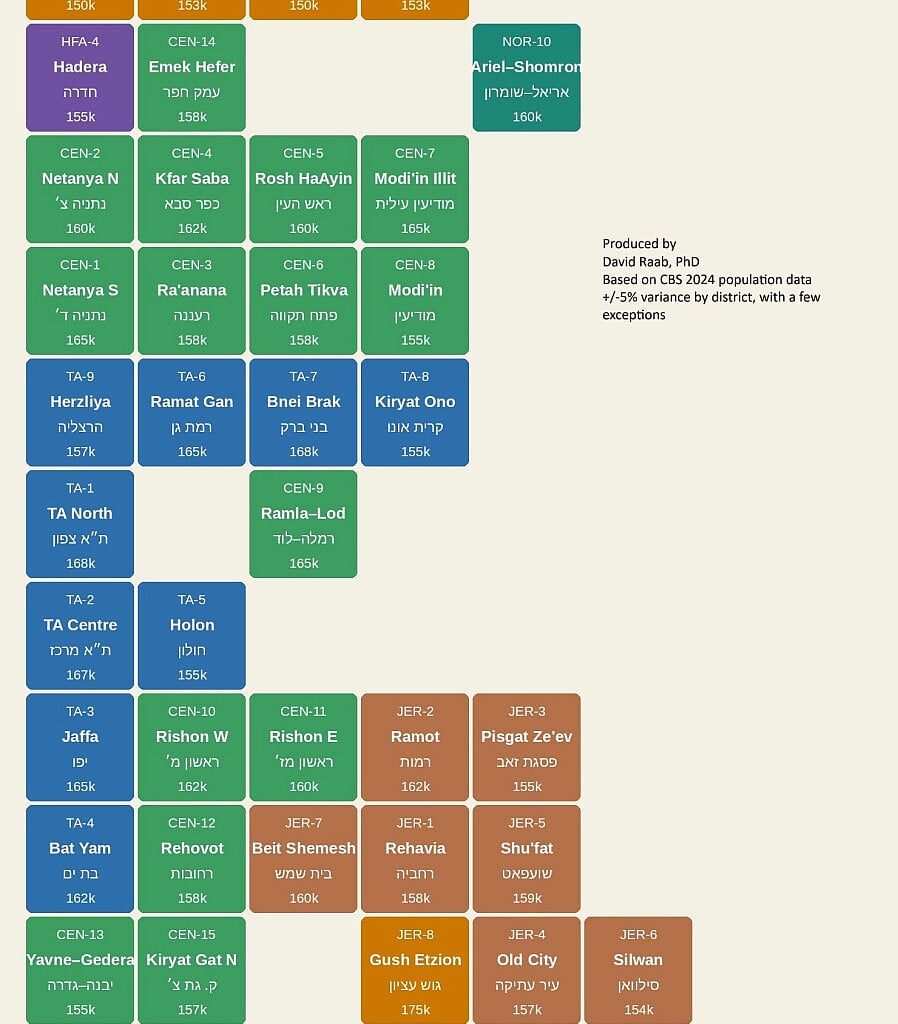
But opponents—usually those advantaged by the current system—raise all sorts of arguments why it is impossible to implement district elections in Israel. Upon investigation, though, these objections turn out specious. One such argument that I would like to address is that district elections would give the center of the country disproportionate power. The facts prove otherwise. Using Israel Central Bureau of Statistics (CBS) data, I created an electoral map of Israel (below) that assumes roughly equal populations of 155,000 to 165,000 in each district, with only a few minor exceptions. I sought not to fragment municipalities, where possible, and to keep the districts contiguous. Clearly, a formal districting process for Israel would be more precise, have more constraints, and be based on the voting-age population. But this simple exercise was enlightening. It turns out that the very north (the Nahariya, Zefat, and Golan districts) would get three representatives in the Knesset. The greater north (Haifa and above) would actually get about thirteen in total. The south (including Beersheva, Ashdod, Ashkelon, and Eilat) would get nine. In other words, these non-“center” districts would have, combined, over a third of the electoral districts, or one-sixth of the Knesset seats. That’s not bad representation at all. Certainly much, much better than what they have today.
There are variations worth considering: maybe an expanded Knesset, a second Knesset chamber, and/or (a more carefully designed) direct election of the prime minister. There are multiple mechanisms that one can choose from for electing a district representative. But the original sin of Israel’s failed governmental system is its current Knesset electoral process that lacks district representation. It is a strategic threat to our survival and well-being. Regional elections for the Knesset are not a cosmetic change but a necessary transformation. Without such change, Israel can expect even worsening dysfunction, instability, extortion, and division. Perhaps there is a statesman at the head of one of the parties who will take on this vital challenge?
David Raab is focused on district elections and a constitution for Israel. He holds a PhD from Touro University and master’s degrees from the University of Pennsylvania and the Weizmann Institute. He has served as executive vice president of the Touro College and University System, on whose Board of Governors he now serves. In 1970 at age 17, David was held hostage for three weeks in Jordan during Black September by the Popular Front for the Liberation of Palestine (PFLP). His history/memoir of the events is published in Terror in Black September: The First Eyewitness Account of the Infamous 1970 Hijackings.