
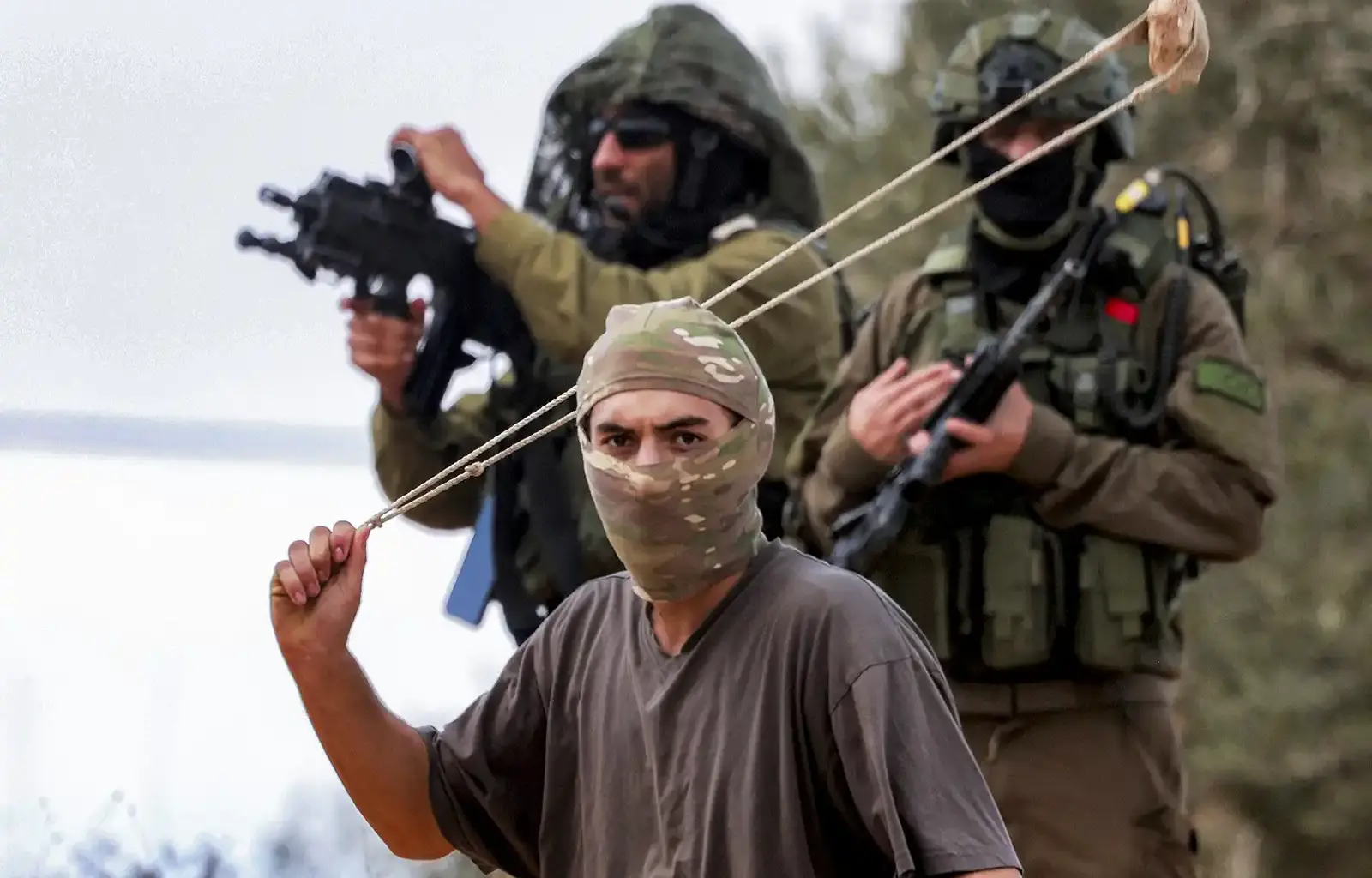
In addition to simply seizing territory, Israel has also taken significant steps to bring settler violence itself under the aegis of the state in ways that would have been unthinkable in years past. Following the Hamas attacks of Oct. 7, 2023, Israel deputized thousands of settlers, equipping them with military rifles and uniforms. They quickly turned this newfound authority on Palestinians. Overnight, settlers often became indistinguishable from soldiers, further blurring an already effectively invisible line between settler violence and state violence.
Crucially, while settler violence has reached unprecedented levels, it is significantly dwarfed by the policies and actions of Israel and its military. Since Oct. 7, 2023, Israeli settlers have killed somewhere between 31 and 51 Palestinian civilians and wounded over 1,700 in the West Bank, according to U.N. data. In comparison, the Israeli military killed over 1,000 Palestinians in the West Bank during this period, at least 619 of whom the United Nations has determined to be civilians, and wounded over 10,000.
When it comes to forcible displacement, the data is even more striking. In early 2025, the Israeli military forcibly displaced about 32,000 Palestinians from just three refugee camps in the northern West Bank. In comparison, since October 2023, Israeli settlers have forcibly displaced an estimated 5,700 Palestinians. Israeli forces, of course, have also killed tens of thousands of Palestinians in the Gaza Strip and forcibly displaced virtually its entire population of over 2 million in that same period.
In announcing the EU decision to impose sanctions on three Israeli settlers and four settler organizations last month, French Foreign Minister Jean-Noël Barrot wrote on X: “The European Union is sanctioning today the main Israeli organizations guilty of supporting the extremist and violent colonization of the West Bank, as well as their leaders. These most serious and intolerable acts must cease without delay.”
Alas, despite Europe’s newfound enthusiasm and willingness to act, the EU sanctions did not in fact target the institutions and leaders guilty of facilitating the extremist and violent colonization of the West Bank. If, as Barrot wrote, the violent colonization of the West Bank is intolerable, then the EU, its member states and others must look at its most significant perpetrators and begin taking concrete steps against the State of Israel and its leaders — not just individual settlers and settler organizations.
Sanctioning violent settlers and settler organizations is meaningful. If nothing else, it chips away at the impunity Israel has enjoyed for far too long and serves as a potential roadmap for more impactful measures. Israeli leaders like Smotrich understand that threat, not just to individual settlers but to the entire settler project and its larger goals of a Greater Israel. Yet as long as it treats Israeli violence and forcible displacement as the work of rogue actors and not a state project, the international community is denying itself the diplomatic and policy tools that could actually form an effective response to Israel’s strategic efforts — actively carried out by settlers, soldiers and government ministers alike — to erase Palestine and Palestinians.