
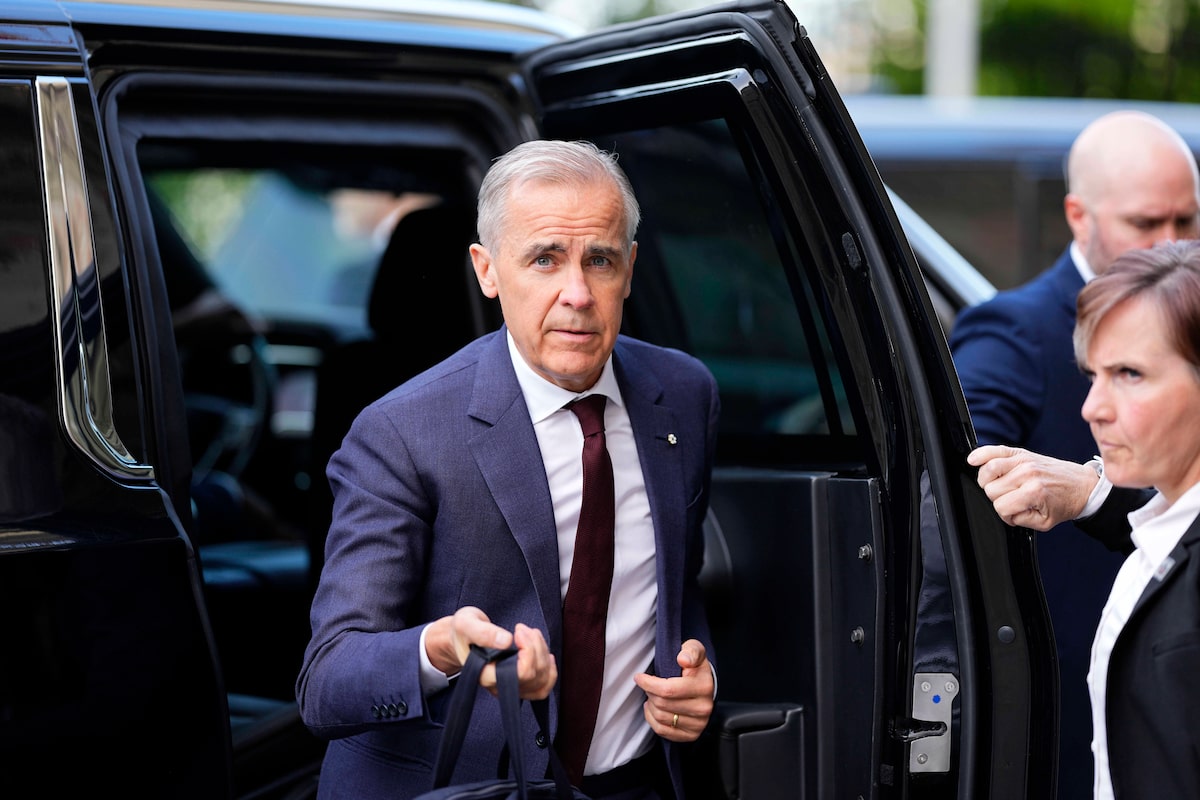
Prime Minister Mark Carney arrives for Tuesday’s federal cabinet meeting on Parliament Hill.Justin Tang/The Canadian Press
Prime Minister Mark Carney responded Tuesday to a report showing the Canadian economy has contracted for two consecutive quarters, saying part of the “weakness” is linked to the government’s decision to scale back immigration.
He said the government’s plans to boost investment will ultimately produce a “stronger, more resilient economy” but that economic data will be “uneven” in the interim.
“You have these cross currents as the economy is being fundamentally transformed. We’re going to continue to work. We’re making progress, but there’s more to be done,” he said.
Mr. Carney’s comments are his first response to Friday’s Statistics Canada report, which said the Canadian economy contracted by 0.1 per cent on an annualized basis in the first quarter of the year. That follows a 1-per-cent annualized decline in gross domestic product in the previous quarter.
Canada’s economy stalls, posting consecutive quarterly declines
Two consecutive quarters of negative GDP growth is sometimes referred to as a “technical recession,” although many economists dismiss the term. A recession is generally marked by a significant decline in economic output that affects a broad range of industries and lasts for at least several months.
Economists on Bay Street say it is premature to determine whether Canada has fallen into a recession – not only because the first-quarter decline was small, but because Statscan will revise the GDP figures at a later date, as is customary.
Conservative Leader Pierre Poilievre has seized on the term, however, using it repeatedly on Parliament Hill. After Mr. Carney made his comments to reporters Tuesday morning on his way into a cabinet meeting, Mr. Poilievre appeared before that same gathering of journalists outside the cabinet room to again highlight the economic figures.
The Conservative Leader accused the Prime Minister of “hiding” from reporters since Friday’s Statistics Canada report.
“You asked him point blank: ‘Are we in a recession?’ and he refused to answer that question. Five days have gone by. The Prime Minister has been in hiding from this devastating economic report. And when he does finally appear, he can’t even answer a basic yes or no question,” he said.
While economists aren’t convinced Canada is in a recession, there is no question economic growth effectively stalled through the end of 2025 and beginning of 2026. And it has struggled to make headway over the past year in the face of aggressive U.S. trade policy, contracting in three of the past four quarters.
U.S. tariffs on autos, industrial metals and wood products are hammering exports while uncertainty about the review of the United States-Mexico-Canada trade agreement is smothering business investment. Unemployment is elevated at 6.9 per cent and the housing market remains in a slump.
USMCA should be renewed for 16 years, LeBlanc writes to U.S. and Mexico
The Q1 GDP numbers showed consumer spending continues to be relatively robust, but overall “domestic demand” declined 0.4-per-cent annualized in the quarter. A drop in government spending on weapons systems and a large jump in imports, which get subtracted from the GDP tally if they exceed exports, also contributed to the fall in GDP.
Topline GDP numbers are also being held back by the country’s declining population – a fact Mr. Carney pointed to in his comments to reporters.
Following criticism of the impact of high immigration targets on Canada’s housing and labour markets, the Liberal government under former prime minister Justin Trudeau announced plans in the fall of 2024 to gradually reduce permanent resident admissions and restrict the number of temporary residents.
Earlier this year, Statistics Canada reported that Canada’s population declined in 2025 by more than 100,000 people, marking the first annual decline in records that date back to the 1940s.
Canada reports first annual population decline on record
In a recent research note about Friday’s GDP data, three National Bank economists said immigration policy is a “key variable” weighing on growth.
“Due to the ongoing slowdown in immigration decided by Ottawa, the country’s population was smaller in the first quarter of 2026 than in the fourth quarter of 2025. This means that real GDP per capita growth was largely positive (+0.9%) in the last quarter and has been on an upward trend for two years,” wrote National Bank economists Taylor Schleich, Matthieu Arseneau and Alexandra Ducharme.
The economists were among those who said the small quarterly decline could easily be revised later.
“To be clear, the Canadian economy remains fragile and faces elevated uncertainty in the coming months,” they wrote. “But we are not ready to bandy about the ‘R’ word, at least not yet.”
There is no formal definition of a recession – technical or otherwise.
The C.D. Howe Institute, the unofficial arbiter of recession in Canada, and the National Bureau of Economic Research in the U.S. make an assessment based on how sharp the contraction is, how long it lasts and how widespread the downturn is throughout different regions and sectors of the economy.
Two quarters of falling GDP can be a useful rule of thumb, but it’s not a hard and fast rule. The Canadian economy only contracted for two months at the outset of the COVID-19 pandemic, but the downturn was so extreme, there was little doubt it constituted a recession.
By contrast, the C.D. Howe Institute determined that the two-quarter decline in GDP in 2015, after the drop in global oil prices, did not amount to a recession because the impact was concentrated regionally in Alberta and other oil-producing provinces.