
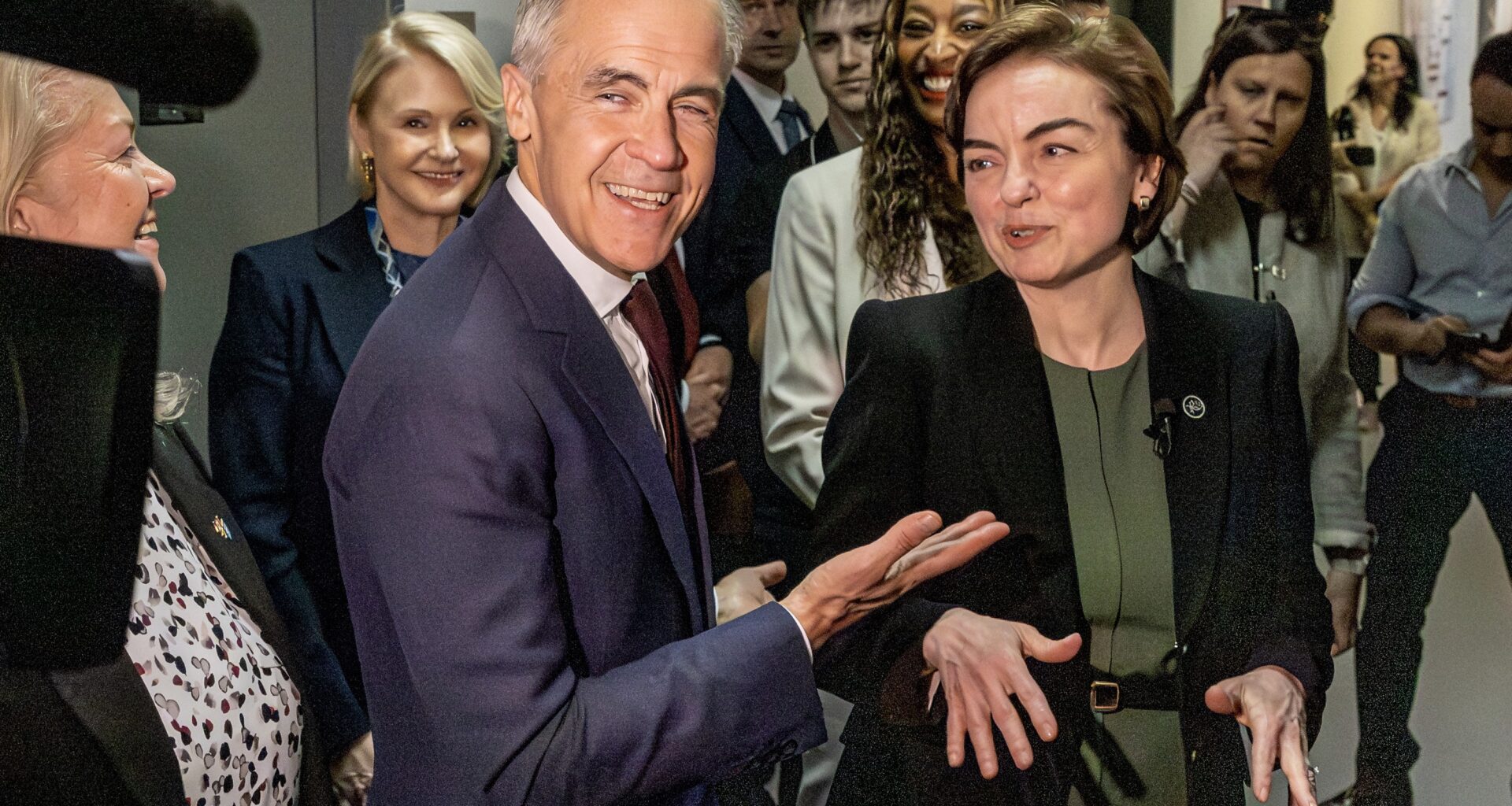
Prime Minister Mark Carney announced a $10 billion federal infrastructure funding package for Quebec Tuesday, which will go toward public transit, hospitals, housing and higher education projects across the province.
The package, which Carney announced alongside Quebec Premier Christine Fréchette in Longueuil Tuesday, among other politicians, will be spread over the next decade.
The biggest chunk — nearly $6 billion — is for transit projects and infrastructure, resolving one of the largest outstanding infrastructure funding negotiations between Ottawa and Quebec. Community infrastructure and housing-related projects will also receive $3.6 billion, plus hundreds of millions more for public transit electrification.
Domestically, Carney has kept infrastructure investments at the centre of his political and economic strategy, making faster delivery of major infrastructure projects a priority. Fréchette, meanwhile, who trails in the polls to both the Parti Québécois and Quebec Liberals ahead of a general election in October, has sought greater flexibility over how federal dollars are spent in Quebec — and to show she gets wins for the province.
Indeed, on Tuesday, she said she did.
“We must get our fair share of federal investments and today I am pleased to announce that Quebec is getting its fair share,” she said. “And even more,” she added, “while respecting our areas of jurisdiction.”
Where the money is going
In sum, the funding package combines five separate agreements between Ottawa and Quebec, the largest of which is from the Canada Transit Fund, where the regular and structural project envelopes total $5.7 billion.
That money will be used primarily for the Quebec City tramway project, the renovation of métro stations and other transit projects that will be announced later.
The funding will also support the development of bus networks and maintenance of existing transportation infrastructure.
Another $400 million comes from the Zero Emission Public Transit Fund that will support 11 projects aimed at electrifying public transportation systems throughout Quebec.
Also announced was a $3.6 billion agreement under the Build Communities Strong Fund.
Carney said those investments would help build housing, university campuses and community centres while also supporting major modernization and expansion projects at 17 hospitals and clinics across Quebec.
Among the facilities expected to benefit are Charles-Le Moyne Hospital, Hôtel-Dieu de Lévis, Chicoutimi Hospital and Montreal’s Maisonneuve-Rosemont Hospital, whose deteriorating condition has repeatedly drawn public attention.
Fréchette emphasized the need to modernize existing infrastructure. Many of Quebec’s major public assets were built in the 1960s and 1970s and now require substantial investment, she said.
“So we’re going to place even more emphasis on the maintenance, upgrading and modernization of our current infrastructure.”
She described the work ahead as “an enormous task” and said Quebec intends to make use of private-sector expertise to accelerate delivery.
“It will also allow us to innovate and work with the private sector, because it’s my intention to leverage the expertise of the private sector to carry out this major project,” she said.
Earlier Tuesday, Carney was asked about the agreements having been “unblocked” by his government, saying “we” unlocked them.
Asked what he meant, the prime minister said federal and provincial officials had aligned their priorities and moved quickly to advance projects that had stalled.
“We had a very clear meeting of minds and priorities,” Carney said.
The agreements emerged from discussions between governments and municipalities about which projects should move forward first.
“We sat down, we made the priorities. We’re going to get on with it,” he said. “It’s what is good for Quebec and good for Canada.”
Municipal leaders welcome announcement
In Longueuil, there were federal, provincial and municipal leaders, including Quebec lieutenant Joël Lightbound, Longueuil MP Sherry Romanado, Montreal Mayor Soraya Martinez Ferrada, Laval Mayor Stéphane Boyer and Longueuil Mayor Catherine Fournier.
“This was an agreement waited for many, many years and months now,” Martinez Ferrada told The Gazette.
The mayor credited both governments for striking a deal.
“Very happy that the political will of the Prime Minister of Canada and the Premier of Quebec finally reached an agreement that will give the financial support that we need all across Quebec.”
“I can’t wait to work with the government of Quebec to see how that’s going to be implemented here, also in the city of Montreal.”
PQ: Ottawa trying to keep separatists out
Parti Québécois Leader Paul St-Pierre Plamondon, however, immediately took aim, suggesting beforehand that Ottawa was attempting to influence Quebec politics ahead of this fall’s election.
“The federal government clearly has a lot of interest in the coming election in Quebec,” St-Pierre Plamondon said.
He argued the funding announcement was intended to help prevent a PQ victory. The party, which currently leads in the recent polls, has promised to hold a third referendum on Quebec sovereignty if elected.
Carney rejected the suggestion.
“This is policy. This is the governments coming together to serve the people we serve,” he said.
“It’s not a political calculation at all.”
Do you have a story tip? Write to me at hnorth@postmedia.com
Editor’s Picks

I’ve been writing for the Montreal Gazette since 2023. My favourite stories are ones that make you think and I’m always looking for new ways to tell them. At McGill, I studied economics and computer science. Now I live in the city’s Plateau, where I wear Doc Martens to try and blend in among the hipsters. Got a story? Email me.
hnorth@postmedia.com