
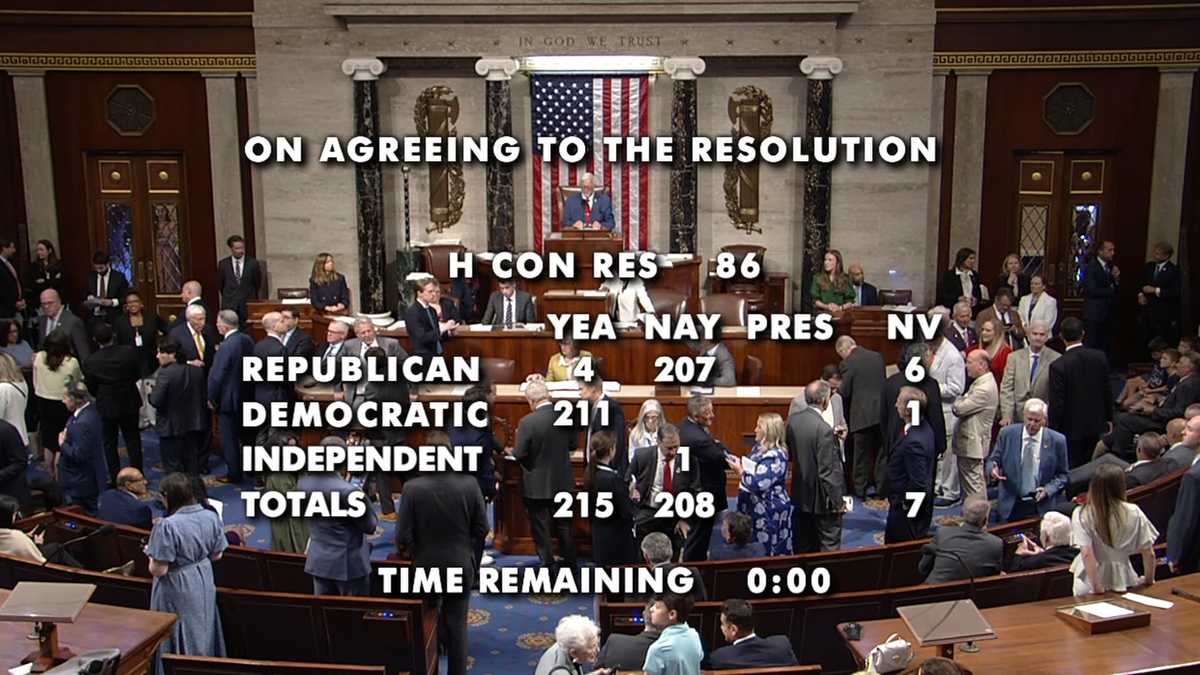
This vote does not immediately stop the war, but the growing number of Republicans trying to block the president’s agenda is certainly *** symbolic step. This is the 4th time the House tried to curb the war against Iran. The resolution is essentially telling the president he needs approval from Congress before carrying out any more military action against Iran. On the other hand, the White House has indicated because the ceasefire has been in effect hostility. are over and it’s been nearly *** week since the US and Iran negotiators reached *** tentative agreement to extend the ceasefire for 60 days and begin new talks to end the war, but strikes this week from both sides are raising concerns the ceasefire could collapse. On Wednesday, President Trump classified the ceasefire in part, quote, When you’re shooting in *** more moderate manner. He also reiterated progress is being made. Towards *** deal, the negotiation itself is going very well, actually, very well. I mean if it happens, and it might not happen, who knows, but if it happens, it could happen like over the weekend. The war powers resolution now heads to the Senate. Even if it passes, which *** similar measure did in that chamber, the president would still need to sign it, which is highly unlikely. On Capitol Hill, I’m Rachel Hirsheimer.
The House voted to end the war in Iran. What happens next?
The House approved a war powers resolution on Wednesday aimed at limiting President Donald Trump’s military actions against Iran, marking a symbolic step in the ongoing conflict.

Updated: 6:34 AM MDT Jun 4, 2026
House votes to rein in Trump’s warThe House voted Wednesday to approve a war powers resolution aimed at restricting President Donald Trump’s military actions against Iran, marking the fourth attempt to curb the ongoing conflict. Republicans, including Rep. Tom Barrett of Michigan, Rep. Warren Davidson of Ohio, Rep. Brian Fitzpatrick of Pennsylvania and Rep. Thomas Massie of Kentucky, joined all Democrats in supporting the measure, which does not immediately stop the war but represents a symbolic step as more Republicans seek to block the president’s agenda. The resolution calls for the president to seek congressional approval before carrying out further military actions against Iran. The law requires the president to get congressional approval to continue a war past 60 days, but several administrations have shirked that responsibility. The Trump White House indicated that hostilities are over due to the ceasefire agreement. The war powers resolution now moves to the Senate. Even if it passes, as a similar measure did in that chamber, the president would need to sign it, which is considered highly unlikely.On Thursday morning, the president posted online, calling the vote “meaningless” and “unpatriotic.”Trump noncommittal about success of Iran talks On Wednesday, Trump offered a new, qualified definition of the ceasefire, telling reporters, “It’s a different part of the world. You know, I’d say in that part of the world, ceasefire is when you’re shooting in a more moderate manner.”He also emphasized that progress is being made toward a deal. “The negotiation itself is going very well, actually, very well. It could happen, I mean, if it happens, and it might not happen, you know, who knows, but if it happens, it could happen like over the weekend,” Trump said. Last week, negotiators from the U.S. and Iran reached a tentative agreement to extend the ceasefire for 60 days and begin new talks to end the war and review Iran’s nuclear program. Neither side finalized the agreement, as strikes from both sides have raised concerns that the ceasefire could collapse. This week, the U.S. fired a missile into the engine room of an oil tanker attempting to reach Iran despite the U.S. blockade. In response, the U.S. military reported that Iran launched attacks on Kuwait and Bahrain, two U.S. allies. A second wave of attacks targeted American forces in Kuwait. U.S. forces shot those strikes down. Iran also fired on at least one civilian ship in the region. An Iranian bomb hit Kuwait’s main airport, killing one person and injuring dozens more. The country’s Interior Ministry shared video of the damaged terminal.Keep watching for the latest from the Washington News Bureau:
WASHINGTON — House votes to rein in Trump’s war
The House voted Wednesday to approve a war powers resolution aimed at restricting President Donald Trump’s military actions against Iran, marking the fourth attempt to curb the ongoing conflict.
Republicans, including Rep. Tom Barrett of Michigan, Rep. Warren Davidson of Ohio, Rep. Brian Fitzpatrick of Pennsylvania and Rep. Thomas Massie of Kentucky, joined all Democrats in supporting the measure, which does not immediately stop the war but represents a symbolic step as more Republicans seek to block the president’s agenda.
The resolution calls for the president to seek congressional approval before carrying out further military actions against Iran. The law requires the president to get congressional approval to continue a war past 60 days, but several administrations have shirked that responsibility. The Trump White House indicated that hostilities are over due to the ceasefire agreement.
The war powers resolution now moves to the Senate. Even if it passes, as a similar measure did in that chamber, the president would need to sign it, which is considered highly unlikely.
On Thursday morning, the president posted online, calling the vote “meaningless” and “unpatriotic.”
Trump noncommittal about success of Iran talks
On Wednesday, Trump offered a new, qualified definition of the ceasefire, telling reporters, “It’s a different part of the world. You know, I’d say in that part of the world, ceasefire is when you’re shooting in a more moderate manner.”
He also emphasized that progress is being made toward a deal. “The negotiation itself is going very well, actually, very well. It could happen, I mean, if it happens, and it might not happen, you know, who knows, but if it happens, it could happen like over the weekend,” Trump said.
Last week, negotiators from the U.S. and Iran reached a tentative agreement to extend the ceasefire for 60 days and begin new talks to end the war and review Iran’s nuclear program. Neither side finalized the agreement, as strikes from both sides have raised concerns that the ceasefire could collapse.
This week, the U.S. fired a missile into the engine room of an oil tanker attempting to reach Iran despite the U.S. blockade. In response, the U.S. military reported that Iran launched attacks on Kuwait and Bahrain, two U.S. allies. A second wave of attacks targeted American forces in Kuwait. U.S. forces shot those strikes down. Iran also fired on at least one civilian ship in the region. An Iranian bomb hit Kuwait’s main airport, killing one person and injuring dozens more. The country’s Interior Ministry shared video of the damaged terminal.
Keep watching for the latest from the Washington News Bureau: