
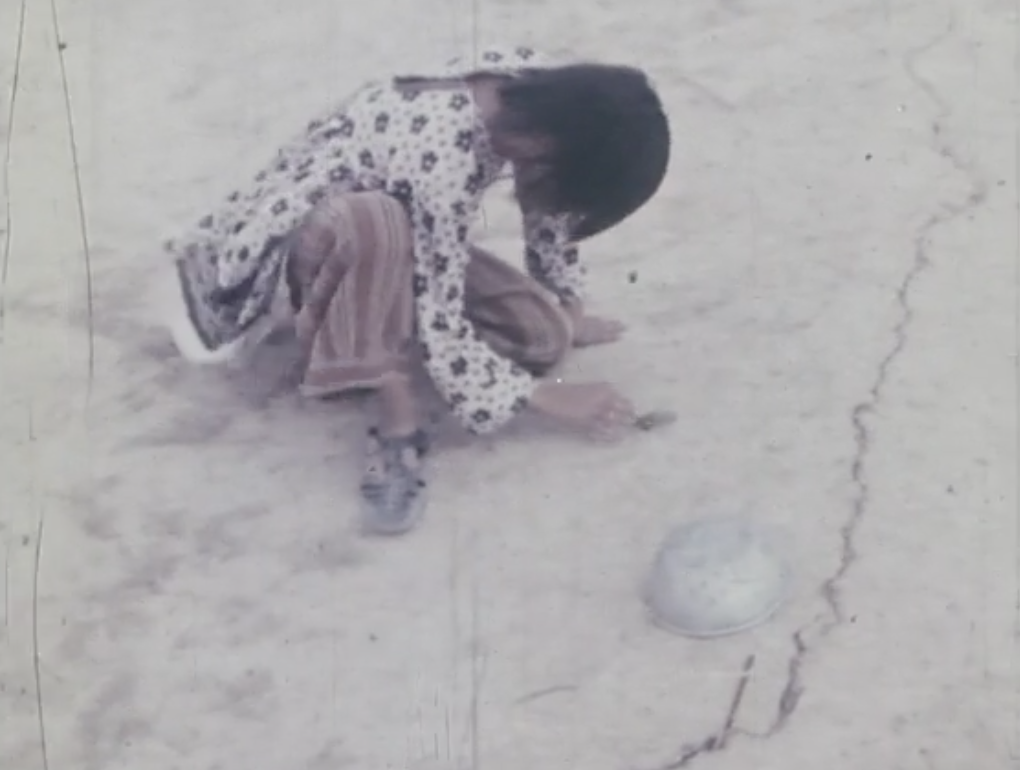
This historical condition gives many of the films their distinct atmosphere. In Another Season (dir. Zaven Ghokasian, 1975), an elderly woman drifts through empty spaces haunted by the absence of her dead son. In Dokhtarbas Didn’t Want to Be Alone (dir. Naser Gholamrezai, 1974), the narrative premise—a young girl searching for a frog believed capable of healing her father’s wound—functions less as a dramatic structure than as a pretext for observation. The film oscillates constantly between documentary and fiction, following gestures, movement, windows, landscapes, and solitary existence without imposing psychological explanation upon them.
Although not officially part of Cinema-ye Azad, Nasib Nasibi’s From Isfahan to Abarkooh (1970) crystallizes many of the tensions that would later recur throughout the movement. The film begins within a largely documentary register, observing caravanserais, desert landscapes, ruined architecture, and everyday life in remote regions of Iran. Yet gradually it moves elsewhere. A little boy wanders through abandoned spaces while the voiceover evokes forgotten myths and buried histories. Dark wells, arches, cracks, and openings recur throughout the film like thresholds between visible reality and mythic memory.
A materialist approach to ritual appears in Tahmasb Solhjou’s Tazieh (1976), which documents the Shiite passion play less as a sacred spectacle than as a communal performance. Through restless handheld camerawork and rapid editing, the ceremony often feels more like a carnival than a moment of spiritual transcendence. Participants wearing sunglasses, top hats, or carrying umbrellas while reenacting historical figures are repeatedly foregrounded, emphasizing the ritual’s strange anachronisms and collective improvisations. Rather than imbuing the event with mystical reverence, the film situates it within the rhythms of ordinary communal life. Images of the surrounding landscape and open sky continually interrupt the ceremony, grounding ritual within material existence rather than transcendent spirituality.
This tendency reaches extraordinary intensity in I Behold the Sleepers Upon the Dusty Tapestry of the Earth (Kianoush Ayyari, 1979), filmed in the aftermath of a devastating earthquake. Bodies are unearthed from rubble while survivors wander through landscapes marked by devastation and mourning. The stench of death appears almost palpable through the screen itself. Yet the film continually interrupts these scenes with images of flowers, gardens, birds, and children’s playgrounds. A corpse wrapped in white cloth is carried across the frame before a graphic match cut transforms the image into white pelicans gliding through water. The result is less a journalistic record of catastrophe than a meditation on mourning, disappearance, and the thin boundary separating life from death.