
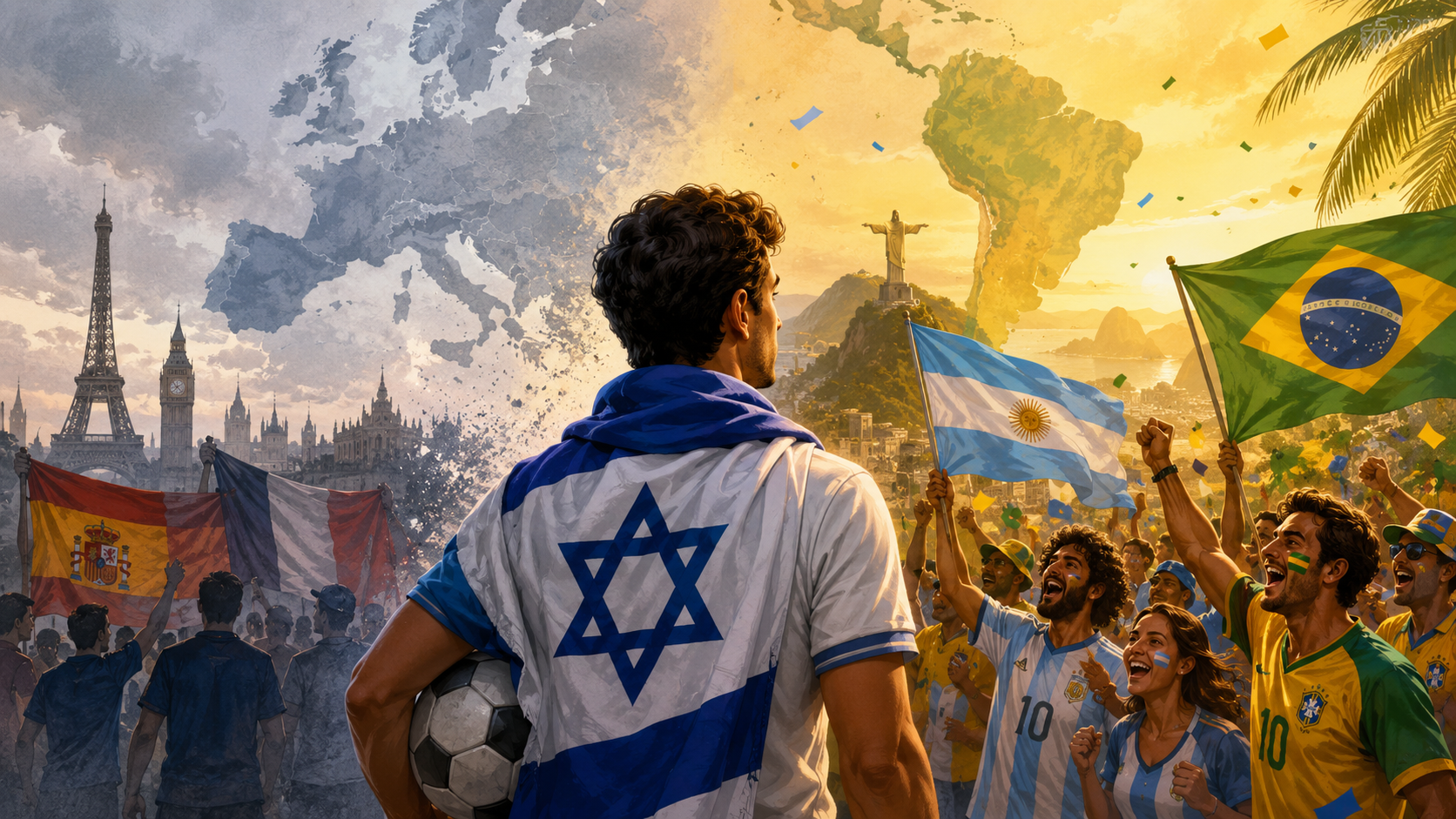
How Have Spain’s and France’s Policies Toward Israel Affected Israeli Support for Their National Teams? And Which Country Will Capture Israeli Hearts During the Next Month?
A new study by Sapio reveals a striking shift in Israeli football loyalties ahead of the 2026 FIFA World Cup.
A discussion in the strategy department of our advertising agency, Glickman Shamir Samsonov | Publicis, about Europe’s evolving attitude toward the “Israel” brand over the years unexpectedly turned into a fascinating conversation about the upcoming World Cup and whether Israeli patterns of fandom have changed during the years of war.
Israel’s near-permanent absence from football’s biggest stage — Mexico 1970 remains the exception that proves the rule — has long forced Israelis to adopt “alternative loves”: national teams to support for one month every four years during the World Cup. These teams represented footballing artistry and beauty, sporting elegance, or cultural and emotional identification.
For many years, European nations stood at the center of this map of affection. The success of Europe’s leading clubs—whose leagues are widely watched and followed in Israel—made their national teams natural candidates for Israeli support.
It began with Johan Cruyff’s legendary Ajax and the “Total Football” philosophy that also characterized the Dutch national team. Israelis of that generation grew up reading Anne Frank and admired the Netherlands’ refusal to bow to the oil embargo pressures of the 1970s. A warm place in the Israeli heart was reserved for England, viewed as the birthplace of football and home to the first league regularly broadcast on Israeli television. Over time, Italy’s tough, disciplined football rose in popularity, driven by admiration for clubs such as AC Milan and Juventus. Spain surged to the top thanks to the brilliance of stars from Barcelona and Real Madrid, two clubs deeply loved in Israel. France joined the elite tier through generations of footballing excellence—from Zinedine Zidane and Thierry Henry to Ousmane Dembélé and Kylian Mbappé today.
Alongside these European favorites, Israelis also admired the dazzling football of Brazil and Argentina. Success in World Cups and the charisma of superstars such as Diego Maradona, Ronaldinho, Neymar, and of course Lionel Messi steadily increased their appeal. Yet Europe was not only geographically closer — it was emotionally closer as well.
The Numbers Tell the Story
Today, however, Israel’s map of football fandom is undergoing a profound transformation — and not because of football itself.
For decades, politics and international relations had little influence on which national teams Israelis supported. Since October 7, 2023, however, the wave of hostility directed toward Israel has triggered a significant backlash. Can Israelis continue to support teams representing countries that, in their view, criticized, condemned, or isolated Israel after it was subjected to a brutal terrorist attack?
When Spain’s prime minister repeatedly attacks Israel in public forums; when European governments suspend arms shipments; when some countries restrict military cooperation; and when the streets of London, Marseille, and Brussels are filled with Palestinian flags and anti-Israel demonstrations, many fans find it increasingly difficult to separate football from the broader political struggle taking place beyond the stadium.
This was our initial intuition. The findings of a survey conducted together with Gali Hershenson, CEO of Sapio, a research and insight consultancy, not only confirmed that intuition — they amplified it.
According to the study, among Israelis interested in the World Cup, 34% say they support Spain less than they did in previous tournaments, while 29% say they support France less, specifically because of those countries’ attitudes or policies toward Israel in recent years. (Respondents could select more than one country.) These are, notably, two countries that were once among the most popular national teams in Israel.
According to Hershenson, “The study demonstrates how a national football team functions as a powerful symbol and an integral part of a country’s national brand, both for domestic supporters and global audiences. Like any brand asset, it reflects the emotions and perceptions associated with the larger brand it represents. Therefore, a change in the perception of a country—as we are seeing now regarding attitudes toward Israel—naturally spills over into sporting support for that country’s national team.”
This list also includes Israel’s southern neighbor, Egypt, cited by 26% of respondents, along with other Arab countries such as Tunisia (13%) and Morocco (12%). Slightly behind them are the Netherlands (10%) and England (9%), both of which have experienced declines in support, largely due to perceptions of their governments’ positions toward Israel.
The trend is unmistakable. Israelis who personally experienced antisemitism during visits to countries such as the Netherlands and Spain, or who encountered anti-Israel sentiment in major European tourist destinations, increasingly struggle to ignore what they perceive as growing hostility. The disappointment many Israelis feel toward a continent they once admired is distancing them from the national teams of Spain, France, and, to a lesser extent, England and the Netherlands.
The New World Takes the Lead
In a mirror-image trend, the study shows South American national teams rising to the top of Israel’s popularity rankings.
Argentina and Brazil are now, by a significant margin, the two most popular national teams among Israelis interested in the World Cup. Argentina leads with 38% support, while Brazil follows with 24% (again, respondents could choose more than one team). Adding the United States (6%) and Uruguay (3%) reveals that teams from the Americas could effectively form a coalition of support in Israel, leaving the European bloc behind.
The reaction to recent international tensions appears so strong that even Germany — a team historically unpopular in Israel for obvious historical reasons — now enjoys support levels similar to Spain’s (12%) and surpasses France (which trails at 5%), despite France’s greater footballing success over the past decade.
This may partly reflect the sympathy shown by several German football clubs toward Israeli hostages and their families, as well as the relatively moderate stance of the German government toward Israel. By contrast, images of Palestinian flags in European stadiums, public displays of solidarity by prominent footballers, and the increasingly critical positions adopted by some European leaders have left a lasting impression on many Israelis.
Thanks to Messi — and Milei
These are not merely statistics.
I feel this shift personally. Since childhood, I loved the Dutch national team, drawn to its beautiful, creative, attacking football. As the next World Cup approaches, my heart still remembers that orange team of my youth. Yet my mind cannot forget the antisemitic demonstrations, the Palestinian flags, the Eurovision controversies, and the violence against Maccabi Tel Aviv supporters in Amsterdam.
Into that emotional vacuum steps Argentina.
Argentina has long been admired in Israel because of Maradona and Messi, but its standing has grown even stronger due to the warm relationship that Argentine President Javier Milei has cultivated with Israel. His public support, high-profile visits, and unusually pro-Israel stance on the international stage have created an unprecedented sense of closeness toward Argentina—not only as a country but also as a football team.
Ironically, just as the Messi era approaches its conclusion, Argentine support in Israel may reach an all-time high. Not only because of its footballing excellence and its triumph in the last World Cup — where it defeated France in the final — but because many Israelis increasingly view Argentina as a genuine friend in a world that feels less welcoming than before.
The upcoming World Cup, therefore, will be more than a contest among continents, nations, and playing styles. For many Israelis, it will also be a test of identity, emotion, and belonging.