
Key Takeaways
Different sources continue to conclude that the Russian military’s performance is declining, despite utilizing differing mapping methodologies to visualize the battlefield situation.
*
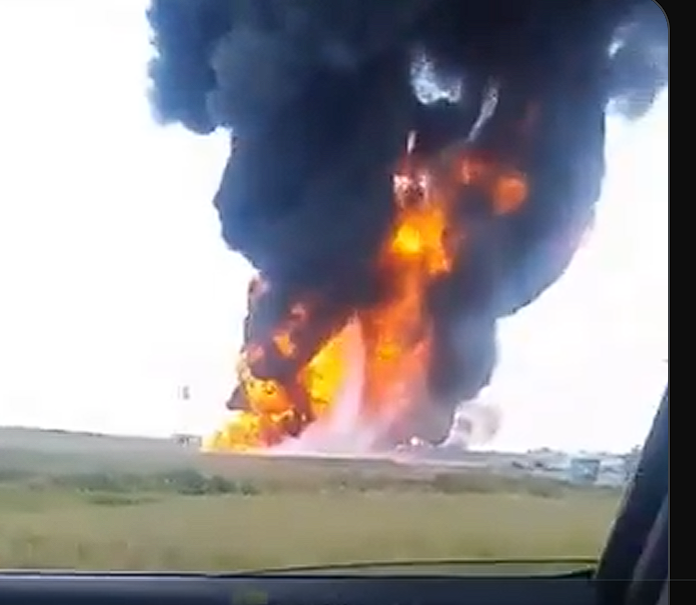
Ukrainian forces conducted a second series of strikes against St. Petersburg as the St. Petersburg International Economic Forum (SPIEF) closed on June 6, demonstrating again that Russia cannot reliably defend its major cities from Ukrainian strikes even during prominent international events.
*
Ukrainian strikes against St. Petersburg undermine Kremlin efforts to use SPIEF to project stability within Russia domestically and to international audiences.
*
Ongoing gasoline shortages in occupied Ukraine are creating long lines on the Kerch Bridge and at gas stations in nearby Russian territories.
*
Fuel shortages continue to spread throughout Russia as well and will likely worsen as high summertime demand continues.
*
Ukraine’s mid-range strike campaign against major Russian ground lines of communication (GLOCs) in occupied Ukraine continues to disrupt vehicle movement.
*
Kremlin officials continue to reject any negotiated settlement that fails to address its fabricated “root causes” of the war in Ukraine.
*
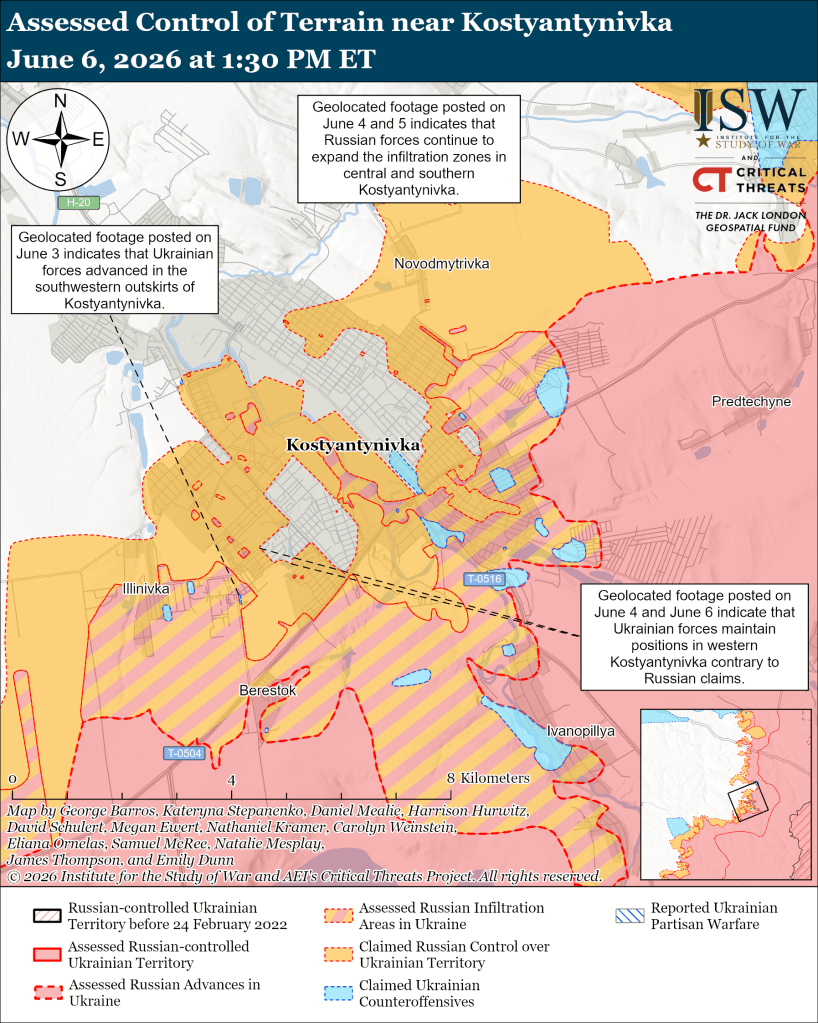
Ukrainian forces recently advanced in the Kostyantynivka direction.
*
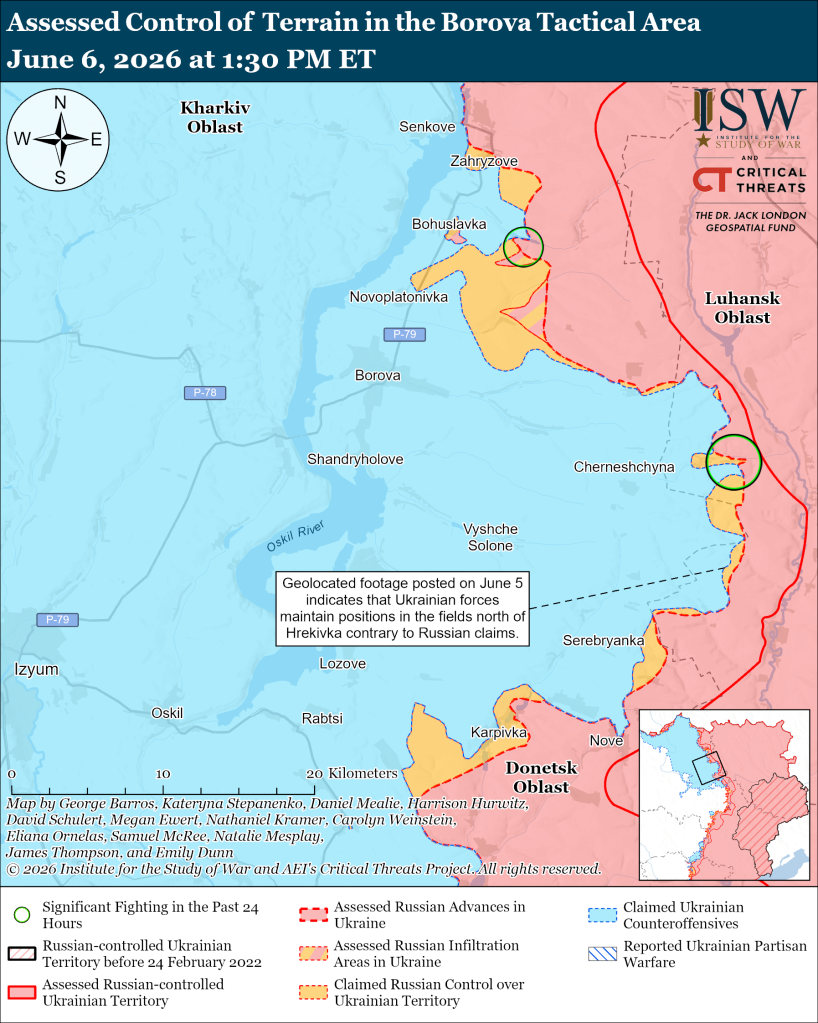
Russian forces recently advanced in the Slovyansk and Pokrovsk directions.
Ukrainian forces struck Russian oil infrastructure in Krasnodar Krai and Russian military assets in Russian border regions on June 6.
*
Russian forces launched 272 drones against Ukraine overnight.
Russian forces conducted a series of drone strikes against Ukraine on the night of June 5 to 6.
The Ukrainian Air Force reported that Russian forces launched 272 Shahed-type, Gerbera-type, and Italmas-type drones; Banderol loitering munitions; and Parodiya decoy drones from the directions of Oryol, Kursk, and Bryansk cities; Primorsko-Akhtarsk, Krasnodar Krai; Millerovo, Rostov Oblast; and occupied Hvardiiske, Crimea.[92] The Ukrainian Air Force reported that Ukrainian forces downed 249 drones, that 19 drones hit 11 locations, and that drone debris fell at 13 locations. Ukrainian officials reported that Russian forces struck civilian infrastructure in Kharkiv and Odesa oblasts.[93] DTEK, Ukraine’s largest energy company, reported on June 5 that Russian forces struck an unspecified DTEK thermal power plant (TPP), causing significant damage.[94] DTEK noted that Russian forces have conducted almost 230 strikes against DTEK TPPs since the start of the full-scale invasion, 11 of which occurred during Winter 2025-2026.
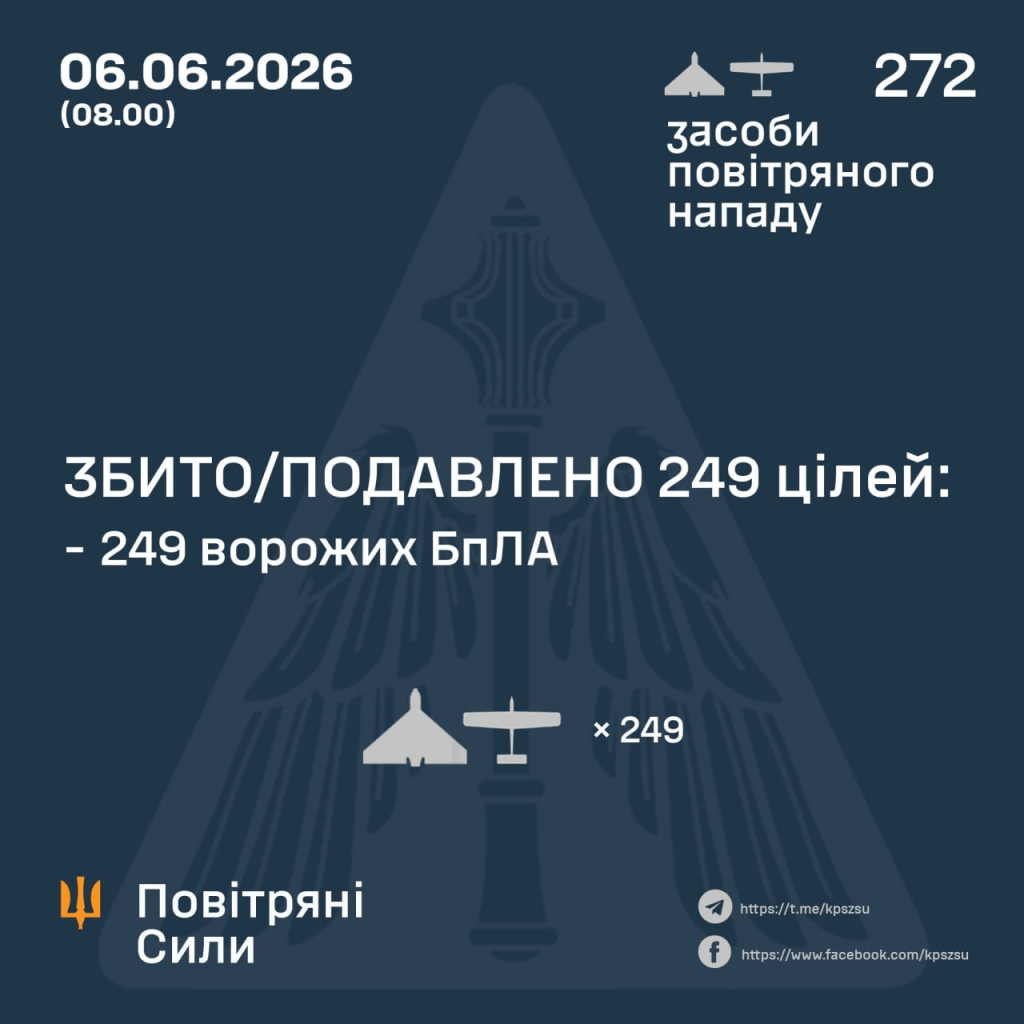 Ukraine’s air defenses downed or suppressed 249 of 272 Russian drones launched overnight, including Shaheds, Gerberas, Italmas UAVs and Banderol loitering munitions. Impacts were recorded at 11 locations as the attack continued into the morning.
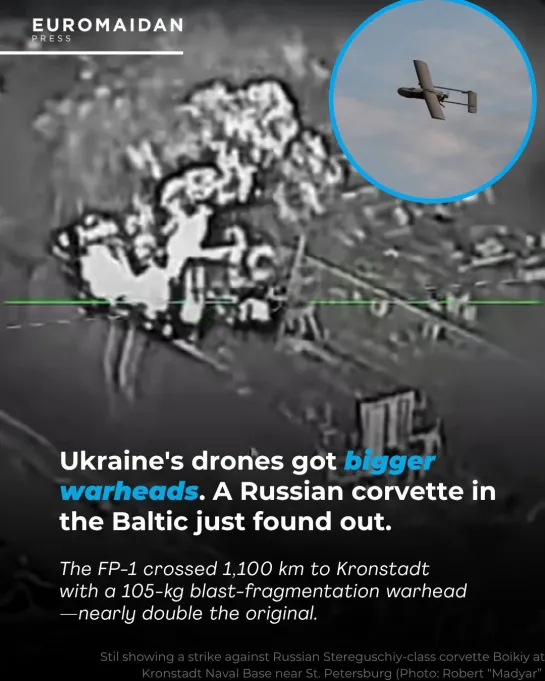
The Ukrainian General Staff reported on June 6 that Ukrainian forces struck the Kronstadt Naval Base (the main base of the Russian Baltic Fleet) in St. Petersburg; the Petergofskaya Oil Depot and Neste Oil Terminal in Lomonosov (west of St. Petersburg across Neva Bay); and a weapons, ammunition, and vehicle arsenal of the Russian 1060th Material-Technical Support Center (Leningrad Military District) in Bolshaya Izhora (northwest of Lomonosov on the Neva Bay).[6] Ukraine’s Security Service (SBU) reported that the strikes also hit the Russian Navy’s 15th Arsenal near Lomonosov.[7] The Ukrainian Special Operations Forces (SSO) reported that several Ukrainian drones reached the Kronstadt Naval Base.[8] Geolocated footage and photos confirm Ukrainian strikes against the 15th Arsenal and the Kronstadt Naval Yard.[9] Leningrad Oblast authorities acknowledged that Ukrainian drone strikes caused a fire near Bolshaya Izhora.[10] St. Petersburg Governor Alexander Beglov called on residents to stay inside for the duration of the strikes, reportedly for the first time since February 2022.[11]
This is the second Ukrainian strike series against St. Petersburg during the 2026 SPIEF.[12] Russia likely prioritized allocating air defense assets for the city during SPIEF, which is a major event that draws tens of thousands of guests and international delegations. Russia appears to have failed to sufficiently protect St. Petersburg for SPIEF, however, even after Leningrad Oblast was among the first regions to announce reforms to increase its air defenses to protect energy and defense industrial infrastructure.[13] The Kremlin appears to be more heavily focused on defending Moscow City. Geolocated footage published on June 6 shows Russian authorities erecting an additional Pantsir-SMD-E anti-drone air defense system on a high-rise building in Moscow City, for example.[14] Ukraine’s escalating long-range and intermediate-range strike campaigns are imposing additional requirements for air defenses across Russia’s operational and deep rears, and these requirements will likely compete with each other given the vast amount of land and large number of facilities Russia must protect.[15]
Ukrainian strikes against St. Petersburg undermine Kremlin efforts to use SPIEF to project stability within Russia domestically and to international audiences. The Kremlin has historically capitalized on SPIEF to project economic strength and power to global audiences, and Ukrainian strikes against St. Petersburg on June 3 and June 6 have undercut this Russian narrative.[16] Russian opposition media source Meduza reported on June 6 that SPIEF organizers focused on providing “normal” conditions to the attendees, particularly foreign guests.[17] Russian President Vladimir Putin made several exaggerated statements about Russia’s battlefield performance and the economy at SPIEF that aimed to paint a positive picture but did not acknowledge Russia’s ongoing issues with air defenses, economic challenges, or mounting battlefield concerns.[18] Ukrainian long-range strikes over 1,000 kilometers from the international border continue to demonstrate how Ukraine is bringing Russia’s war closer to home.
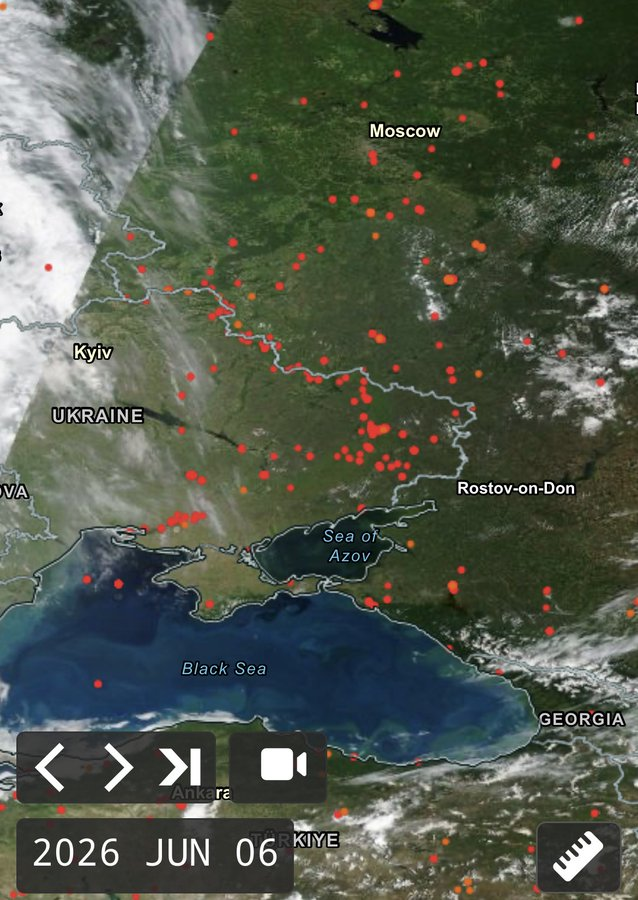
Ukrainian forces struck a Russian oil depot in Krasnodar Krai overnight on June 5 to 6. The Ukrainian General Staff reported on June 6 that Ukrainian forces struck the Ust-Labinsk oil depot in Krasnodar Krai, causing a fire at the depot.[34] Ukraine’s Security Service (SBU) reported that the strike caused fires at three petroleum product tanks.[35] Russian authorities confirmed that a Ukrainian drone strike caused a fire at the oil depot, and geolocated footage published on June 6 shows a fire at the depot.[36]
The Ukrainian General Staff reported that Ukrainian forces struck Russian personnel concentrations near Tetkino and Anatolevka, Kursk Oblast (both along the international border) on the night of June 5 to 6.[37]
Ukrainian sources and satellite imagery continue to provide updated battle damage assessments (BDAs) of recent long-range Ukrainian strikes against Russian defense industrial plants. Satellite imagery published on June 5 shows damage to one of the production buildings of the Elastik propellant powder plant of the Gefest-M company in Ryazan Oblast following Ukrainian strikes against the plant overnight on June 3 to 4.[38] Additional satellite imagery published on June 6 shows three new impacts on the roof of a workshop at the Michurinsk Progress Plant in Tambov Oblast following Ukrainian strikes on the night of June 2 to 3.[39]
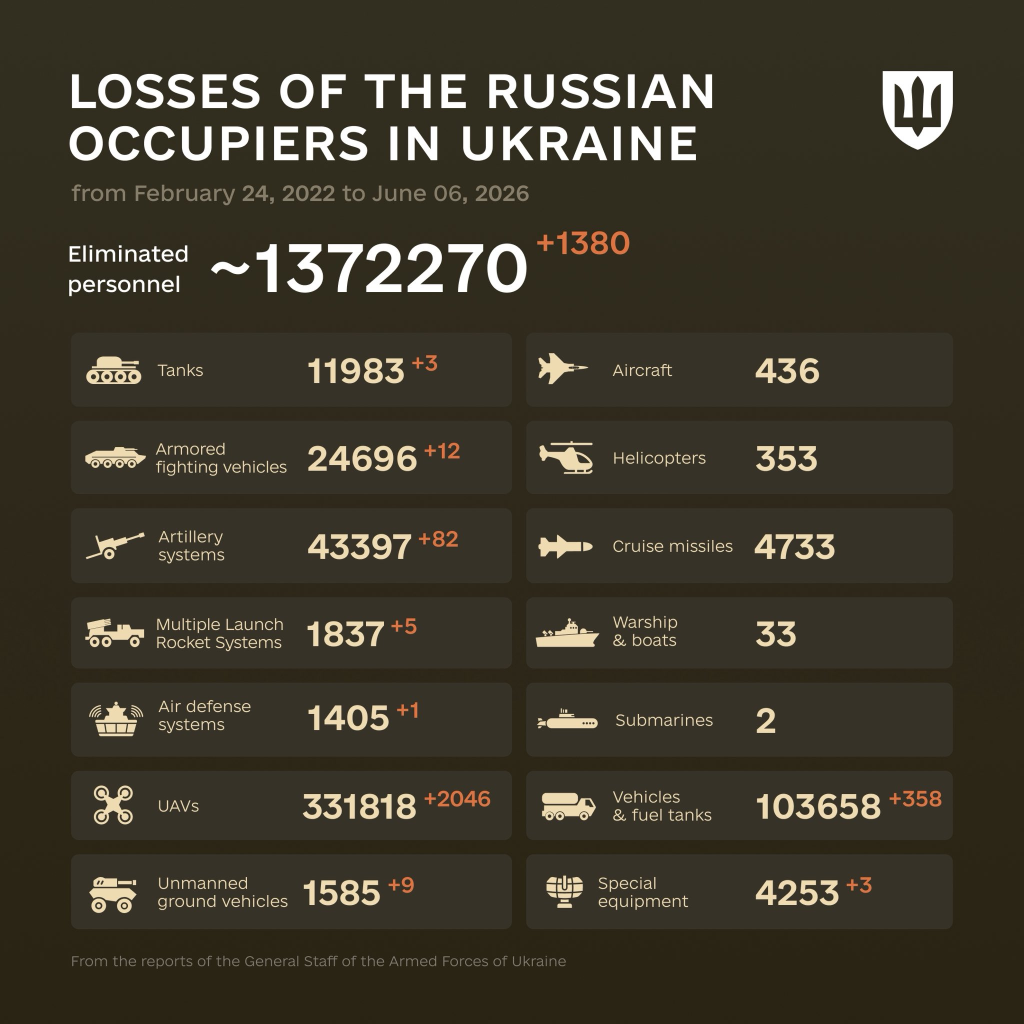
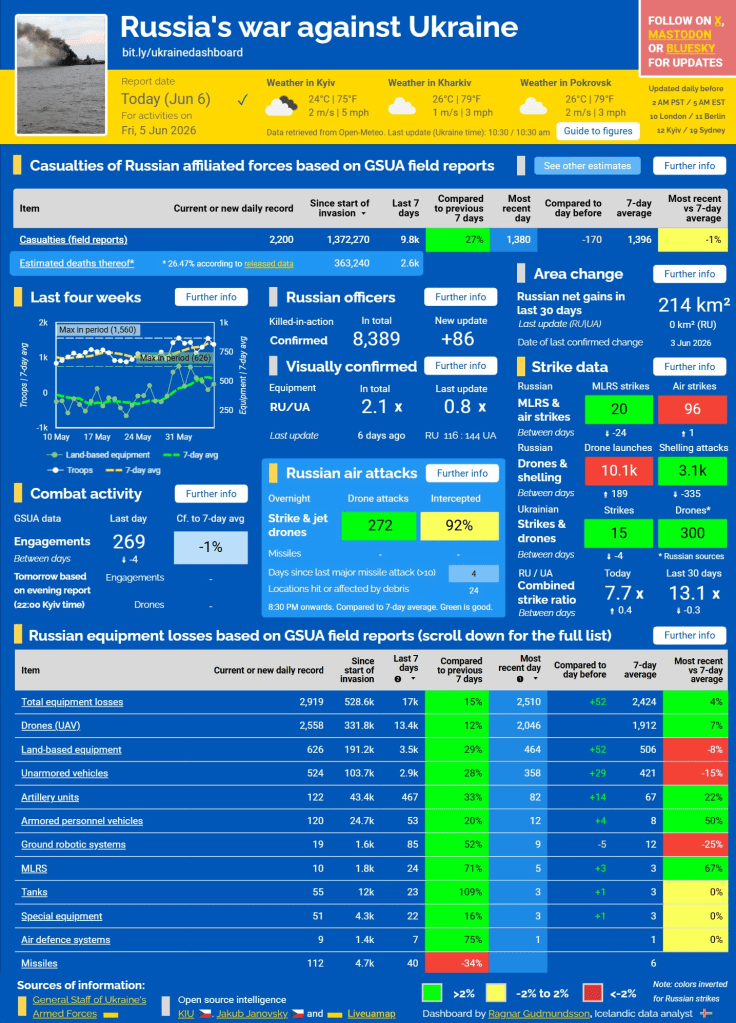
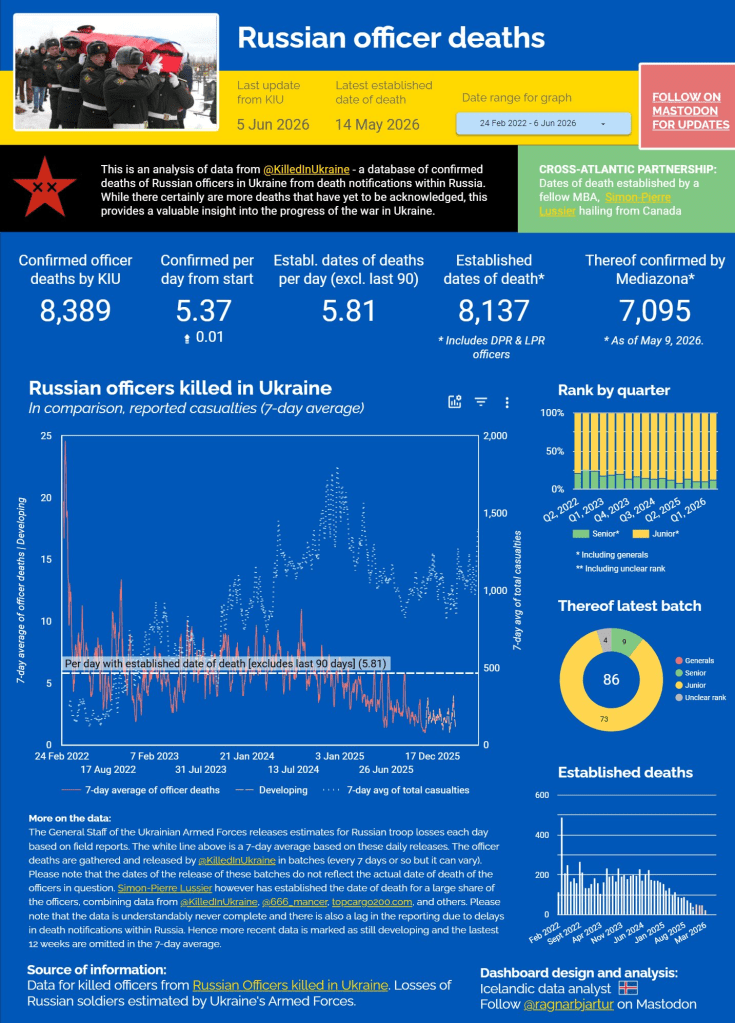
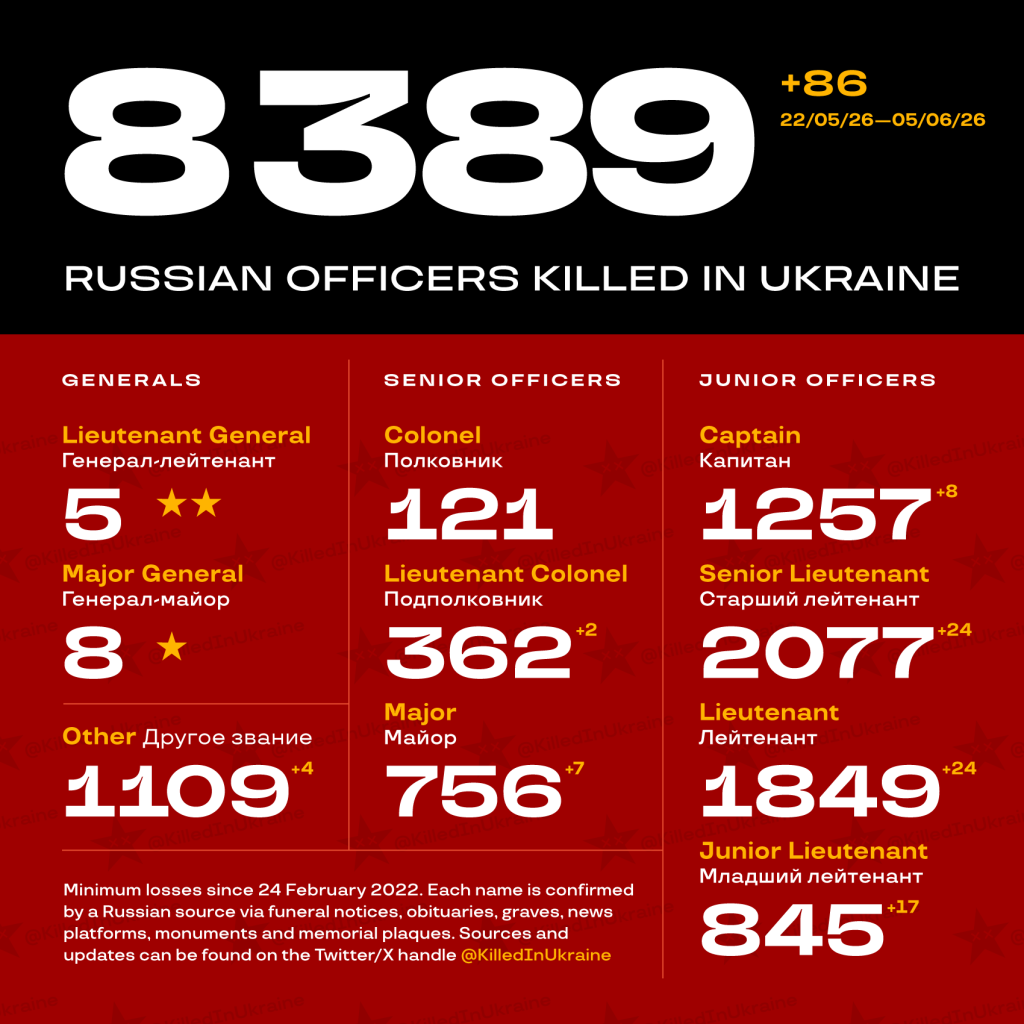 Different sources continue to conclude that the Russian military’s performance is declining, despite utilizing differing mapping methodologies to visualize the battlefield situation.
General Staff of the Armed Forces of Ukraine
Operational update as of 10:00 PM on June 6, 2026, regarding the repulsion of the Russian invasion
Since the start of this day, 183 combat engagements have been recorded on the front lines.
During the day, the aggressor carried out 46 airstrikes, using 134 guided bombs. Additionally, to fire upon our positions and nearby settlements, the invaders deployed 6,064 kamikaze drones and carried out 2,445 attacks using various types of weaponry.
In the Northern Slobozhanshchyna and Kursk directions, four combat engagements took place during the day, two of which are still ongoing. The enemy fired on our troops’ positions and border settlements 56 times.
In the Southern Slobozhansky direction, the occupiers stormed our units’ defensive lines four times near Staritsa, Lyman, and Vovchansk.
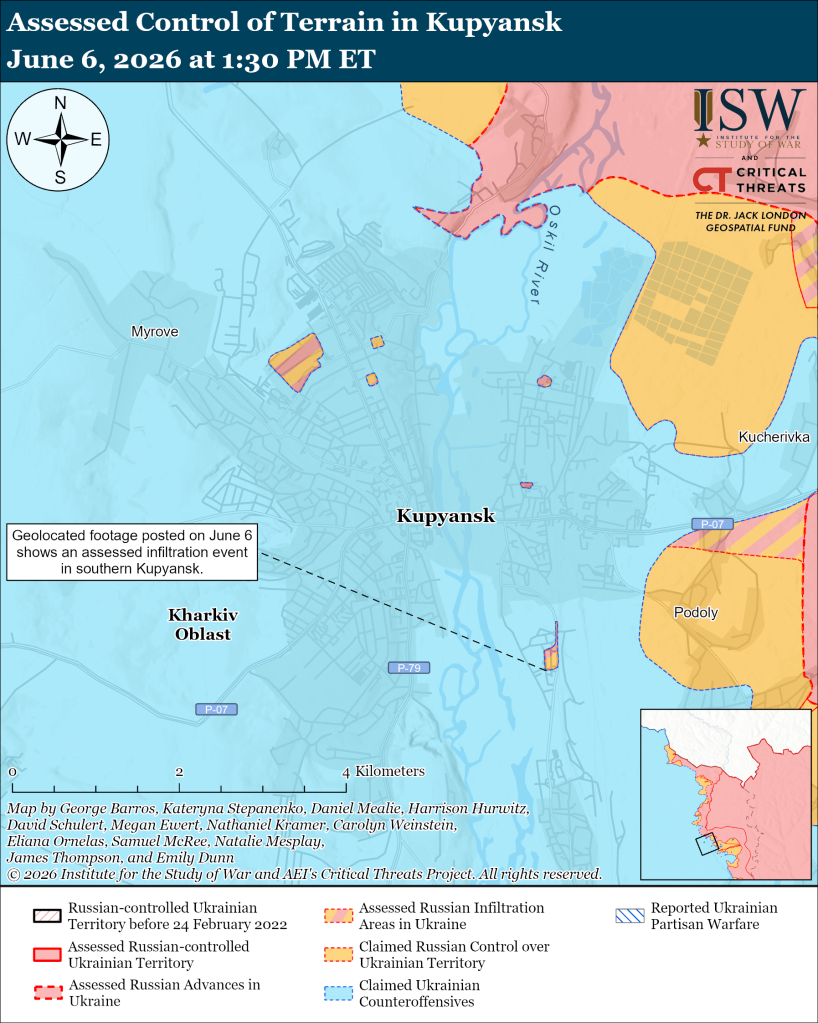
In the Kupyansk direction, the invaders launched two attacks, attempting to push back our units near Pishchane and Kupyansk.
In the Lyman direction, Ukrainian soldiers successfully repelled eight enemy attempts to advance near the settlements of Novoselivka, Druzhlyubivka, Ozerne, Stavy, and Drobysheve. Another combat engagement remains active.
In the Sloviansk direction, the Defense Forces completely neutralized seven attempts by the invaders to break through in the areas of Rai-Oleksandrivka, Riznykivka, Kryva Luka, and Zakitne.
In the Kramatorsk sector, our defenders halted one offensive operation by the occupying forces in the area of the settlement of Chasiv Yar.
Defense forces in the Kostiantynivka sector successfully repelled thirteen enemy assaults in the areas of Kostiantynivka, Ivanopil, Pleshchiivka, Rusynove Yar, and Illinivka.
In the Pokrovsk sector, the enemy launched 26 attacks. The occupiers attempted to break through our defenses in the areas of Toretsk, Sofiivka, Dorozhne, Vilne, Novyi Donbas, Zapovidne, Novooleksandrivka, Rodynske, Shevchenko, Hryshyne, Serhiivka, Kotlyne, Novopavlivka, and Udachne. Two combat engagements are still ongoing there.
According to preliminary data, 42 occupiers were eliminated in this sector today, and another sixteen were wounded. Our soldiers neutralized one unmanned aerial vehicle command post, two artillery systems, two enemy vehicles, and four units of special equipment. Six vehicles, five artillery pieces, a multiple launch rocket system, and a UAV control center were also damaged. Additionally, 237 enemy drones of various types were destroyed or neutralized by electronic warfare systems.
In the Oleksandrivka sector, the occupiers made seven attempts to advance in the areas of the settlements of Tovste, Ternove, Sichneve, Novoselivka, Vorone, and Verbove. One combat engagement is still ongoing there.
In the Huliaipole sector, 22 attacks by the occupiers were recorded near Dobropillia, Vozdvyzhivka, Zaliznychne, Olenokostiantynivka, Staroukrainka, Huliaipole, and Charivne; three more battles are ongoing.
In the Orikhiv sector, enemy units made two attempts to breach our defenses near Shcherbakiv.
In the Dnipro sector, two combat engagements took place today in the areas of the Antonivsky Bridge and Bilohrudy Island.
In other sectors of the front, the situation remains under control; there have been no significant changes in the operational situation.
Let’s defeat the enemy and bring our Victory closer!
Glory to Ukraine!
Local Krasnodar Krai and Crimea channels reported on June 6 that drivers from occupied Crimea are travelling to gas stations in Temryuksky Raion, Krasnodar Krai to buy gasoline amid ongoing shortages and sale restrictions in Crimea.[19] The local channels and Russian opposition source Astra reported long lines to cross the Kerch Bridge from the Crimean side all day on June 6.[20] Sevastopol occupation governor Mikhail Razvozhaev announced that major Crimean gas stations TES and ATAN would only sell 20 liters (5.283 gallons) of gasoline on June 6 to customers with previously purchased coupons and that general sale of gasoline would no longer be available.[21] The growing restrictions on gasoline sales in occupied Ukraine will likely exacerbate existing shortages or cause new shortages in nearby areas of Russia as residents from occupied Ukraine seek alternative sources of gasoline.
Fuel shortages continue to spread throughout Russia as well and will likely worsen as high summertime demand continues. Russian opposition source Vazhnye Istorii reported on June 6, citing local media, that there were long lines at gas stations in the Republic of Tatarstan and that the gas stations were only selling more expensive diesel variants as cheaper diesel is no longer available.[22] Russian opposition sources have recently reported gasoline shortages in Belgorod, Kursk, Leningrad, Saratov, Ryazan, Moscow, Tomsk, Murmansk, Voronezh, Oryol, Novgorod, and Kamchatka oblasts; the Republic of Karelia; and Krasnoyarsk Krai.[23] Any Kremlin efforts to preemptively prevent another gasoline shortage in 2026 like the one Russia faced in 2025 appear to have failed.[24] The 2025 shortages, in contrast to the ongoing ones, emerged at the end of summer and the start of fall.[25] Russia will likely struggle to combat this year’s shortages as effectively as it did last year, given the months of high summertime demand that lie ahead.
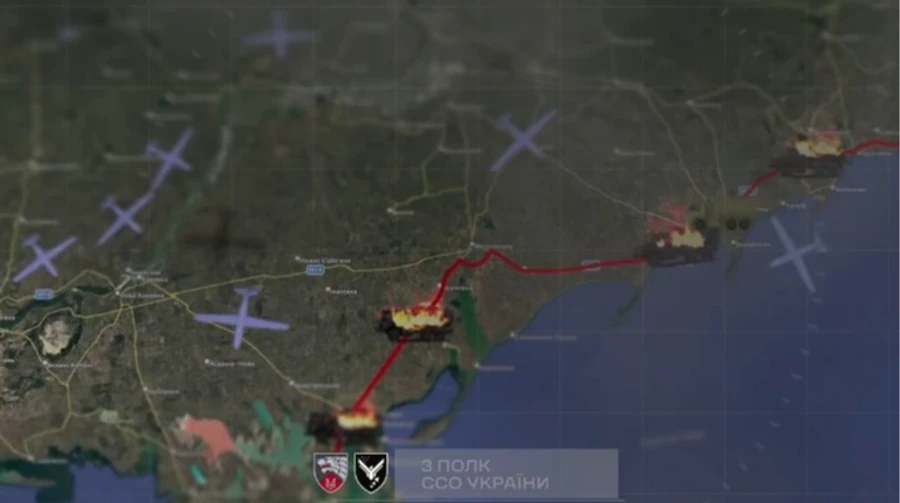
Ukraine’s mid-range strike campaign against major Russian ground lines of communication (GLOCs) in occupied Ukraine continues to disrupt vehicle movement. Luhansk People’s Republic (LNR) Head Leonid Pasechnik issued a decree on June 6 banning commercial passenger transport vehicles from occupied Luhansk Oblast from using the M-14 Rostov-Crimea highway (which Russian occupation officials denote as the R-280 highway) and the section of the Belgorod City-Mariupol highway (the R-150 highway) that runs through occupied Luhansk Oblast.[26] Pasechnik advised private vehicles to not use the highways but stated that bus services will continue to operate along modified routes. Pasechnik’s decree also banned commuter train service in occupied Luhansk Oblast. Zaporizhia Oblast occupation head Yevgeny Balitsky claimed on June 6 that there are no similar restrictions along the M-14 highway in occupied Zaporizhia Oblast.[27] Ukrainian forces have increased their mid-range strikes against these major GLOCs in the past month and against railway infrastructure in occupied Ukraine in the past two months.[28] The Ukrainian 3rd Army Corps notably reported on May 31 that Ukrainian forces have achieved drone-enabled fire control over occupied Luhansk City, Starobilsk, Alchevsk, Bryanka, and Kadiivka, all of which are on or near the Belgorod City-Mariupol highway in occupied Luhansk Oblast.[29]
We’ll get straight to the point: The financial hardships that Daily Kos is facing this year are tough.
We continue to be paywall-free. We continue to be supported by our readers, not billionaires or corporations. But we need to bring in more revenue. We are leaning on our community more than ever to help make ends meet.
Power matters.