
Every day, the Ukraine Battlefield update newsletter offers a clear look at how the war is unfolding on the ground. Subscribe for free here to get the full text delivered to your inbox.
The effort to isolate Crimea has expanded to bridges and trains.
The fuel ration in Crimea has been reduced to 20 litres per car per week.
The tourist season in Crimea is collapsing as Russians cancel reservations en masse.
Z-channels criticise Putin as detached from reality.
Ukrainian partisans claim Russians are abandoning the Kinburn spit due to supply problems.
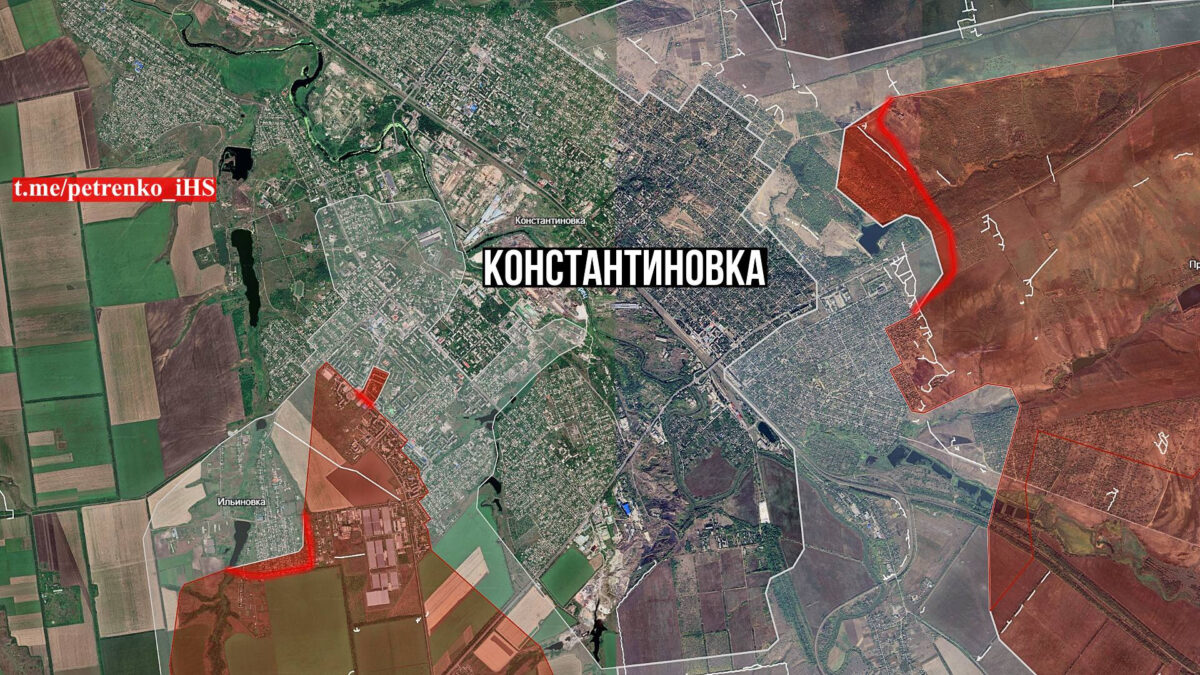
Russians already consider the battle for Kostyantynivka decided, and its fall is indeed approaching.
Maps of the day – Chonhar bridge; Kostyantynivka
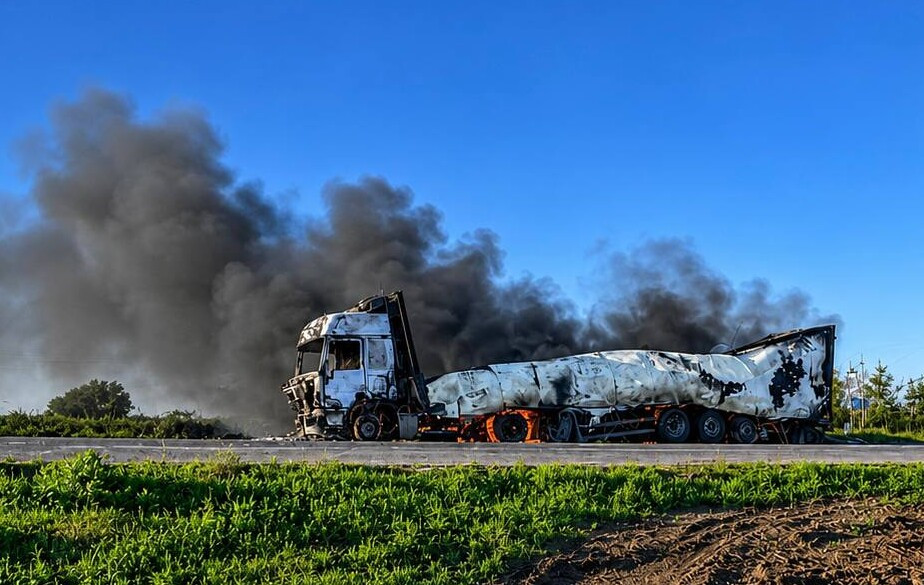
Videos of the day – drone stops a train; detailed MiG-29 cockpit footage while chasing a drone; drone shoots down another drone with a shotgun; Ukrainian trucks are also burning.
The effort to isolate Crimea has expanded to bridges and trains. The offensive against Russian supplies for the entire southern front is deepening. Hundreds of attacks on the road from Mariupol via Berdiansk and Melitopol are well known. Over the weekend, they were joined by an airstrike on the Chonhar bridge, after which one of the three road crossings to the occupied peninsula was temporarily closed and the remaining traffic had to be rerouted via Armiansk.
The bridge had already been heavily damaged in 2023. At that time, it was part of an unsuccessful Ukrainian offensive. Russians now fear that a new one is approaching. All the more so because, in addition to the bridge, drones have begun attacking trains in Crimea. On Sunday night to Monday, they hit a freight train, and Russians subsequently suspended passenger services as well.
Insane video of Ukrainian drones targeting and severely damaging the crucial Chongar Bridge connecting Crimea with the southern frontline. pic.twitter.com/cuvpX0Cw8r
— WarMonitor🇺🇦🇬🇧 (@WarMonitor3) June 7, 2026
What is happening in the south really looks like a systematic cutting off of the Russian army from its resources. It is highly questionable whether Ukrainians have the capacity to launch a major counter-offensive, but many Russian observers are already treating it as almost a done deal. The same goes for a new attempt to destroy the Kerch bridge.
In the following paragraphs we look at why Russians are afraid of a Ukrainian offensive.
The first is Komsomolskaya Pravda war correspondent Alexander Kots.
“The logic of the enemy is the same as with fuel tankers on the R-280 route: not to destroy, but to suffocate. First the fuel. Then the bridges. Now the passengers. What is essential is that they are targeting the locomotives, the ‘head’ of the train, because they understand that without it everything stops,” he wrote about the railway attack, during which the train driver was wounded and his assistant killed, while passengers were unharmed.
Kots sees two objectives which, in his view, Ukraine is pursuing.
The first is military: “The railway is not only about holiday-makers with suitcases. Fuel, food and construction materials for the entire southern grouping of forces flow along the same tracks.”
The second is psychological, as the holiday season begins: “Kyiv’s goal is simple: that a ticket to Crimea in June 2026 is no longer perceived as a trip to the seaside, but as a lottery. That hotel occupancy falls, that carriers raise insurance premiums. The tourist industry of the peninsula is worth billions of roubles a year. That is what they are targeting now.”
The highly influential Rybar, in his post after the attack on the train from Moscow to Simferopol, also wrote about two intentions of the Ukrainians. By disrupting logistics, Ukraine was, in his view, trying to deepen the crisis in south-west Russia (which for him includes the occupied territories): “The more residents this crisis affects, the more difficult it will be to respond.”
Rybar is one of those who write about a possible ground offensive by the Ukrainian army: “It is highly likely that it will launch a local offensive with the aim of ‘cutting off’ the land corridor. Attempts to attack infrastructure around the Kerch bridge are also possible. The enemy will then try to inflate even minimal tactical successes in order to cause panic and further escalate the crisis.”
Rybar’s theory of smaller attacks intended to trigger panic makes sense, because it is indeed unlikely that Ukrainians have sufficient forces stashed away for something bigger.
Another Z-channel, Notes of a Veteran, argued that if the current trend does not change, Crimea could be surrounded by autumn. “These are not chaotic strikes and raids, but targeted attacks on the region’s logistics infrastructure. The task is to ‘break’ logistics for our southern group of forces,” the author wrote.
His post appeared after the strike on the Chonhar bridge. “According to military logic, such measures are usually taken to isolate the battlefield and for further steps linked to a counter-offensive,” he added.
🌉 According to the Russian-installed governor of occupied Kherson Oblast a Ukrainian drone attack damaged the roadway of the Chongar Bridge today.
Traffic has been rerouted through the Armyansk and Perekop crossing points following the strike. pic.twitter.com/8p99VLgy7r
— Special Kherson Cat 🐈🇺🇦 (@bayraktar_1love) June 7, 2026
The fuel ration in Crimea has been reduced to 20 litres per car per week. Sevastopol governor Mikhail Razvozhayev published a notice about new fuel rationing rules in the city on his official account shortly before midnight on Friday.
At that time they applied only to one network of petrol stations, namely ‘TES’. City residents receive a coupon via QR code for 20 litres of fuel per car. That is already the first change, because last week the quota was still 20 litres of fuel per person.
The second change is even more serious. “After refuelling, the system will allow you to generate another QR code for that vehicle only after seven calendar days. The aim is to ensure equal access to fuel for as many people as possible and at the same time prevent speculation, long queues and unnecessary rush at petrol stations,” Razvozhayev wrote on Friday.
Nothing in the system announced before the weekend had changed by Monday morning.
The head of the Crimean government, Boris Aksyonov, has not published any new updates on the fuel situation. In a post from Wednesday last week, however, he apologised that 400 public transport routes had not been put into operation.
The most important commentary on the fuel shortage was published by Russian war correspondent Roman Saponkov. He criticised the fact that authorities were sending the QR code only into the Max app, which the regime forces all residents to use because it allows their surveillance, but which, according to him, cannot be installed on iPhones.
“One day there will be books written about how, in the shortest possible time, they turned a loyal population into what they have turned it into,” Saponkov said, in a remark that can be read as an admission of Crimean residents’ discontent with the situation.
The tourist season in Crimea is collapsing, as Russians cancel reservations en masse. The peninsula is a traditional tourist destination dependent on the summer season, which the Ukrainian army is now apparently cancelling. Russian daily Kommersant quoted the owner of the Pin Elephant chain of travel agencies as saying that for every two new bookings in Crimea there were 10 cancellations of already agreed accommodation: “No one wants to get stuck because of fuel problems.”
According to the same source, clients of the Travelline travel agency cancelled 79 percent of bookings across Crimea and 71 percent directly in Sevastopol between 24 May and 6 June.
At the same time, the same travel agency said that in the same period the number of new bookings in Crimea fell year-on-year by 31 percent across the peninsula and by 40 percent in Sevastopol.
Z-channels criticise Putin as detached from reality. Russian president Vladimir Putin also spoke at last week’s economic forum in St Petersburg and the reaction to his words is one of the indicators of dissatisfaction with the course of the war. Among the most hardline supporters of Russian aggression, Putin’s remarks triggered a negative response.
The so-called Z-channels often used to criticise lower levels of power or, in their view, poor-quality officers. What testifies to the changing mood in Russia now is that Putin himself has become the target of criticism.
This is evident even in something as trivial as the share of critical or mocking emojis under various posts, which was unusually high and overall clearly hostile to Putin. For the fifth year, this audience has not criticised the war as such, but the fact that Russia is not waging it well, while not questioning its necessity. If they are now turning on Putin as well, it is a development that is undesirable for the regime. Until now he had enjoyed strong support in this milieu.
One of the posts that spread widely was a message by a smaller Telegram channel, Verum Regnum, whose author writes under the motto “Death to fascist occupiers!”, by which he of course means Ukrainians, “occupying” their own territory. The author has an audience of 70,000, but his angry post was shared by the larger and more influential Yury Kotenok (320,000 readers).
The author picked out three Putin quotes which he clearly considered nonsensical and attached questions to them. Each time the first line is Putin’s quote, followed by the questions. In the first set of questions there is a note by the blogger in brackets:
Putin: “On the battlefield there is parity (in drones, do we understand correctly?), in some sectors we have the advantage.”
Verum Regnum, among other things, asked: “What has to happen for the information presented by the head of state to be at least somewhat in line with reality?”.
Incidentally, one of the most servile supporters of Putin, Alexander Sladkov, also said on Russian television: “We have 17 drones per kilometre, they have 10 drones for every one of our attacking infantrymen.”
Putin: “Long-range drones would not pose a threat if the necessary decisions had been taken in time.”
Questions:
Who exactly failed to take the necessary decisions in time?
Is this person still in office?
What conclusions have been drawn from the fact that the decisions were not taken in time?
Putin: “Russia, unlike Ukraine, has all the means necessary to develop new weapons on its own.”
Question:
“If we have everything, why is the ‘development of new weapons on our own’ proceeding so pathetically slowly that we are constantly lagging behind the enemy?”
Ukrainian partisans claim Russians are abandoning the Kinburn spit due to supply problems. “Soldiers of the 337th regiment are abandoning their positions – supplies have been completely cut off. Deliveries of ammunition, fuel and food have stopped,” the Ukrainian partisan movement Atesh wrote on its Telegram account.
Russians are allegedly withdrawing from the northern and western part of the narrow projection into the sea, while being constantly harassed by Ukrainian drones. “Only remnants of units remain on the ‘spit’, which can no longer hold the defence. The occupiers’ supply system in this sector has completely collapsed,” Atesh claimed, linking it to the offensive against Russian logistics on the southern front.
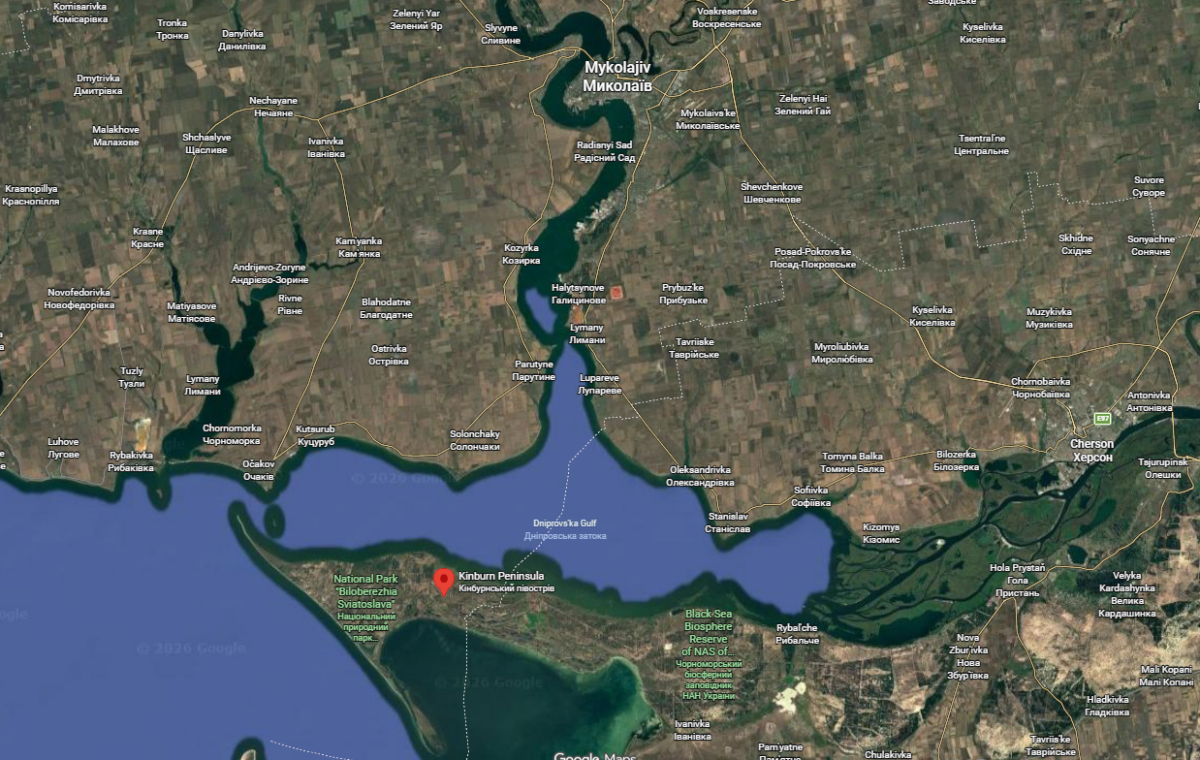
For now this is an unconfirmed report, but if it proved to be true, it would represent a significant success. The Ukrainian army has repeatedly and unsuccessfully tried to land on the spit. It is a small, but strategic piece of territory that lies in the way of ships sailing to Kherson and Mykolaiv.
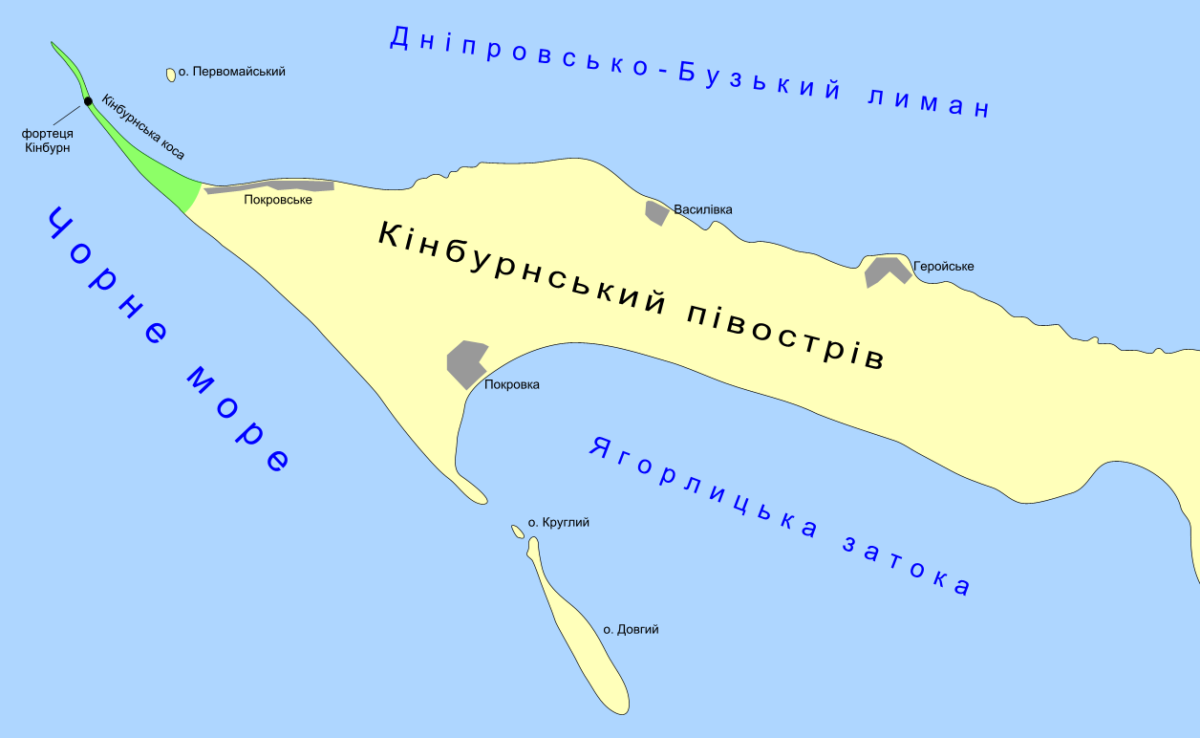
The Kinburn spit is at the tip of the Kinburn peninsula. On the map it is unmistakable thanks to its pointed shape. You will find it in the bottom left.
Here is a further detail from a map on Wikipedia:
Russians already consider the battle for Kostyantynivka decided, and its fall is indeed approaching. “According to operational reports, the enemy has up to 12 percent of the city’s territory left,” Russian commentator Yury Kotenok wrote after the weekend’s fighting for the town.
In his post he claimed that Russian units had broken through Ukrainian defences on the north-western and north-eastern outskirts of the town. According to Kotenok’s map, Russians already control almost all districts. This Russian account is, however, notoriously unreliable and constantly exaggerates Russian successes.
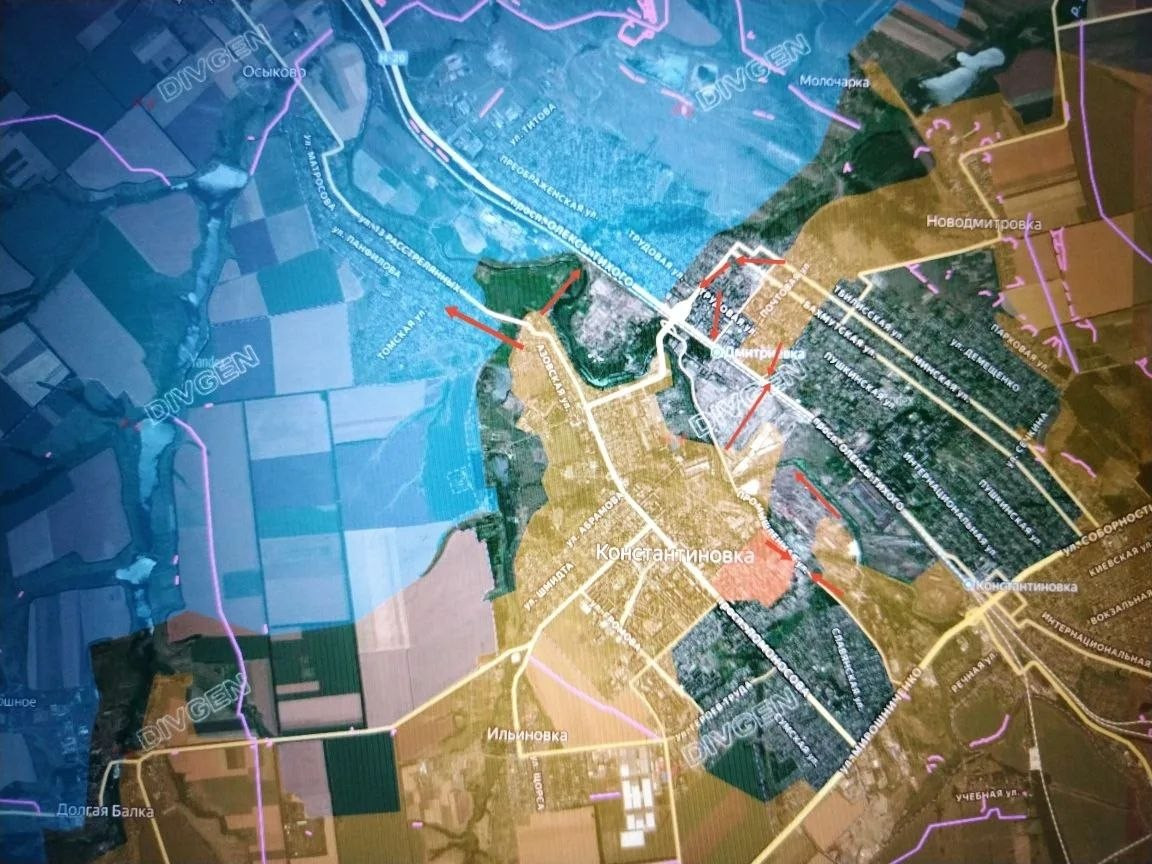
An independent Polish account, Thorkill, confirmed that defences on the western edge of the town had collapsed and that, in the south, the remaining troops faced the threat of encirclement. Already a week ago, he wrote of a similar development, which various observers at that time considered an inaccurate description of the situation. This source often sparks controversy, but equally often has interesting insights and sometimes correctly spots what others miss.
Sytuacja w rejonie Konstantynówki, część VI. Załamanie się ukraińskiej obrony w zachodniej części miasta.
Opublikowana przeze mnie tydzień temu mapka, która miała być rzekomo kontrowersyjna, bo “za dużo dawała Rosjanom”, po tygodniu okazała się trafna w 90 procentach. Wkrótce po… pic.twitter.com/TSHQjV0C2E
— Thorkill (@Thorkill65) June 7, 2026
Another Russian, Pavel Kots, also wrote about encirclement: “Fighters of the South grouping advanced along Moskovska Street to Oleksiya Tykhoho Street, cutting off Ukrainian army soldiers in the city centre. The encirclement has closed.”
Russian sources also published video from fighting in the western part of the town. Consider whether or not to watch it; it shows the death of Ukrainian soldiers trying unsuccessfully to escape along the balconies of a shelled building. The ending is explicit.
Close combat in high-rise buildings in Kostyantynivka, recon by the 1465th Motorized Rifle Regiment:
A Ukrainian soldier is wounded by Russian small arms fire and later killed in a close-up. A second Ukrainian soldier escapes.@GeoConfirmed @UAControlMap
📌 48.498284, 37.688168 pic.twitter.com/DkB1hAZh08
— Audax (@AudaxonX) June 7, 2026
“The situation is extremely serious,” Ukrainian military account Bakhmut Demon wrote.
Ukrainian analyst Petrenko also spoke of a “tense and dynamic situation”. In his report he mentioned fighting over multi-storey apartment blocks in the west of the town. According to his map, he meant the same location as in the video above. On his map, as on the earlier Polish one, an encirclement is emerging which Russians are already writing about as a done deal.
Videos of the day
A drone stopped a Russian freight train.
There are many videos from the cockpit of Ukrainian aircraft chasing Russian drones, but this is one of the best.
Cockpit footage from a Ukrainian Air Force MiG-29 Fulcrum as it shoots down a Russian attack drone using an R-73 AAM. pic.twitter.com/njQ59q3L4V
— OSINTtechnical (@Osinttechnical) June 7, 2026
A drone armed with a shotgun shoots down another drone.
The following footage is from the free part of Kherson region; Russians showed it as proof that they too strike Ukrainian rear areas.
What are the losses
By Monday morning, Russia had demonstrably lost 23,593 pieces of heavy equipment (on Monday (1 June) it was 23,556). Of these, 18,585 (18,551) pieces were destroyed by Ukrainians, 982 (979) were damaged, 1,199 (1,199) were abandoned by their crews and 2,827 (2,827) were captured by the Ukrainian army. This includes 4,397 (4,394) tanks, of which 3,300 (3,293) were destroyed in combat.
Ukraine has lost 11,425 (11,397) pieces of equipment, of which 8,888 (8,863) were destroyed, 680 (678) damaged, 670 (669) abandoned and 1,187 (1,187) captured. This includes 1,426 (1,424) tanks, of which 1,091 (1,089) were destroyed in combat.
Note: Neither side regularly reports its dead or its destroyed equipment. Ukraine publishes daily figures for Russian casualties and destroyed equipment, which cannot be independently verified. This overview uses data from the Oryx project which, since the start of the war, has compiled a list of equipment losses documented exclusively by photographic evidence.