
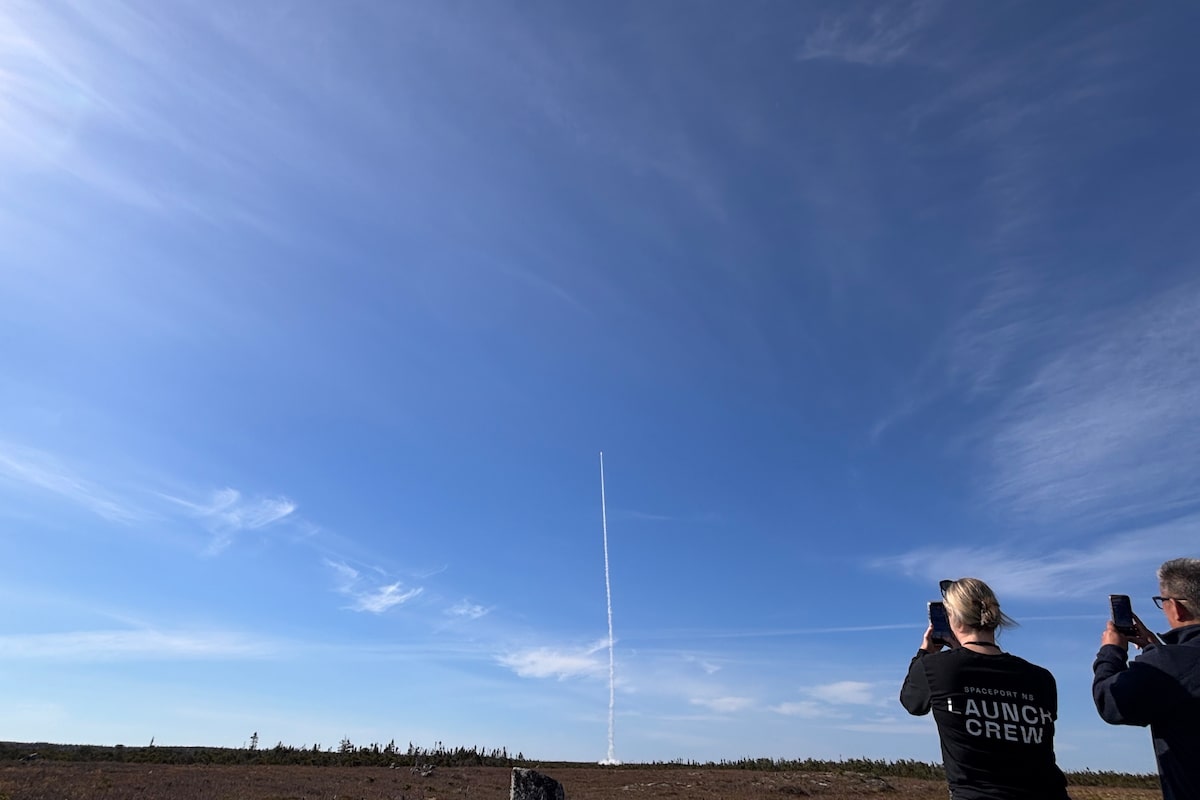
A Dutch-built rocket ascends from a launch site near Canso, N.S., Wednesday.Ivan Semeniuk/The Globe and Mail
Canada took another step toward achieving domestic access to space with the launch of a Dutch-built rocket that lifted off from Nova Scotia on Wednesday morning.
The rocket launched successfully at 8:51 local time and immediately shot upward into the pale Atlantic sky.
It quickly approached the boundary of outer space, which by convention is considered to begin at 100 kilometres above Earth’s surface. But an anomaly in the later part of the flight caused the rocket to diverge from its expected course, and it did not reach that threshold.
Team members with the rocket’s builder, T-Minus Engineering BV of Delft, said they would continue to analyze data to understand what happened.
To allow time for the analysis, the launch of a second rocket was scrubbed for the day, though it could still be rescheduled as a window for the test flight remains open until June 13.
“Just remember, rockets are hard,” said Steve Matier, president and chief executive of Halifax-based Maritime Launch Services, which hosted the launch.
Ottawa investing $200-million in Nova Scotia spaceport to enable sovereign satellite launches
Wednesday’s event marked the second commercial flight for the company, which is developing a permanent spaceport near the town of Canso.
But unlike an earlier effort last November, this launch was witnessed by about 100 guests and media, including a busload of NATO officials and Canadian astronaut Jeremy Hansen.
Col. Hansen did the honours of pushing the button that ignited the rocket.
Those watching from a viewing area more than a kilometre away saw the brief orange spark of ignition, followed by the immediate ascent of the small rocket.
Unlike the heavy rockets used to carry astronauts and massive payloads into orbit, this one sprang into the sky like an arrow and was out of sight in a matter of seconds.
The sense of occasion around the event marks a growing political and economic interest in developing domestic launch capacity in Canada.
In addition to commercial clients, Maritime Launch also has a contract with the federal government and aims to eventually launch payloads into orbit from the budding Nova Scotia spaceport. The facility is situated on a rocky plateau amid stands of evergreens on a peninsula that is the easternmost point of North America’s mainland.