

Every day, the Ukraine Battlefield update newsletter offers a clear look at how the war is unfolding on the ground. Subscribe for free here to get the full text delivered to your inbox.
Ukrainians have hit four more bridges leading towards Crimea, this time from the north-west.
A Ukrainian journalist wrote that Russian logistics were essentially cut off.
Where exactly Ukrainians have already hit bridges and what options Russia has.
Ukrainians are quietly advancing near Lyman, but the maps have not yet recorded it.
In the first three months of this year, Russia recruited fewer than one thousand soldiers a day.
Chart of the day: last week Russia advanced by 15 square kms.
Videos of the day: petrol stations without fuel and some food items sold out in Crimea, and a video showing the death of a Russian hero.
Ukrainians are trying to turn the Crimean peninsula into an island. After damaging in recent days two bridges leading from Russian-occupied southern Ukraine to Crimea (near the towns of Chonhar and Henichesk) in the north-east, they hit another four bridges in the north-western part of the peninsula on Thursday night.
The Russian governor of the occupied Kherson region, Vladimir Saldo, reported this.
“During the night, the enemy attacked bridges over the North Crimean Canal near the villages of Preobrazhenka and Myrne, the road bridge between Perekop and Armiansk, and a bridge near the village of Stavky. According to preliminary reports, there was some damage. Experts are inspecting and assessing the condition of these structures,” Saldo wrote.
He added that Russian forces had shot down 45 Ukrainian drones – though clearly not all of them.
Crimea is connected by land to southern Ukraine only in the north-west, via the Perekop Isthmus, which is just 9 kms wide at its narrowest point. There are also several road bridges over the North Crimean Canal here, and putting them out of action would significantly complicate logistics to Crimea.
According to Google Maps, these could be smaller bridges over the North Crimean Canal, including the main bridge leading to the town of Armiansk.
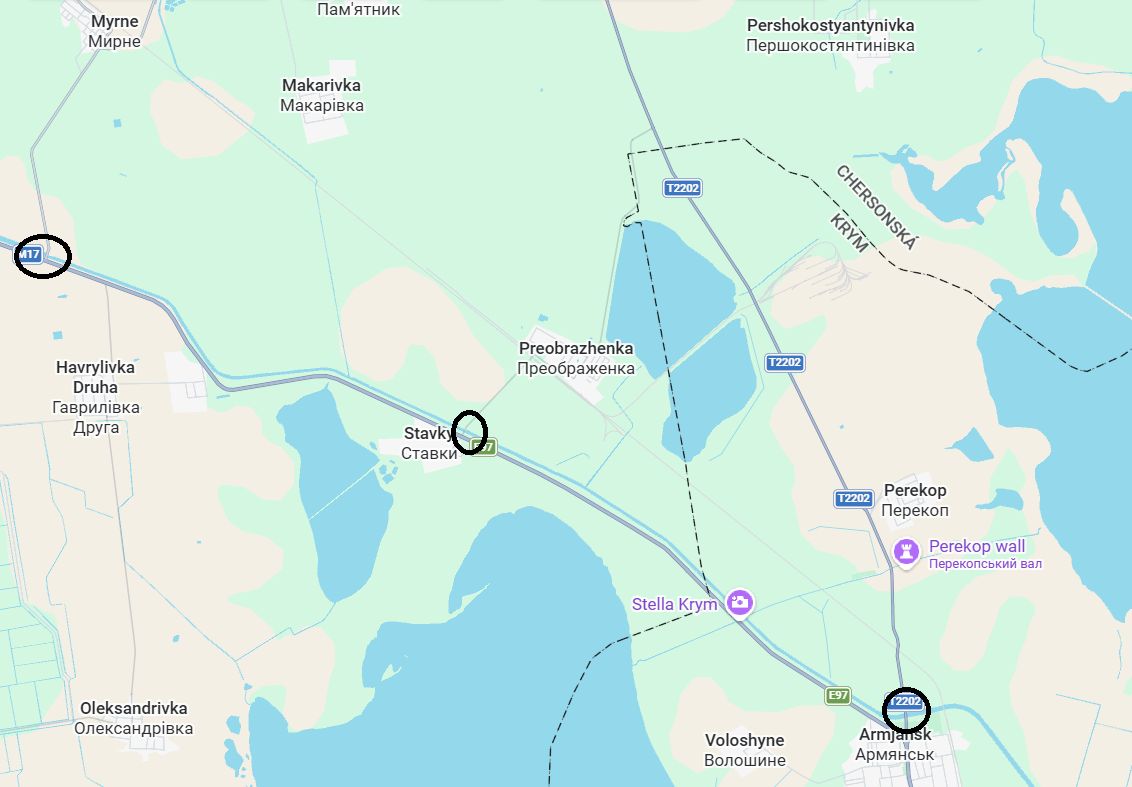 Probably three of the four bridges hit by the Ukrainians. Source: Google Maps
How extensive was the damage, and are the roads cut off? The pro-Ukrainian account Crimean Wind has been monitoring information from Crimea. According to it, residents of Armiansk reported that only private cars were being allowed to cross the bridge into the town. “The bridge itself is being inspected to determine whether it is fit for operation,” the account wrote.
“Next to the road bridge there is a pedestrian bridge carrying two pipes with a diameter of one metre, which supplied water to the town. Because of the explosions, the pipes have been shattered into pieces. Residents of the town are in a panic because they will be left without water,” Crimean Wind added.
Ukrainian journalist Andriy Tsaplienko wrote that, according to Russian public channels, logistics via the land corridor to Crimea were cut. “Ukrainian forces critically damaged three bridges during the night. The passage of military equipment across them is practically impossible,” he wrote.
The Ukrainian account Oko Hora published a map with all the bridges leading to Crimea that Ukrainians have hit over the past week.
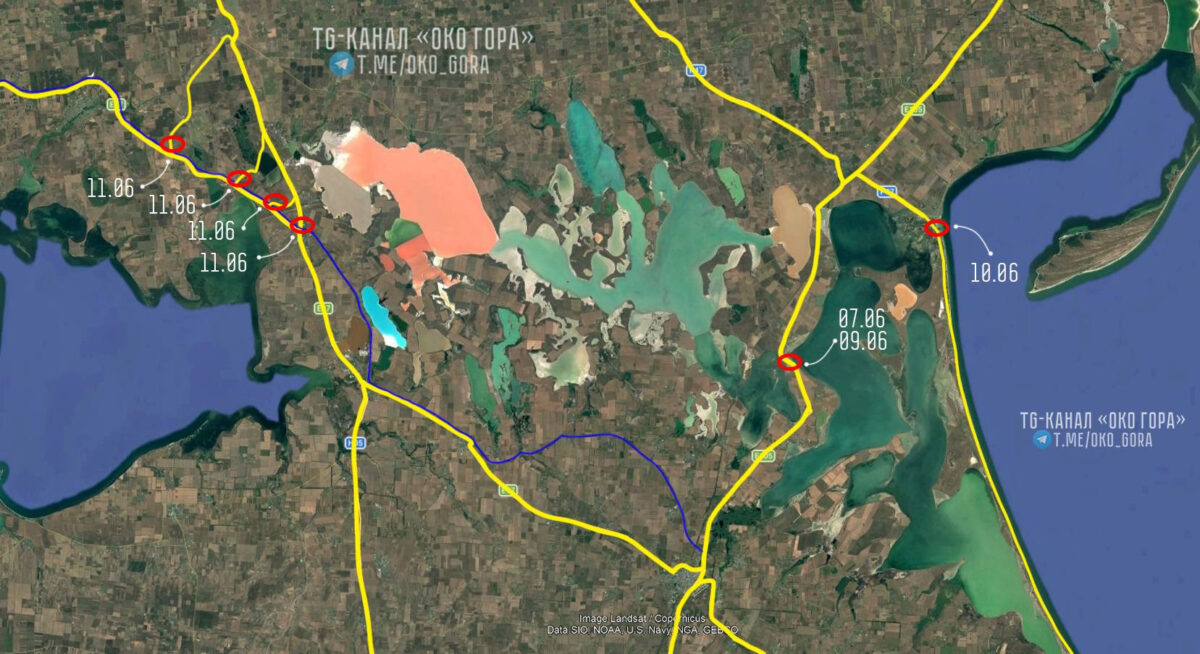
They have hit the Chonhar bridge in the north-east of Crimea twice; it was the main entry route to the peninsula. In reality there are two bridges here, but as the account DeepState UA wrote, the old bridge was not suitable for use.
After the second strike, a pontoon bridge again appeared in satellite images.
The Russians had built this pontoon bridge here already in 2023 after the first attacks on the Chonhar bridge. At that time, the Ukrainians used Storm Shadow missiles.
Now they are attacking with FP-2 drones, or with the new Behemoth drone. Even though the Russians shoot many of them down, they have not managed to fully protect the bridges. The drones cause only limited damage, but they allow the bridges to be shelled repeatedly.
A little further north, a road from the town of Henichesk leads onto the Arabat Spit, which can also be used to reach Crimea. And even though on Tuesday we wrote that this was mostly a dirt track for adventurers, as Google Maps also shows, the DeepState account wrote that the Russians had built a new road here and that “the occupiers are using it as an alternative route.”
However, the Ukrainians have now damaged the bridge leading onto the spit, as satellite images also show.
Damage to the bridge connecting Kherson Oblast and Crimea via the Arabat Spit following the June 8 Ukrainian strike can also be seen in a low-res @Planet image taken June 10. The image also shows pre-existing infrastructure for the deployment of a pontoon bridge. 46.1476, 34.8076 pic.twitter.com/PgGaysKHJA
— Mark Krutov (@kromark) June 11, 2026
If, in the long term, Russia redirected its logistics routes via the Perekop Isthmus, this would extend transport by at least two hours. It would also bring freight lorries closer to Ukrainian positions, which would, according to the DeepState UA account, create a kind of trap for the Russians.
Of course, the connection via the Crimean bridge still exists. However, Ukrainians have already attacked it in the past, and a similar strike cannot be ruled out again.
Completely cutting Crimea off from southern Ukraine will, however, be difficult. As the account Vitaliy wrote, there are several dams across salt marshes that can be used as backup routes, even if they would be a very limited alternative. It is unclear whether heavy lorries could drive along them.
For the Ukrainians, however, a major success would also be to significantly complicate transport. “Crimea cannot be completely cut off, so the main focus is to make transport less convenient,” Vitaliy wrote.
It is very difficult to put these bridges completely out of action, since the Russians keep repairing them. “Unfortunately, it is not always possible to inflict significant damage that would allow these facilities to be disabled for a long time,” the Oko Hora account stated.
From a military point of view, this may affect operations above all in southern Ukraine, particularly in the Zaporizhzhia region. Russian accounts had previously speculated that Ukrainians were preparing a larger offensive, which, however, still seems rather unlikely for now.
“Extending such a blockade could lead to significant changes in combat operations in the south. We must not succumb to euphoria over the destruction of bridges, because they can be restored, which people in Moscow are already doing. However, the defence forces have demonstrated much more – capabilities that allow them to control everything moving through the southern part of the occupied territory, especially from Crimea,” DeepState UA wrote.
In the meantime, the situation with petrol supplies in Crimea has worsened further. The governor of occupied Sevastopol, Mikhail Razvozhayev, wrote that the QR codes which allowed residents to buy petrol worth up to €20 per week were no longer valid.
“Unfortunately, tanker trucks with fuel were unable to enter the city this evening,” he wrote. “I urge everyone: there is no point in standing in line tomorrow (Thursday – editor’s note) at TES petrol stations. As for the validity of QR codes, all codes issued so far will be deactivated today,” he said, according to Ukrainska pravda.
Apparently, petrol can still be obtained on the black market. The Crimean Wind account published a video showing petrol being sold at 180 roubles per litre, which is roughly €2.1. That is twice the price at which it is normally sold in Russia. According to the account, there were also reports that in some places it costs 250 roubles per litre, or about €3.
The Russians have also restricted and cancelled some bus services in Crimea.
While Russian forces are pushing ever deeper into the town of Kostyantynivka, Ukrainians are also carrying out smaller counterattacks. Less is said about them because the Ukrainian army and pro-Ukrainian analytical accounts are observing operational silence and are not reporting on them.
As French analyst Clément Molin wrote, these are two locations. First of all, Ukrainians have advanced north of the town of Lyman.
In recent days, Andrew Perpetua has recorded advances here. On this map there are two newly liberated “blue” areas between the villages of Lypove and Shandryholove.
Source: Andrew Perpetua
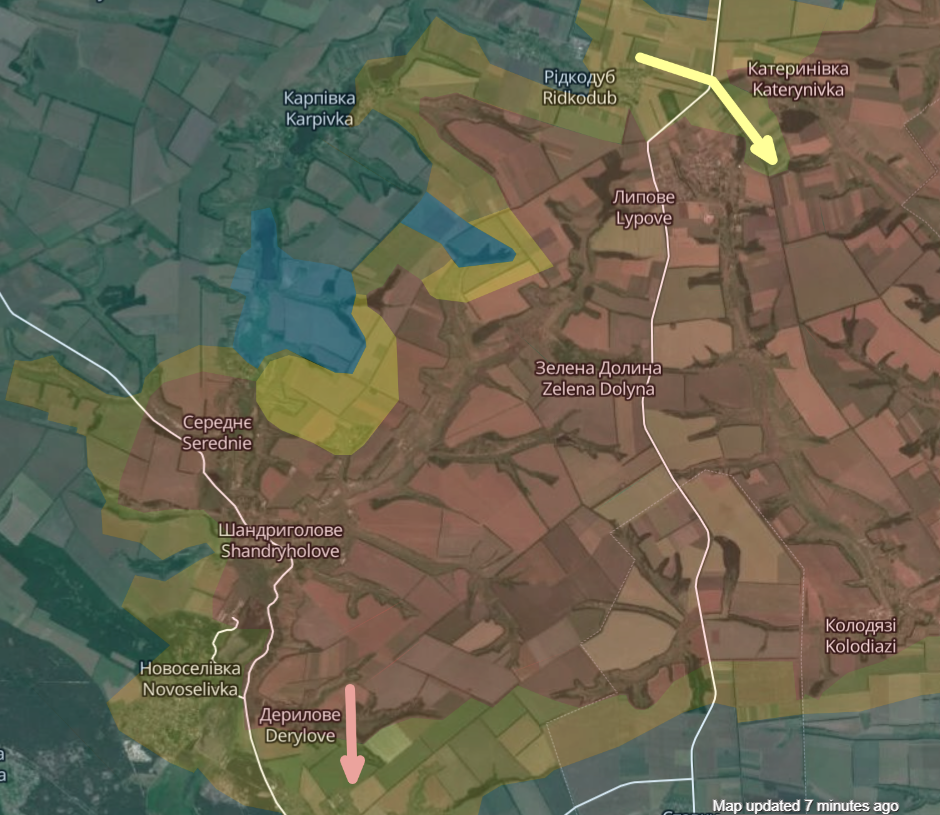
This corresponds with data from the same area published by the Russian account Rybar.
Source: Rybar
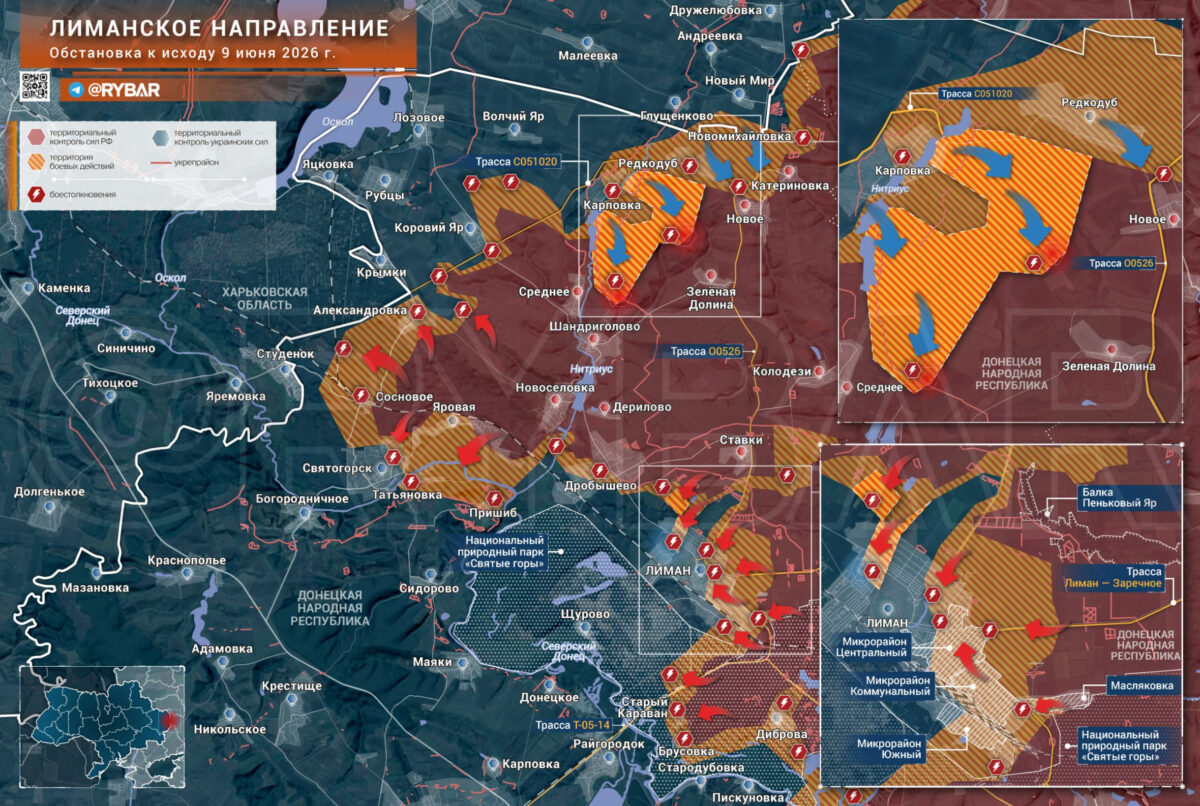
“In the Lyman direction, the situation on the northern flank is deteriorating, with the Ukrainian armed forces having occupied several forest belts along the Shandryholove–Lypove line,” the Russian channel Two Majors also wrote.
Expert Andrew Perpetua believes that Ukrainians are also advancing from the west of this salient. This is what the map would look like if he incorporated Russian claims about the Ukrainian advance.
And this is what it would look like if he mapped the most maximalist Russian claims he found.
“Everything suggests that Ukraine has advanced further than current maps show north of Lyman. The Russians claim that Ukraine has captured villages and other areas that were once firmly under their control but are now contested. I try to ensure my map contains only verified facts, so I am much more cautious,” Perpetua wrote.
“Confirmation will probably come soon from official Ukrainian sources (likely from DeepState), so I cannot tell you more for now, but the analysis of satellite imagery suggests that maps in this area are significantly outdated,” French expert Clément Molin also wrote.
The French analyst added that Ukrainians were also advancing further south towards the town of Velyka Novosilka. According to him, they have liberated the villages of Ivanivka and Novopalivka. According to DeepState, the first of these villages has been liberated, while in the second, half of the territory is a grey zone.
Ukrainian 🇺🇦 forces have been conducting for weeks two unnoticed counter-attacks in two directions of the frontline.
With barely any geolocation, the Ukrainians kept a good level of OPSEC and the russians have been reluctant to publish videos from these areas.
In the Ivanivka… pic.twitter.com/hNJy4YhkxG
— Clément Molin (@clement_molin) June 10, 2026
According to federal data, Russia recruited 71,216 new soldiers in the first quarter of this year. That works out at about 800 per day.
This is indicated by the amount the finance ministry spent on signing bonuses. German economist Janis Kluge, who has long focused on this topic, reported this.
It is significantly fewer soldiers than in the first quarter of 2025 (89,601), and also fewer than in the same period in 2024.
According to the latest federal budget data, Russia recruited 71,216 contract soldiers in Q1 2026, confirming a slow start to the year.
–> Link to my latest report on Russian recruitment the comments. pic.twitter.com/KX9MseYIeQ
— Janis Kluge (@jakluge) June 9, 2026
Data from regional administrations confirm this as well. Signing bonuses for Russian soldiers are paid out by both federal and regional authorities. More or less, this also matches the words of former Russian president Dmitry Medvedev about recruitment in the first quarter.
Average daily recruitment of soldiers according to federal data (dark blue), regional data (blue) and Medvedev’s statements (grey). Source – Janis Kluge
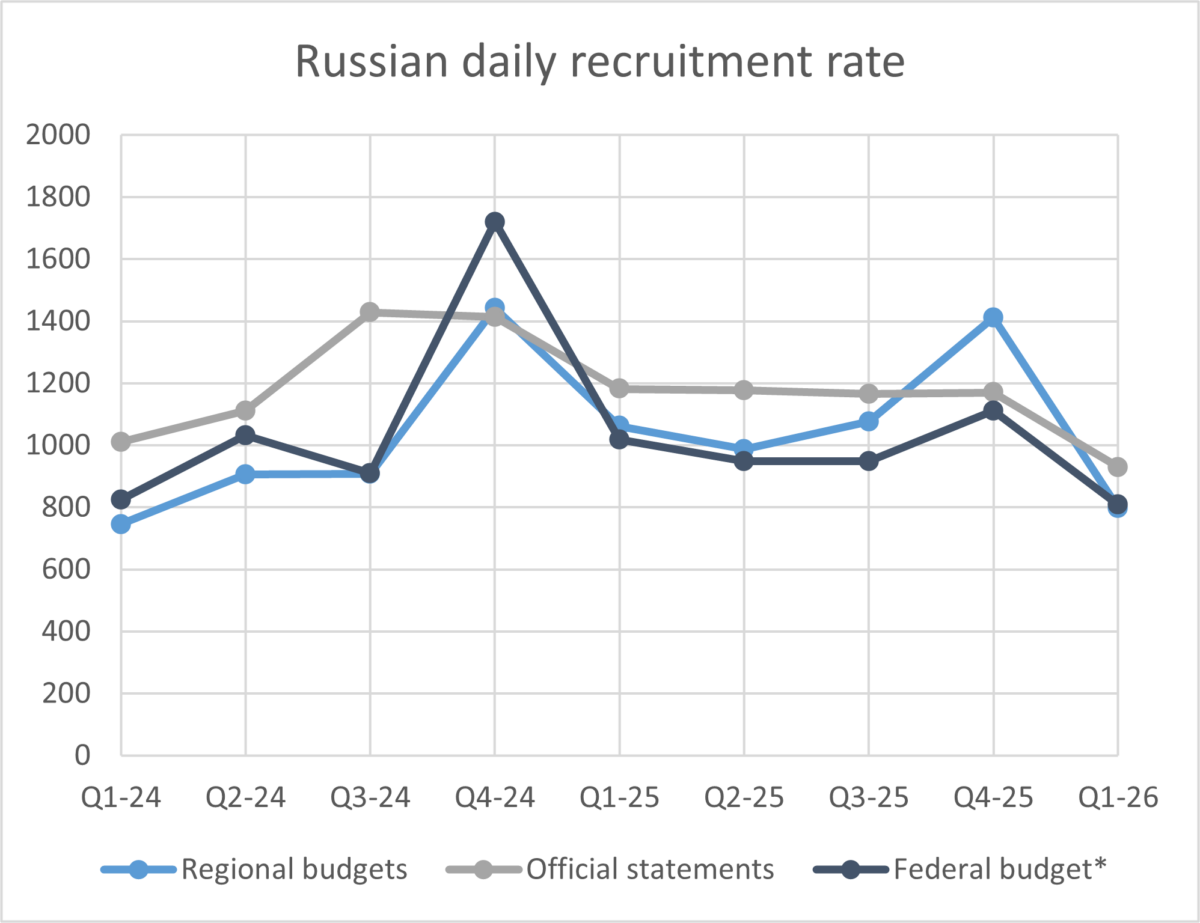
In April, recruitment already increased slightly, at least according to Medvedev and regional data, to around one thousand soldiers per day.
Ukrainians claim that they are currently killing and wounding more Russian soldiers than Russia can recruit. This cannot be definitively confirmed, but the recruitment data indicate problems with replenishing manpower for the Russian army in Ukraine.
Chart of the day
Last week, Russian forces made slight gains of 15 square kms, according to the Oko Hora account. Compared with previous months, this is very little, but at least they are not in the red as they were the week before, when Ukrainians liberated more territory than they lost.
These figures are based on the DeepState UA map. However, this account has recently been updating its maps much less frequently than before.
Russian advance by week
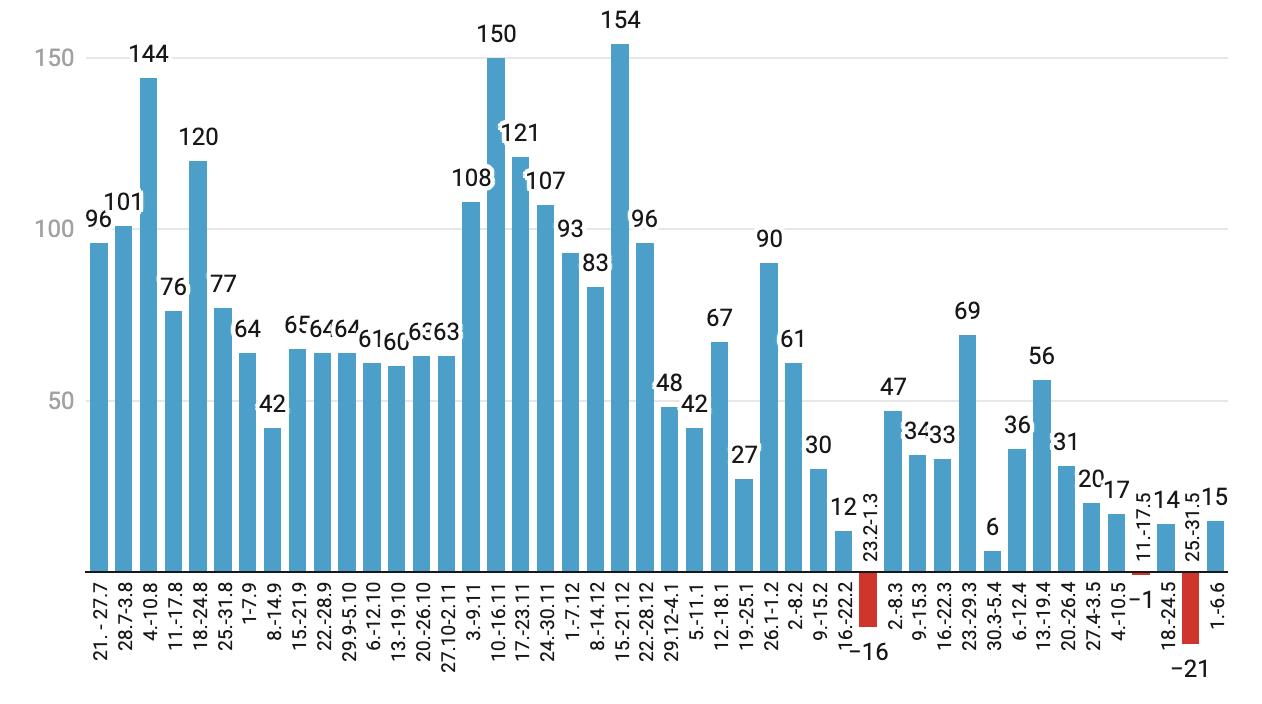 The amount of territory occupied by Russian forces per week. The figures are given in square kilometres (km²).
Videos of the day
Footage from Crimea provided by Radio Svoboda shows empty shelves in some supermarkets, limits on the purchase of certain foodstuffs, and petrol stations without fuel. “Putin wanted the return of the Soviet Union, they are almost there,” one user commented jokingly.
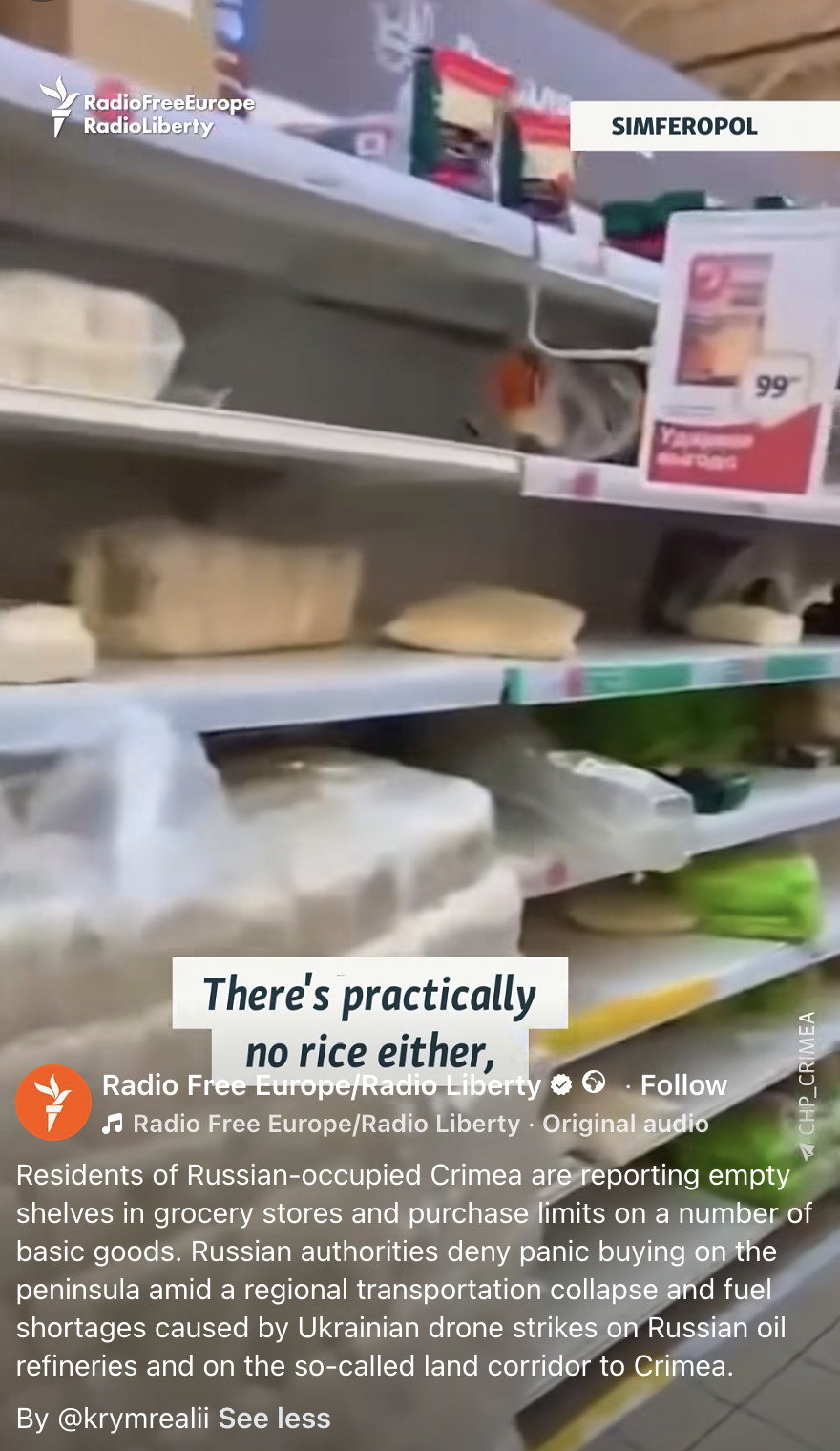 Screenshot from a video posted on Facebook by Radio Free Europe/Radio Liberty.
The commander of the Unmanned Systems Forces, Robert Maďar Brovdy, boasted that his people had eliminated one of the decorated “Heroes of Russia”. Colonel Naran Ochir-Goryayev had previously reported the capture of the town of Siversk to Putin. He will not be reporting any further captured towns. His death had already been confirmed by Caucasus media.
☠️ SBS commander Robert “Magyar” Brovdy showed a video of the liquidation of the Hero of Russia, Kalmyk Naran Ochir-Goryaev, who reported to Putin about the capture of the city of Siversk. pic.twitter.com/oyTmQohTBm
— MAKS 26 🇺🇦👀 (@Maks_NAFO_FELLA) June 10, 2026
What are the losses
No update on Thursday.
By Monday morning, Russia had demonstrably lost 23,593 pieces of heavy equipment (on Monday (1 June) it was 23,556). Of these, 18,585 (18,551) pieces were destroyed by Ukrainians, 982 (979) were damaged, 1,199 (1,199) were abandoned by their crews and 2,827 (2,827) were captured by the Ukrainian army. This includes 4,397 (4,394) tanks, of which 3,300 (3,293) were destroyed in combat.
Ukraine has lost 11,425 (11,397) pieces of equipment, of which 8,888 (8,863) were destroyed, 680 (678) damaged, 670 (669) abandoned and 1,187 (1,187) captured. This includes 1,426 (1,424) tanks, of which 1,091 (1,089) were destroyed in combat.
Note: Neither side regularly reports its dead or destroyed equipment. Ukraine publishes daily figures on Russian casualties and destroyed equipment, which cannot be independently verified. In this overview we use data from the Oryx project, which since the start of the war has compiled a list of equipment losses documented exclusively by photographic evidence.