
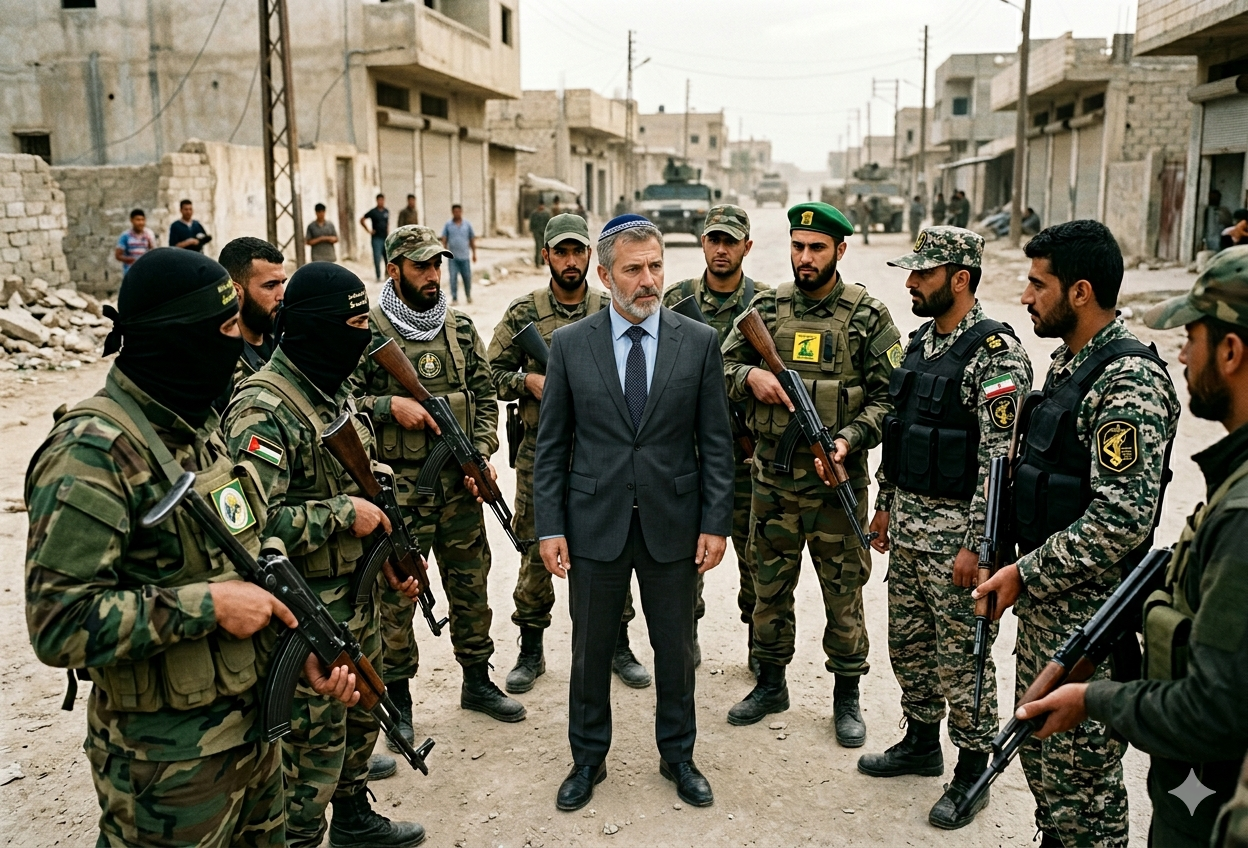
Israelis have perfectly rational reasons to believe they live under existential threat. This is not a matter of exaggeration or political theater; it is a conclusion shaped by centuries of persecution, the trauma of the Holocaust, and the lived experience of a small nation surrounded by adversaries. Jewish historical memory is long, but the modern Israeli sense of vulnerability is anchored in events that remain within living memory. The Holocaust was not simply a tragedy; it was a civilizational rupture that convinced Jews worldwide that their survival could never again depend solely on the goodwill of others. The founding of Israel was therefore not only a political act but a strategic necessity, a response to the near annihilation of a people. When Israelis speak of existential threat, they are not invoking metaphor. They are articulating a worldview shaped by catastrophe.
This worldview was reinforced by the Arab–Israeli wars of 1948, 1967, and 1973. These were not symbolic conflicts. They were wars that reinforced the perception that Israel’s survival could never be taken for granted. Even after the era of large wars with Arab states faded, Israel faced decades of terrorism, rocket fire, suicide bombings, and asymmetric warfare.
The rise of the Islamic Republic of Iran as a regional power, its support for Hezbollah, Hamas, and other proxies, and its repeated threats to destroy Israel, deepened the sense of encirclement. Then came the horrors of October 7th, followed by the more recent barrages of ballistic missiles, drones, and rockets from Iran, Hezbollah, and the Houthis.
For most Israelis, the prospect of an Iranian nuclear weapon is not merely an abstract proliferation concern but a direct threat to the continued existence of their country. Their fears are grounded in history, geography, and strategic reality.
But the task of serious geopolitical analysis is not to question whether Israeli fears are legitimate. They are. The task is to ask whether that is the full analysis. A fear can be rational and still be only one part of a larger system. Analysts must ask whether other actors also possess legitimate fears, whether those fears shape their behavior, and whether ignoring them creates blind spots that increase the risk of miscalculation. The question is not whether Israelis have existential fears, but whether they are unique in having them.
Iranians, too, have legitimate fears — fears that are often invisible in Western or Israeli discourse. Before the Shah’s rule, Iran had a democratically elected government that was overthrown in 1953 with the direct support of the United States and the United Kingdom, largely following Prime Minister Mohammad Mossadegh’s decision to nationalize Iran’s oil industry and amid broader Cold War concerns in Washington and London. This event is not a footnote in Iranian history; it is a foundational trauma — the original proof of concept that Western powers would intervene directly in Iranian sovereignty when their strategic and economic interests required it. Everything that followed was interpreted through that lens. The Iran–Iraq War, in which hundreds of thousands of Iranians died and chemical weapons were used against them with at minimum Western acquiescence, reinforced the belief that Iran must be self-reliant in matters of security, because external powers would not merely fail to protect Iran — they would actively arm its enemies. The United States then proceeded to topple two of Iran’s neighboring governments — Afghanistan in 2001 and Iraq in 2003 — positioning American military forces on Iran’s eastern and western borders simultaneously. From Tehran’s perspective, this was not coincidence; it was the architecture of encirclement.
Within this framework, the Iranian regime views Israel as a specific and particularly threatening actor. Iranian leaders generally do not perceive Israel primarily as an independent regional actor making sovereign decisions about its own security. Instead, they view Israel as the forward operating instrument of American regional hegemony — the military-technological node through which Washington projects and enforces a regional order designed to contain Iran. This perception has a traceable history: Israel and the United States have operated as an exceptionally close strategic partnership, sharing intelligence, coordinating military planning, and aligning on the shared objective of preventing Iran from becoming a nuclear or conventionally dominant regional power. When Iranian policymakers look at Israel, they see not merely a neighboring adversary but the cutting edge of a larger system designed to keep Iran weak, isolated, and perpetually subordinate. Iran’s support for Hezbollah, Hamas, and other proxy forces — what Tehran calls the “axis of resistance” — is, in Iranian strategic logic, a rational counter-encirclement response: maintaining forward pressure on Israel to keep it defensive, imposing costs on the American-Israeli partnership that reduce its capacity to project power toward Iran, and preserving strategic depth without which Iran would have little deterrent leverage. Whether this framework is morally defensible is a separate question. What matters analytically is that it provides a coherent strategic rationale through which most Iranian leaders interpret their security environment.
Palestinians also live with existential fears — fears of displacement, statelessness, and the loss of national identity. Their narrative begins not with abstraction but with the specific reality of who was living on that land in 1900, in 1920, and in 1947 — farming specific plots, inhabiting specific villages, and bearing title to specific tracts of land. The fact that Jewish historical and religious claims to that same territory stretch back thousands of years does not erase what Palestinians experienced as a concrete, modern dispossession.
From the Palestinian perspective, the Zionist project arrived not as the return of an indigenous people acting on their own behalf, but as a European colonial enterprise carried in on the infrastructure of the British Empire. The Balfour Declaration of 1917 — in which Britain endorsed the establishment of a Jewish national home in Palestine without meaningful consultation with the Arab majority living there — is, in Palestinian memory, the original instrument of dispossession: a colonial power disposing of a land it did not own in favor of a population it wished to relocate. That the Jewish people had been catastrophically expelled from this same territory by Rome nearly two thousand years earlier — Judea proper was near-depopulated through mass killing, enslavement, and forced displacement following the Bar Kokhba revolt of 135 CE, with surviving communities retreating to Galilee and the diaspora — is historically real. But for Palestinians, the passage of two millennia, and the unbroken presence of Arab civilization across that interval, meant that Jewish historical suffering under Rome could not morally authorize their own dispossession in the twentieth century. Whether one accepts this reasoning or not, it is a genuinely held and structurally coherent framework of grievance. The fear is not only of physical displacement but of cultural erasure — the sense that an ancient civilization’s tragedy has been made whole at their expense.
The point is not to equate these fears or to assign them equal moral weight. The point is that they are all real to the actors who hold them. And this is where the greatest danger lies. When any nation believes its fears are uniquely legitimate, it becomes more likely to dismiss the fears of others as irrational, evil, or manufactured. Throughout history, societies have resolved this tension by defining themselves as inherently good and their adversaries as inherently evil. This framing is emotionally satisfying and politically unifying, but it is analytically disastrous. It blinds policymakers to the motivations of other actors, reduces complex strategic behavior to moral caricature, and increases the risk of miscalculation.
Objective geopolitical analysis requires stepping back from one’s own national or religious identity and asking whether traditional frameworks of “good versus evil” or “rational versus irrational” are accurate. More importantly, analysts must ask whether these frameworks make the world safer or more dangerous. If every actor believes its fears are uniquely justified and its adversaries’ fears are illegitimate, the system becomes primed for escalation. If, instead, analysts begin from the premise that all actors have legitimate fears rooted in their own histories and threat perceptions, then the dynamics of the system become clearer. Recognizing mutual fear does not guarantee peace, but acknowledging it is the first step toward understanding why conflicts persist and why restraint is so fragile.
Israelis’ fears are legitimate. So are the fears of Iranians, Palestinians, and countless other societies shaped by their own histories and threat perceptions. Recognizing this does not diminish Israel’s security; it enhances it by grounding analysis in reality rather than exceptionalism. The greatest danger in any conflict is not that one side’s fears are illegitimate, but that each side believes only its own fears matter. The task of strategic analysis is to resist that temptation, to map the system as it is, and to understand that existential fear is not unique to anyone. It is a universal human condition — and the foundation upon which both war and peace are built.