
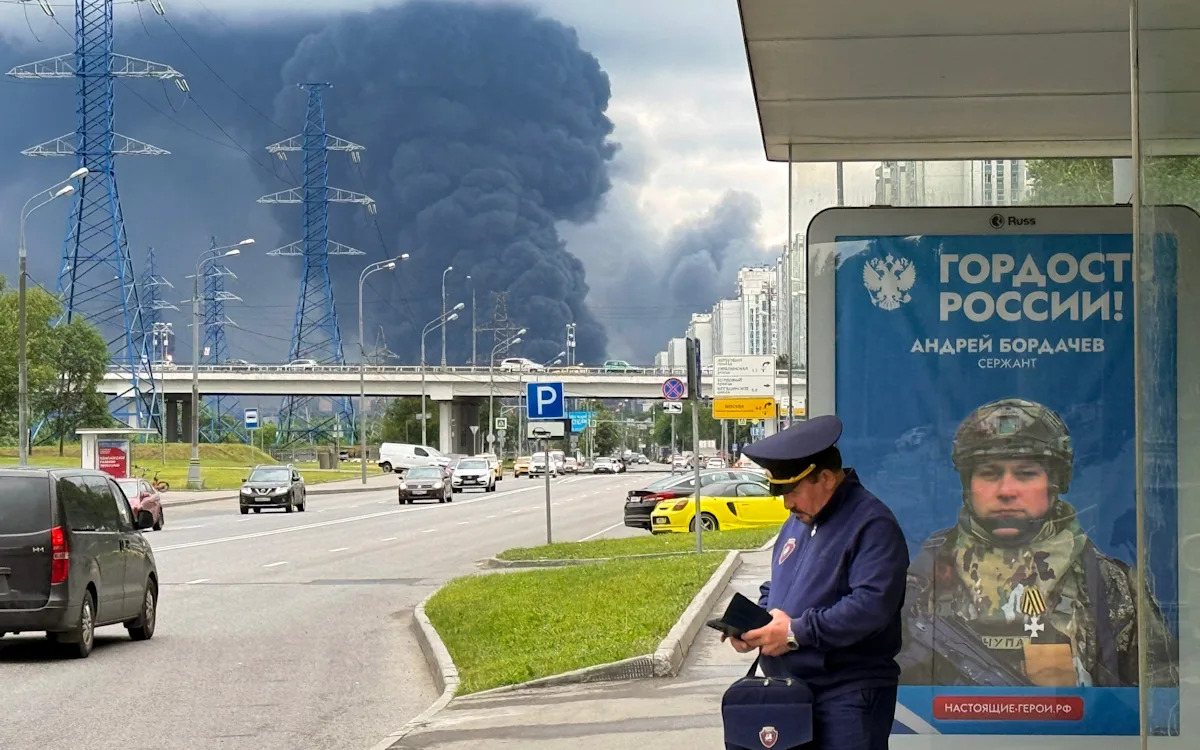
Credit: X/@visegrad24
Russia pledged to hit back with “massive group strikes” in response to Ukraine’s largest-ever drone bombardment of Moscow.
Ukrainian forces launched nearly 200 drones at the Russian capital on Thursday – a third consecutive day of attacks. More than 1,000 drones were fired at Russia on Thursday alone.
In one attack on Moscow’s largest oil refinery, projectiles blew the lid off a storage tank, with images circulated widely in Russia despite Vladimir Putin cracking down on sharing pictures of the growing number of air strikes.
Volodymyr Zelensky shared videos of the attacks while in Brussels seeking further backing from European leaders for his pressure campaign to force Putin to the negotiating table.
He arrived there from a G7 summit in Evian-Les-Bains, France, where leaders pledged to support what they described as a “new momentum” in the war by bolstering Ukraine’s long-range capabilities.
Credit: Social media
The Russian defence ministry claimed on Thursday that it had downed almost 1,000 drones across the country – the largest number fired by Ukrainian forces in a single attack since the start of the war almost five years ago.
Sergei Sobyanin, the Moscow, mayor, said 194 drones had been shot down over the city, adding that some had struck a sprawling refinery in Kapotnya, on the south-eastern outskirts.
Ukrainian forces also struck it on Tuesday, and had previously hit it a month earlier.
Plumes of thick black smoke from the facility, which covers 40 per cent of Moscow’s fuel needs, filled the skies and the city’s four airports were shut down.
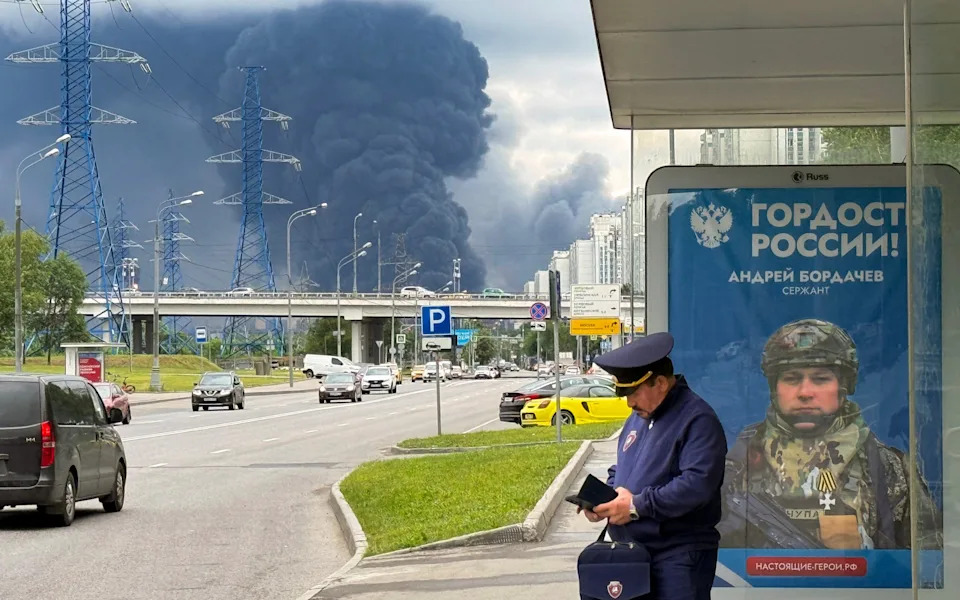
Black smoke rises in Moscow after the Ukrainian strikes – AFP via Getty
For days, long queues have formed at petrol stations, with rationing introduced, as Ukraine’s long-range strikes on Russian oil refineries continued to prove a success.
Hardliners called for the Kremlin to respond to the latest assault with brutal force to deter any future cross-border attacks.
Putin did not respond personally to the attacks as he hosted south Asian leaders for a summit in the Russian city of Kazan.
But Sergey Lavrov, his veteran foreign minister, said: “It is no coincidence that the president announced some time ago, after another stunt by the Kyiv terrorists, that we would now carry out massive group strikes on a regular basis.”
“This task has been set by the supreme commander-in-chief, and our armed forces are fulfilling it and will continue to fulfil it.”
It is uncertain how Russia will respond, but its forces have frequently bombarded civilian targets across Ukrainian cities with ballistic missiles and drones since the beginning of the war.
Mr Zelensky said the latest Ukrainian strikes were a “fully justified response” to previous Russian attacks, including one against an ancient cathedral in Kyiv. “If Ukraine burns, so will Moscow,” he added.
Kyiv has used its long-range attacks to pile pressure on Putin by ensuring that his war has an impact on everyday life in Russia.
There is a growing belief that the president will soon have to make a decision on peace talks as his country’s economy falters because of a prolonged period of increased defence spending.
On Thursday, at a meeting of the Ukraine Defence Contact Group, which coordinates aid deliveries, Mr Zelensky told allies: “We have the tools, and they are strong enough to put Russia on a path where diplomacy becomes the only choice.”
The Ukrainian president was in Brussels to build on the backing he believes to have received from Mr Trump in their meeting at the G7.
“The president of the United States is very clear about increasing pressure on Russia to end this terrible war Russia has brought against Ukraine and all of Europe,” he told the meeting at Nato’s headquarters.
At the gathering, Britain pledged to deliver some 150,000 drones, along with 350 air-defence missiles and radars.
Bolstering Ukraine’s air defences is seen as a key priority to ensure the country can head off any potential retaliation by Moscow for its deep strikes.
European diplomats believe Mr Trump’s agreement with Iran to end their months-long war will re-invigorate the Ukrainian peace process. The US president has served as a key mediator between Kyiv and Moscow while trying to reach a ceasefire agreement.
American officials have also argued that Washington will be able to reimpose sanctions on Russian energy exports now the price of oil is coming down with the Strait of Hormuz reopening.
But any hopes that the Iran deal would soothe tensions between Mr Trump and European allies were dashed on Thursday, when Pete Hegseth, the US Secretary of War, accused them of putting American troops at risk by refusing to open up their bases during the conflict.
During a meeting of Nato’s defence ministers in Brussels, Mr Hegseth criticised members of the alliance, which includes Britain, for their reticence during the US-led operations, describing the situation as “shameful”.
He also announced a six-month review of US forces in Europe, as he warned allies on the continent of cuts if they refused to increase defence spending in line with Nato targets.
“All he [Mr Trump] said was that our jets would need to take off from bases in Europe or … our ships from ports, to strike targets in the Middle East, Iranian targets that threaten European interests even more directly than they threaten us,” Mr Hegseth told the meeting on Thursday.
“But too many of our allies said no or tried to drown us in arcane legal debates or criticised us publicly for doing what they aren’t prepared or able to do themselves.
“It was shameful. These allies, they put America’s sons and daughters, our sons and daughters at risk by denying them the predictable access facing overflight that never should have been in question at all.”