
In June, US Vice President JD Vance reminded the Israeli ministers who had criticized the new understanding between Washington and Tehran that two thirds of the defensive weapons protecting Israel had been built and paid for by the United States. President Trump went further at the G7 summit in France, stating that without the United States there would be no Israel and that the country would have been destroyed long ago had he not intervened.
Both remarks were offered as reassurance. They also measure how much of Israel’s defense now depends on Washington, and they raise a question its planners can no longer postpone. If so much of the defense over Israel is American, what happens to its most sensitive site if the United States decides to scale back that support?
The Shield Over the Negev Has an Owner
The issue is political before it is military. The THAAD batteries stationed on Israeli soil, several of them in the Negev near Nevatim, do not belong to Israel. They are US Army systems, operated by American soldiers at roughly ninety per battery, and they were deployed by presidential order in October 2024. Their number grew through 2025 until Israel became the largest foreign host of THAAD outside the United States.
The contrast with Israel’s neighbors is instructive. The United Arab Emirates purchased its own THAAD batteries in 2011, and Saudi Arabia signed a fifteen billion dollar agreement for its system in 2017. Those states own the systems that defend them. Israel does not own the THAAD batteries on its territory but hosts American ones, and a deployment authorized by a US president can be ended by one.
What the War Actually Showed
The 2026 war showed how much of the upper tier of that defense Israel had effectively delegated to the United States. American forces fired more than two hundred THAAD interceptors in Israel’s defense, close to half the Pentagon’s total inventory, along with more than one hundred SM-3 and SM-6 interceptors from Navy ships.
Over the same period, Israel fired fewer than one hundred Arrow interceptors and about ninety from David’s Sling. The expenditure left the United States with a reduced THAAD reserve that cannot be replaced quickly, a constraint that concerned Japan and South Korea, which depend on the same interceptors against North Korea and China.
This was consistent with earlier rounds. During the twelve day war of June 2025, American THAAD and SM-3 accounted for close to seventy percent of all interceptors used to defend Israel, and THAAD alone for almost half of the interceptions. In 2024, when Iran first struck Israel directly, a coalition of the United States, Britain, France and Jordan intercepted most of the salvo, after which Washington deployed its first THAAD battery to Israel that October. In each successive episode, the American share increased.
The Distancing Is Already on the Record
Preparing to act alone is a response to the current state of relations rather than a prediction of betrayal. Vance criticized Israeli ministers in public while defending the understanding Washington was negotiating with Tehran, a deal the Israeli government opposes but has no part in signing. The two governments now differ over how to handle both Iran and Hezbollah.
The specific way a future rupture might occur matters less than the underlying exposure. A change of administration, a shift in priorities, or a judgment in Washington that a given agreement serves American interests more than an open ended defense of Israel could each reduce the commitment. Israel cannot base its security on a decision it does not control.
The Sword Stays Sharp
While defensive stocks are being drawn down, Iran’s offensive capability is being left intact. The memorandum of understanding between Washington and Tehran makes no reference to Iran’s ballistic missiles, and President Trump has publicly said it is acceptable for Iran to keep some of them, arguing that its neighbors are armed the same way.
American officials acknowledge that no agreement can effectively police Iranian missile production over the long term. US intelligence assesses that Iran retains close to seventy percent of its prewar arsenal, and during the 2026 war Iran launched more than five hundred ballistic missiles at Israel, at least fourteen of them carrying conventional warheads of hundreds of kilograms into populated areas despite the defenses arrayed against them.
Why the Arrow Struggles Without Help
Nearly all of Iran’s medium range arsenal can reach Dimona, which lies between roughly one thousand and fifteen hundred kilometers from Iranian launch sites. The list includes the Sejjil, the Emad, the Ghadr and the Khorramshahr. The Khorramshahr carries the heaviest warhead Iran fields, as much as fifteen hundred kilograms.
The more difficult problem for the defense is maneuverability. After its missiles performed poorly against American and Israeli defenses in 2024 and 2025, Iran concentrated on reentry vehicles capable of maneuvering.
The Fattah, the Kheibar Shekan, the Khorramshahr-4 and the Emad are designed to alter their trajectory in the terminal phase, which complicates interception by systems that compute a predictable ballistic path. Arrow 3 intercepts above the atmosphere, but each interceptor costs two to three million dollars and takes months to produce. A finite and expensive defensive inventory facing large salvos of missiles designed to evade interception is at a structural disadvantage.
This is not a hypothetical concern. In March 2026, Iranian missiles penetrated the layered defenses around Dimona for the first time and struck the city and neighboring Arad, wounding more than one hundred people and prompting an Israeli Air Force investigation into the failure.
The warheads in that attack did not maneuver and followed a straight ballistic trajectory. The Arrow interception reportedly failed over Jordanian airspace, and Iron Dome made the final attempt. Non-maneuvering missiles reached their targets even with US systems present.
What a Hit Would Mean
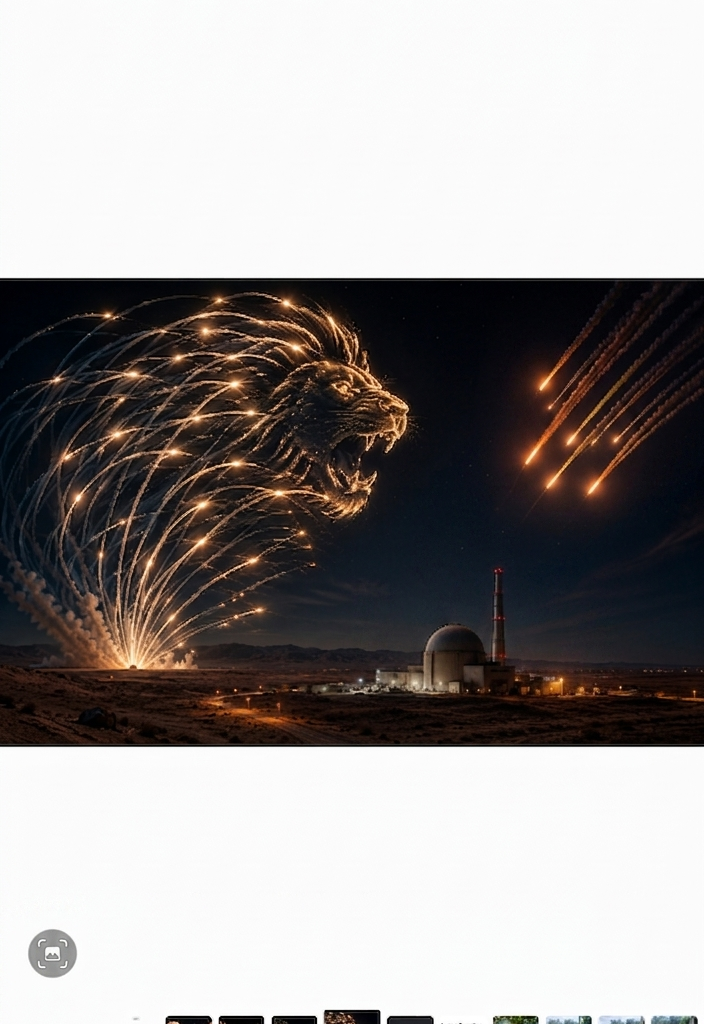
Dimona is among the most heavily protected sites in Israel, defended by Arrow batteries and by hardened, deeply buried construction, with its plutonium separation facility built several floors underground. The reactor has operated for more than sixty years and holds an estimated eight hundred kilograms of plutonium; its spent fuel, rather than the reactor core, represents the principal radiological hazard.
A successful strike would not produce a Chernobyl-scale disaster, because Dimona is a small research reactor rather than a large power plant and does not store finished weapons. The consequences would still be serious. A breach of containment would resemble a large radiological weapon, releasing a fraction of the material released at Chernobyl but enough to disperse long-lived contamination beyond Israel’s borders, exposing populations in the West Bank, Jordan and potentially Egypt depending on prevailing winds.
Even a strike that caused no radiological release would carry major strategic consequences. Iranian commanders have already described their threats against nuclear sites as proportionate retaliation. A government facing collapse, with few options remaining, could direct its last accurate missiles at the one target whose penetration alone would damage both Israel’s deterrent posture and its standing.
Israel Has Begun, But Not Nearly Enough
Israel is responding. It signed an agreement in December 2025 to expand Arrow 3 production and accelerated it again in April 2026, and in December 2025 it fielded Iron Beam, the first operational high power laser interceptor. Iron Beam, however, engages rockets, drones and mortars at short range and offers no defense against a ballistic missile aimed at the Negev.
The Arrow system itself is developed and produced jointly with the US Missile Defense Agency, so even Israel’s effort to reduce its dependence relies on American production. Israeli officials maintain that the country holds sufficient interceptors and describe the buildup as preparation for an extended campaign, though preparation does not yet amount to sufficiency.
One Point, and Then a Whole Country
All of the above concerns a single installation. The defense of one reactor, with consequences that extend across national borders, is already challenging with American assistance and would be harder without it. Defending the rest of Israel, its cities, its coastline and its population, against the same uncapped and evolving arsenal would be a substantially larger task.
Israel should prepare to defend Dimona, and the rest of its territory, on its own. The United States may never reduce its support. But Israel cannot build its national defense on that assumption, because the most capable element of that defense has never been Israel’s to keep.
Céleo Ramírez is an ophthalmologist and scientific researcher based in San Pedro Sula, Honduras where he devotes most of his time to his clinical and surgical practice. In his spare time he writes scientific opinion articles which has led him to publish some of his perspectives on public health in prestigious journals such as The Lancet and The International Journal of Infectious Diseases. Dr. Céleo Ramírez is also a permanent member of the Sigma Xi Scientific Honor Society, one of the oldest and most prestigious in the world, of which more than 200 Nobel Prize winners have been members, including Albert Einstein, Enrico Fermi, Linus Pauling, Francis Crick and James Watson.
He is also the author of two books on the ethical and human dimensions of artificial intelligence: Algorithmic Psychopathy: The Dark Secret of Artificial Intelligence, endorsed by Dr. David L. Charney, M.D., psychiatrist, founder of the National Office for Intelligence Reconciliation (NOIR), and advisor on U.S. intelligence security, and AI Displacement: 12 Human Stories of Job Loss in the Age of AI. Both are available on Amazon.