
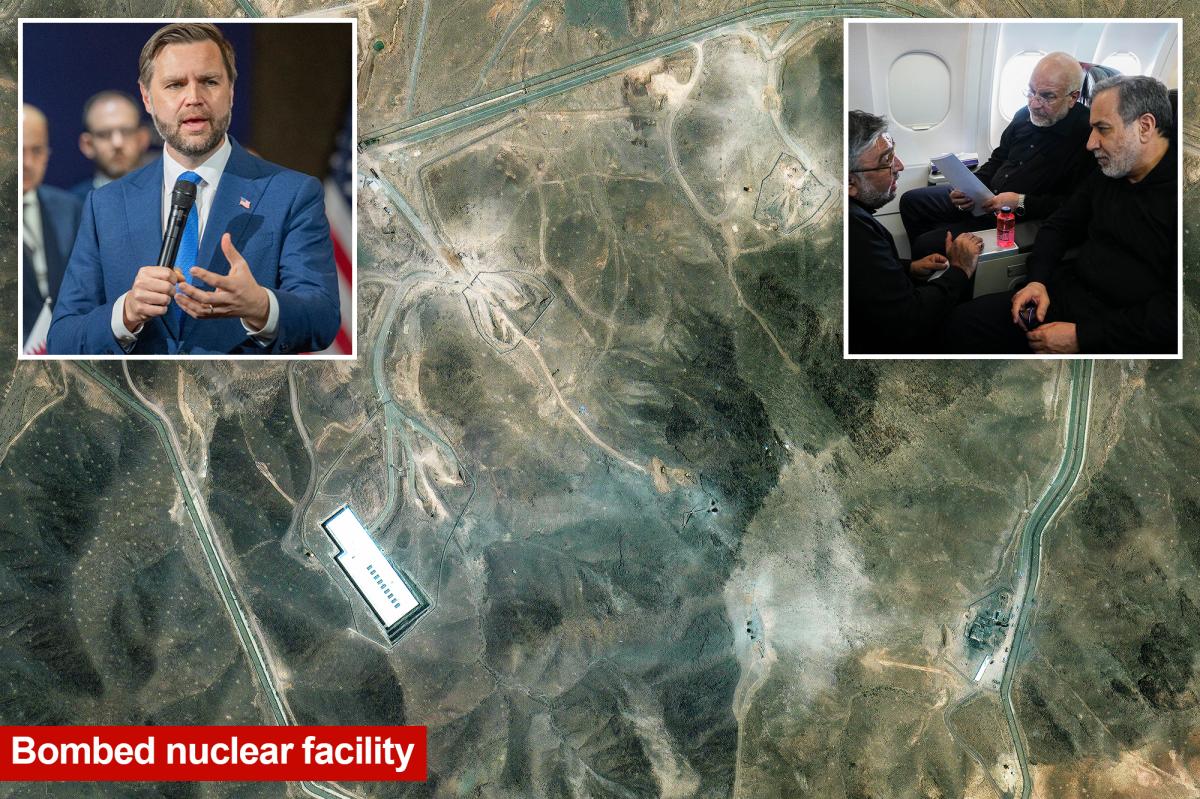
Iran will allow United Nations nuclear inspectors into the country following two days of talks in Switzerland, Vice President JD Vance announced Monday — despite Iran putting out mixed messaging.
“The Iranians have agreed to invite IAEA inspectors back into their country,” Vance told reporters in Lucerne before returning to Washington. “That is a major milestone for the American people and the first step in permanently denuclearizing, or permanently ending a nuclear weapons program in Iran, and that’s exactly what we want to do. That’s exactly what we asked to happen.”
Inspectors from the International Atomic Energy Agency have entered Iran since last year’s 12-day war between Israel and the Islamic Republic.
However, Iran has refused access to three nuclear facilities bombed by the US on June 21, 2025, where nearly 1,000 pounds of highly enriched uranium is believed to be buried.
Vice President JD Vance spent two days in Switzerland for talks with Iranian officials. POOL/AFP via Getty Images
Foreign Ministry spokesman Esmail Baghaei indicated Monday that the status quo would not change, telling state-run IRNA that “Iran’s interactions with the agency, in line with its obligations under safeguard agreements, will continue according to the existing framework.”
The semi-official Tasnim News Agency added: “The issue of granting permission for IAEA inspectors to enter Iran was not approved by the Iranian negotiating team or by responsible government officials.”
“We laid a very good foundation for a successful final deal,” Vance insisted.
“The final deal is the house. We set the foundation, we haven’t built the house, but we’ve laid a successful foundation to get to a good place for the American people.”
Vance acknowledged that working with the Iranians can be “extremely confusing,” addressing reporters as he boarded Air Force 2 to return to Washington.
“I’ve spent a lot of time dealing with the Iranians over the last few months. Sometimes I find them extremely confusing as negotiators,” he said, adding that he still felt “like we’re making progress.”
President Trump appeared to respond to Iran’s public protestations to the inspections, posting to Truth Social that “everybody is fully aware that Iran will agree to have Major Weapons Inspections in order to ensure ‘Nuclear Honesty’ long into the future.”
The vice president also claimed Iran and the US had established “mechanisms” to resolve disputes over the Strait of Hormuz as well as the latest cease-fire between Israel and Hezbollah in Lebanon — which appeared to be holding as of Monday morning.
Vance did not elaborate on what those “mechanisms” were beyond “actually talking to each other and figuring out how to stop the shooting.” However, a joint statement by mediators from Pakistan and Qatar said a “de-confliction cell” involving the US, Iran, and Lebanon — but apparently not Israel or Hezbollah — would be created to “ensure the adherence of the termination of military operations in Lebanon.”
A satellite image shows the Fordow nuclear complex in Iran after US strikes in June 2025. DigitalGlobe/Getty Images
The vice president further stated that any Iranian assets that are unfrozen as the result of a final peace deal could be used to purchase American soy, corn and wheat “for the benefit of the Iranian people.”
Vance credited President Trump’s son-in-law Jared Kushner with coming up with the idea alongside the Qataris, calling it “a classic Trump deal, where if Iranian assets are ever unfrozen, they’re going to go to make American farmers richer and to feed the Iranian people.
“That’s a very, very good and very classic Trump deal that’s great for our people, great for the people of Iran, and fundamentally, again, will contribute to this regional security architecture that we’ve built, and that we’re going to work very hard to ensure that it endures,” he added.
Iranian sources pushed back on the assertion, calling it “Western propaganda.”
“Iran is not planning to purchase US agricultural goods, and there were no discussions yesterday regarding IAEA inspectors coming to Iran,” Mohammad Marandi, an Iranian professor closely linked to the regime, posted to X.
Vance did not mention concrete agreements reached on the nuclear issue — Trump’s north star for the talks. While the MOU committed the US and Iran to discussing the degradation of enriched uranium on Iranian soil, no breakthrough on the topic was announced in the readouts of the talks.
Also not in the US-Iran agreement: restrictions on Iran’s ballistic missile stockpile, which threaten not just Israel but also Gulf allies in the region.
Vance’s comments Monday followed a series of blistering statements from Trump Sunday, including a threat to seize the Strait of Hormuz and “blow the s–t out of” Iran.
Speaker of the Iranian Parliament Mohammad Bagher Ghalibaf (center) and Iran Foreign Minister Abbas Araghchi (right) confer on a flight to Zurich Sunday. Office of Iranian Parliament Speaker/AFP via Getty Images
The VP confirmed Monday that the comments by the president had caused the Iranians to “threaten to walk out, or at least there were social media threats that they would walk out, but we were negotiating well past 1 in the morning yesterday, so they didn’t walk out, and their technical team is still here.”
Vance ultimately shrugged off the comments, telling reporters: “What we told the Iranians yesterday is, ‘When you guys engage in what us millennials might call trash talk, you can’t expect the president of the United States not to respond and not to correct the record,’ so when they say things that aren’t true, the president is going to respond to it, I’m going to respond to it, Americans are going to respond to it.
“When they make threats that aren’t rooted in reality, they have to accept that the president of the United States is actually going to set the record straight. That’s all that happened. So, yes, there was a little bit of threatening, there was a little bit of whining, but at the end of the day, the talks continued, and we made great progress.”
The Pakistan-Qatar joint statement confirmed that while high-level negotiations had wrapped up, technical talks would continue in Switzerland for the rest of this week, with Kushner and special envoy Steve Witkoff taking the lead for the Americans.
An interim deal to end more than three months of fighting between the US and Iran, signed by Trump last week, opens a 60-day window for negotiators to settle the future of Tehran’s nuclear program as well as billions in frozen Iranian assets, among other issues.
With Post wires