

Ukrainian forces conducted another strike near Moscow City on the night of June 21 to 22 — the third strike against Russia’s capital area in the past week.
*
Russian authorities have reportedly been trying to strengthen air defenses covering Moscow City in recent weeks, including possibly at the expense of frontline areas.
*
Ukraine continues to expand the intensity and range of its intermediate- and long-range strike campaign.
*
Ukrainian strikes continue to exacerbate Russian gasoline shortages and inhibit Russian logistics to occupied Ukraine.
*
Ukrainian forces struck a Russian defense industrial enterprise that produces components for Russian cruise missiles and air defenses in Voronezh Oblast.
*
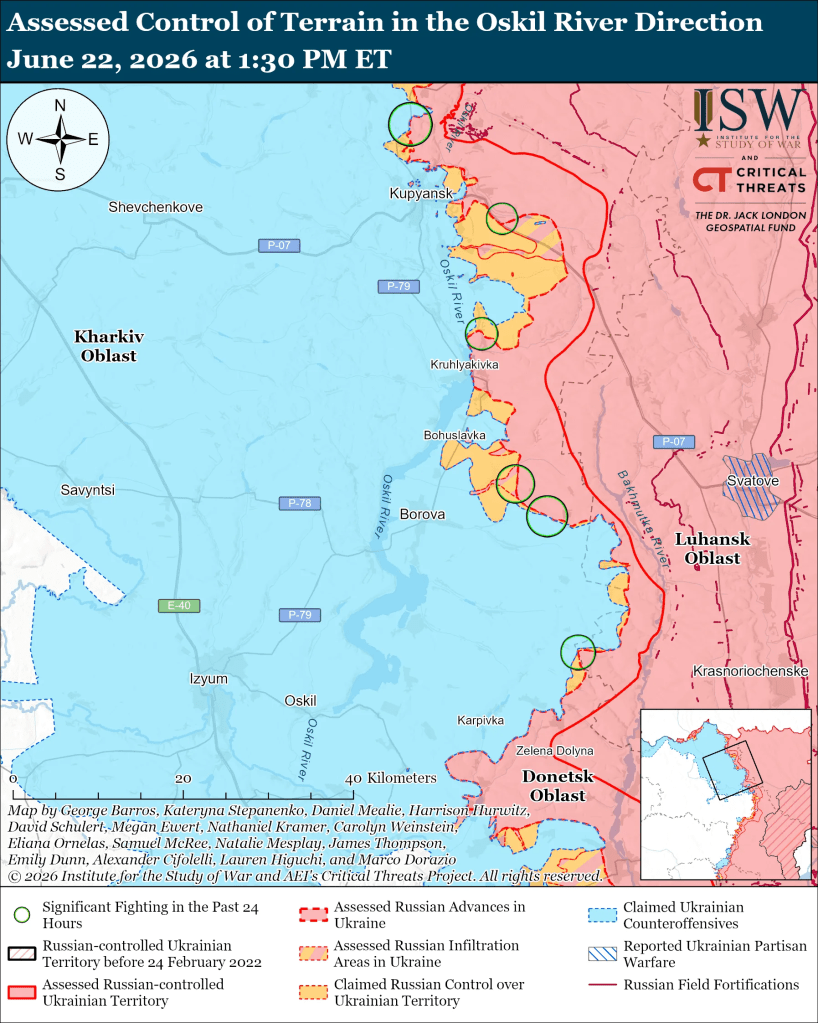
Russian forces recently advanced in the Kupyansk direction.
*
Russian forces launched one missile and 88 drones against Ukraine on the night of June 21 to 22.
*
The Ukrainian Air Force reported that Russian forces launched one Iskander-M ballistic missile from occupied Crimea and 88 Shahed-, Gerbera-, and Italmas-type strike drones and Parodiya-type decoy drones from the directions of Kursk, Oryol and Bryansk cities; Millerovo, Rostov Oblast; Shatalovo, Smolensk Oblast; Primorsko-Akhtarsk, Krasnodar Krai; occupied Hvardiiske, Crimea; and occupied Donetsk City.[66] The Ukrainian Air Force reported that Ukrainian forces downed 79 drones, that the ballistic missile and five drones struck six locations, and that drone debris fell on nine locations. Ukrainian officials reported that Russian strikes damaged civilian, energy, and educational infrastructure in Chernihiv, Mykolaiv, Odesa, Zaporizhia, and Sumy oblasts.[67] Ukrainian drone manufacturer General Chereshnya reported on June 22 that Russian forces struck one of its production facilities at an unspecified location.[68] The Ukrainian Energy Ministry reported that Russian strikes caused power outages in Donetsk, Kherson, Sumy, Kharkiv, Mykolaiv, Chernihiv, and Zaporizhia Oblasts.[69]
Russian forces struck several civilian merchant vessels in the Black Sea on June 21 to 22.
The Ukrainian Navy reported that a Russian drone struck and started a fire on the Turkish-owned Victress vessel that was flying the Panamanian flag.[70] Ukrainian Deputy Prime Minister Oleksiy Kuleba stated that the Russian strike killed one crew member from Egypt on the Panamanian-flagged vessel and caused significant damage to the ship.[71] Kuleba stated that Russian forces also struck vessels that were flying the flags of Palau and Belize on the same night but that the vessels were able to continue their journey.
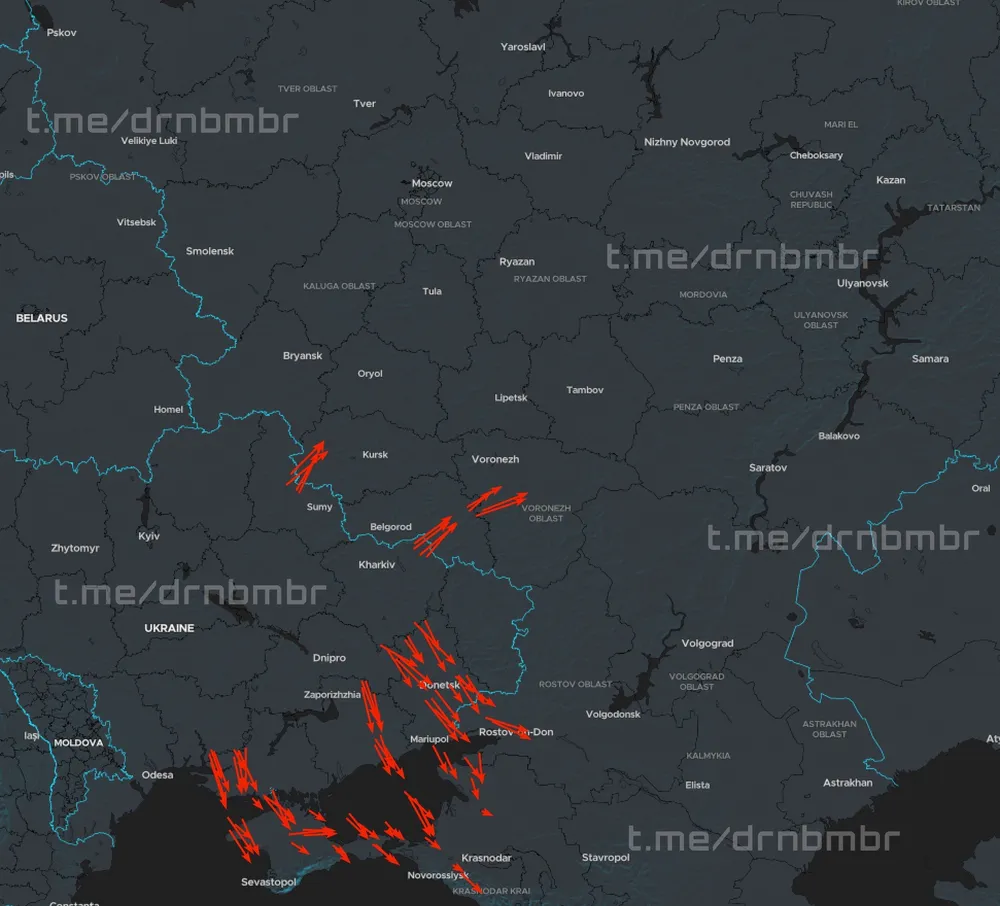
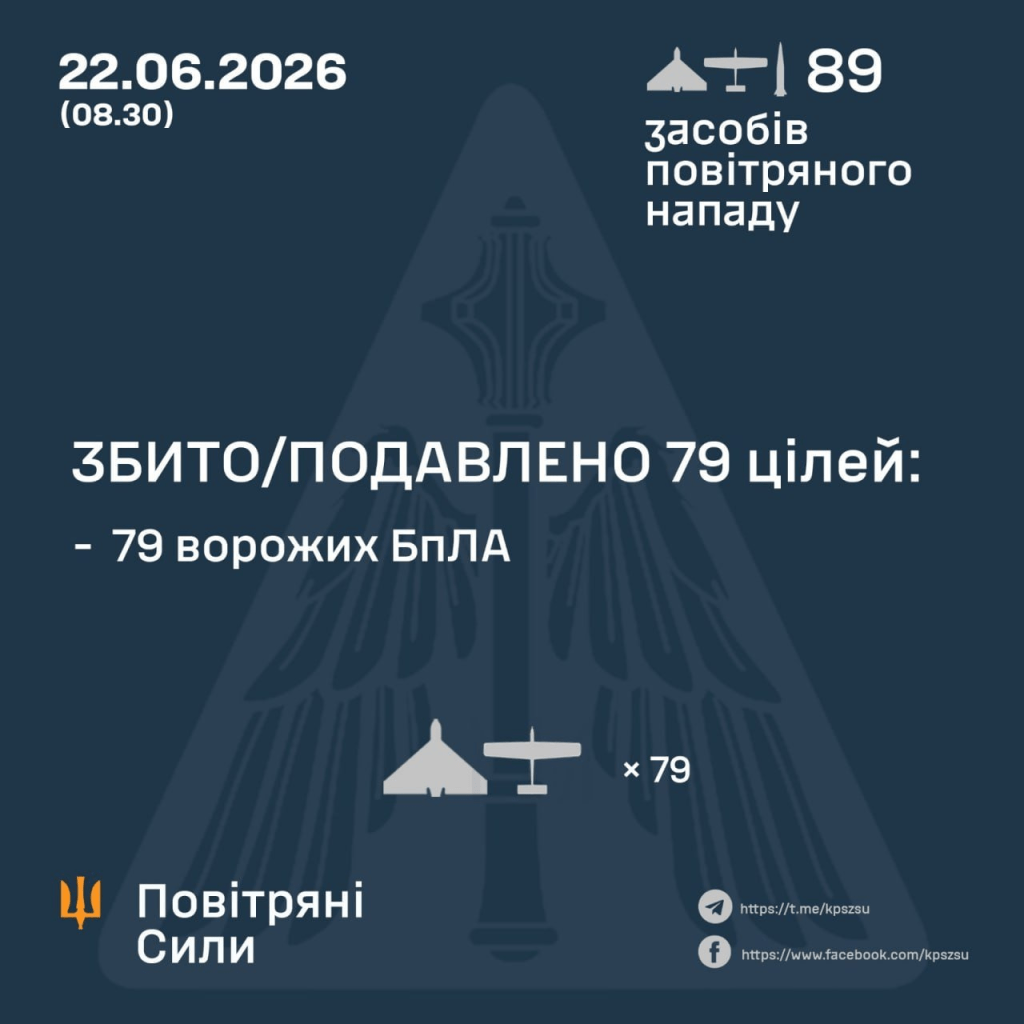 Russia launched 88 attack drones and an Iskander-M ballistic missile overnight, using Shaheds, Gerbera, Italmas and Parodiya decoy drones. Ukraine says 79 drones were shot down or suppressed, though missile and drone impacts were recorded at 6 locations. Ukraine has signed a contract with Germany for the purchase of 600 missiles for Patriot air defense systems.
Ukrainian forces conducted another strike near Moscow City on the night of June 21 to 22 — the third strike against Russia’s capital area in the past week.
The Ukrainian General Staff reported that Ukrainian forces struck the Dubna Space Communications Center in Dubna, Moscow Oblast (just northwest of Moscow City and about 540 kilometers from the Russian-Ukrainian international border).[1] The center is a major ground hub that connects satellites with terrestrial communication networks and manages satellite links across Russia and abroad.[2] Geolocated footage published on June 22 shows smoke rising in Dubna.[3] The Dubna Space Communications Center’s parent company, the State Space Communications Company, reported on June 22 that a large-scale Ukrainian drone strike hit the center but that the strike did not disrupt television broadcasts and communications.[4] Moscow Mayor Sergei Sobyanin claimed on June 22 that Russian forces downed 84 drones en route to Moscow City in the past day and that the drone strikes did not cause any damage.[5] Ukrainian forces recently struck Moscow City, including the Moscow Oil Refinery, on June 15-16 and June 17-18.[6]
Russian authorities have reportedly been trying to strengthen air defenses covering Moscow City in recent weeks, including possibly at the expense of frontline areas.
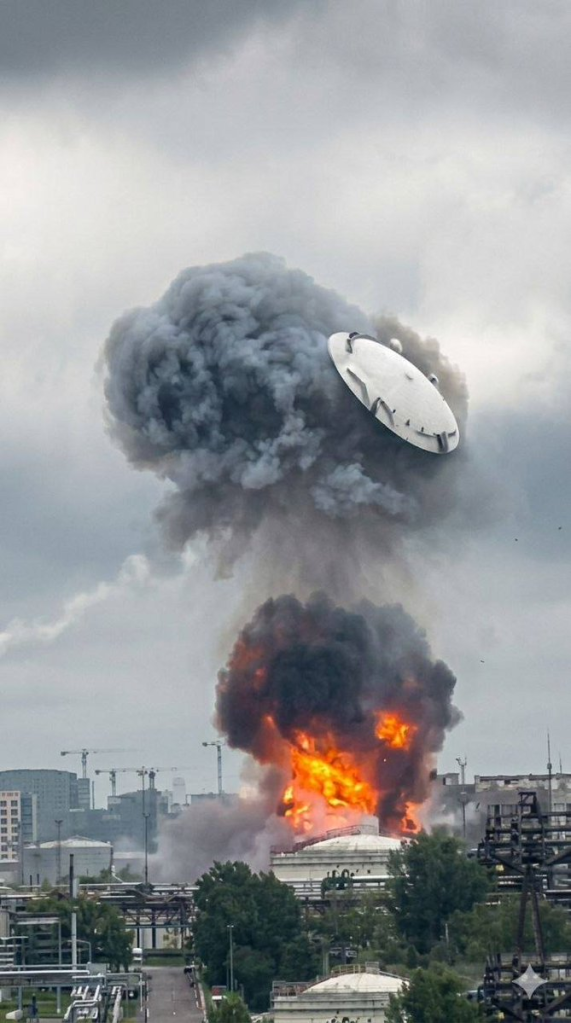
Open-source analysts assessed on June 20 that satellite imagery collected on June 4 suggests Russia started constructing a new S-400 air defense installation at the Moskvoretsky Historical and Nature Park west of Moscow City in late May 2026.[7] The open-source analysts assessed that the size and shape of the construction site are similar to other S-400 sites near Moscow City and noted that the new construction sits on one of the highest elevation points west of the capital. The Telegraph also reported on June 22 that Russia redeployed a Pantsir air defense system from an unspecified area of the frontline and installed it on a tower near the Moscow Oil Refinery in southeastern Moscow City.[8] The Telegraph noted that the Pantsir system includes a protective metal cage similar to those located near the frontline, leading Ukrainian military experts to assess that Russia redeployed the system from the frontline to Moscow City. The Telegraph added that online imagery of the moved Pantsir shows that it has only two of the standard six launch missiles on one side, suggesting that Russia may be suffering from a Pantsir interceptor missile shortage. CBS News recently reported, citing Ukrainian official sources, that Russia is experiencing a shortage of S-300 air defense missiles as Western sanctions have limited Russia’s quantity of key components.[9]
The Telegraph’s report suggests that the shortages may be affecting multiple types of air defense systems. ISW continues to assess that Ukraine’s intensifying long-range and intermediate-range strike campaigns are imposing additional competing requirements for air defenses across Russia’s operational and deep rears, compounding Russia’s air defense challenges given the vast amount of land and large number of facilities Russia must protect.[10] Ukraine’s strike campaign has forced Russia to make difficult decisions about where to allocate its limited air defense assets.[11] Ukrainian strikes disabling Russian air defense radars over the past months are also likely contributing to Russia’s inability to sufficiently repel strikes even in areas with increased air defense protection.
Ukraine continues to expand the intensity and range of its intermediate- and long-range strike campaign.
Russian opposition source Meduza analyzed coordinates of Ukrainian strikes against trucks and other military targets in occupied Ukraine from open-source geolocation organization GeoConfirmed since April 2023 and found that Ukrainian forces greatly increased their median strike depth in May and June 2026 to several tens of kilometers from several kilometers in previous months.[12] French open-source analyst Clement Molin verified footage confirming that Ukrainian forces struck at least 500 Russian trucks and vehicles in occupied Ukraine between May 1 and June 18 and that geolocated footage confirms 270 such Ukrainian strikes since January 2026.[13] Meduza noted that Ukrainian forces significantly increased their strikes against rear areas of the Russian Eastern Grouping of Forces’, which is operating in the Hulyaipole and Oleksandrivka directions, including heavily targeting sections of the M-14 Rostov-Crimea highway in southwestern Donetsk Oblast and eastern Zaporizhia Oblast, in May 2026 but have reduced the intensity of their strikes in these areas in June 2026 as Ukrainian forces have shifted their strikes westward toward occupied Kherson Oblast and occupied Crimea. Meduza reported that Ukrainian forces have started to expand their strike campaign against Russian near rear areas in the Pokrovsk, Kostyantynivka, and Slovyansk directions. ISW has observed geolocated evidence that Ukrainian forces conducted at least 210 intermediate-range strikes in occupied Ukraine in May 2026 and 145 thus far in June 2026.
Ukrainian forces are also expanding the range of their long-range strike capabilities, with Ukrainian President Volodymyr Zelensky stating on June 21 that new Ukrainian Fire Point drones recently struck targets up to 2,070 kilometers in depth and that Ukrainian drones will soon be able to strike targets up to 3,000 kilometers deep.[14] Ukrainian forces have significantly increased the range, volume, and intensity of their long-range strike campaign against Russian oil infrastructure and military assets since March 2026.[15] ISW has observed geolocated evidence that Ukrainian forces conducted at least 18 long-range strikes against Russian oil infrastructure in Russia in April 2026, 33 in May 2026, and 28 thus far in June 2026.
Ukrainian strikes continue to exacerbate Russian gasoline shortages and inhibit Russian logistics to occupied Ukraine. Ukraine’s intensified strike campaign against Russian oil refineries and logistics since March 2026 has led to gasoline shortages across occupied Ukraine and in many Russian regions, and Russian authorities have thus far struggled to adjust and address these shortages.[16] …
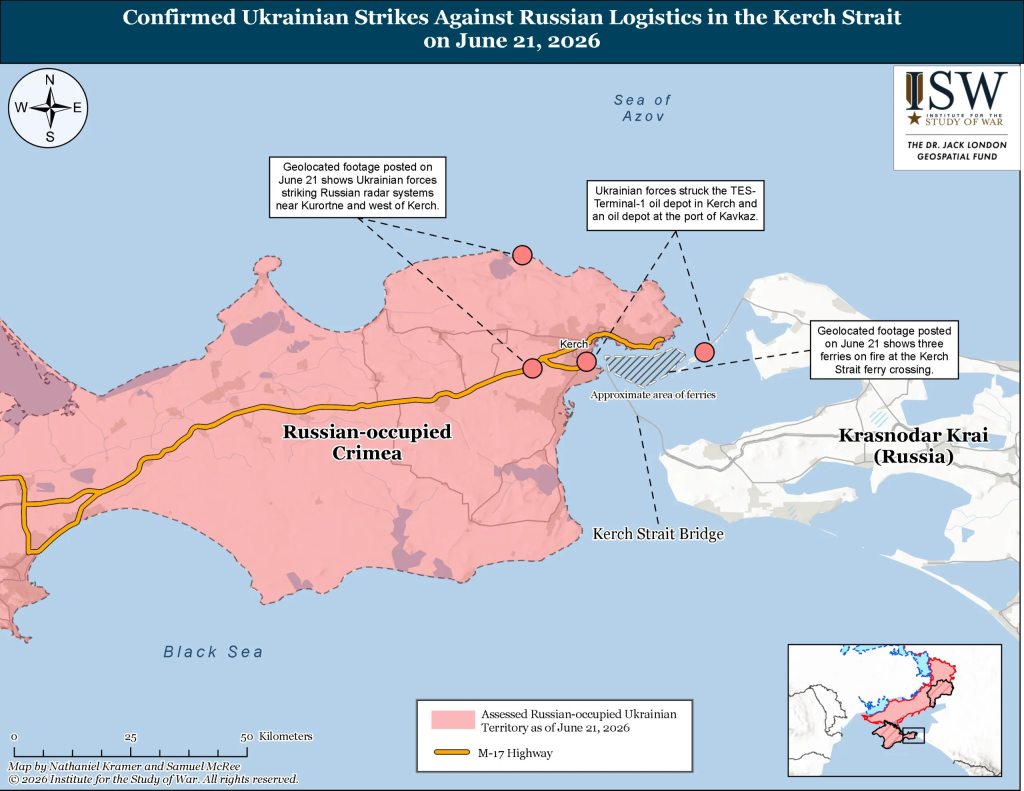
Russian authorities are also introducing more restrictions on gasoline purchases and encouraging civilians to reduce their private travel to combat the shortages.[19] Russian occupation authorities are also further restricting travel along key logistics arteries into occupied Crimea. Russian authorities temporarily closed traffic across the Kerch Strait Bridge on June 22, likely due to nearby Ukrainian strikes.[21] Crimean occupation authorities also recently shut off gasoline sales to any non-state entities and suspended ferry operations.[22] Crimea occupation governor Sergei Aksyonov announced on June 22 that authorities are suspending all children’s camps in occupied Crimea until September 1, 2026.[23]
On the night of June 23, explosions were heard in several areas of occupied Crimea due to an attack by Ukrainian drones. Traffic on the Crimean Bridge was blocked, and Russian air defense unsuccessfully attempted to shoot down the drones.
Ukraine Warns Russia at UN to Leave Occupied Lands Before It Is Too Latehttps://www.europesays.com/people/125256/Ukraine’s ambassador to the United Nations delivered a blistering warning to Russia at the Security Council, saying Moscow’s…
— (@eu-people.bsky.social) 2026-06-23T02:50:18+00:00
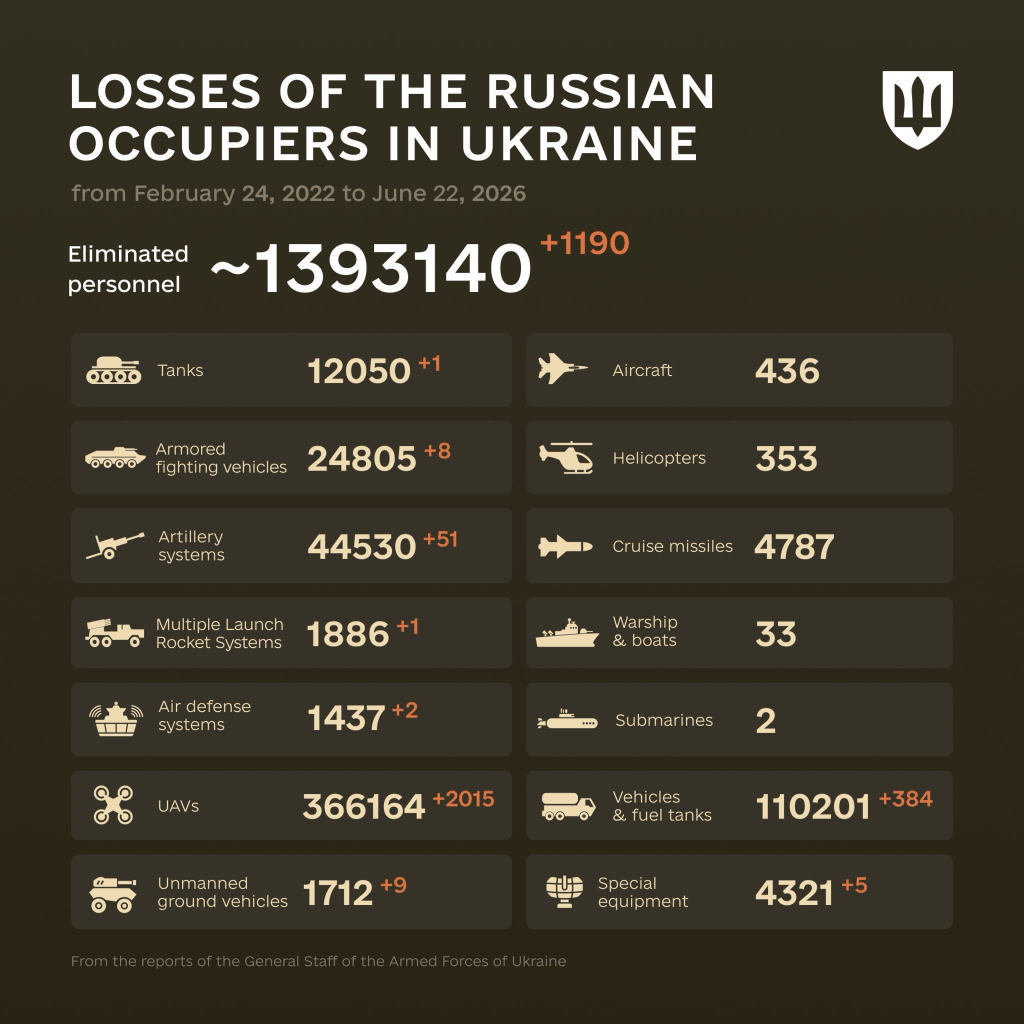
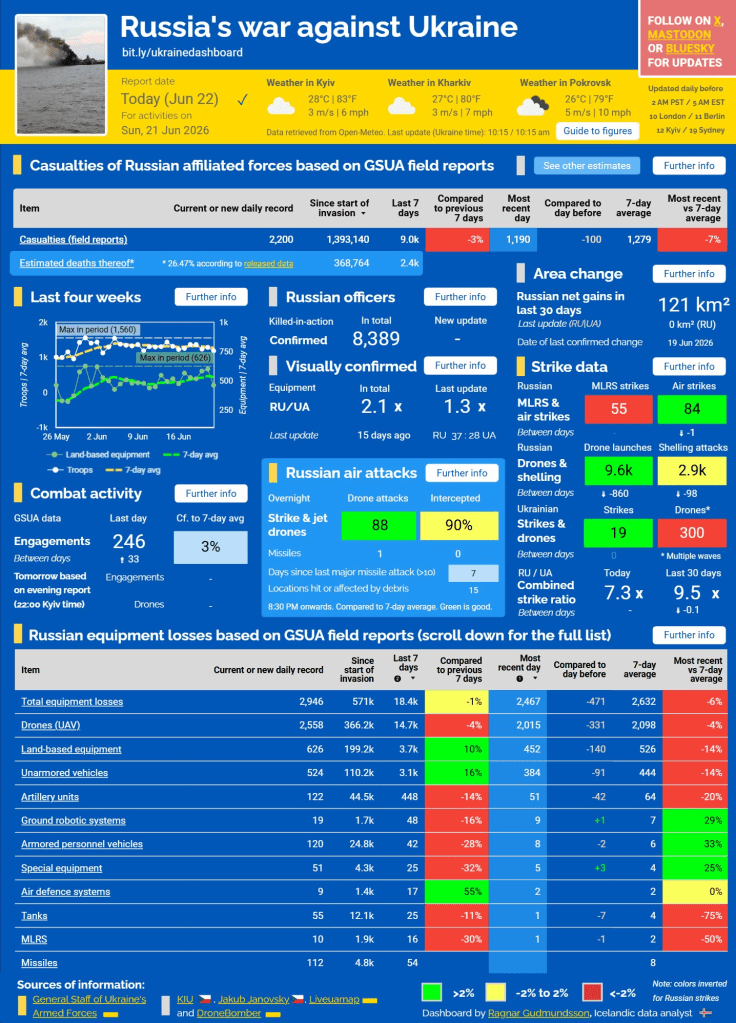
General Staff of the Armed Forces of Ukraine
Operational update as of 22:00 on June 22, 2026, regarding the Russian invasion.
In total, 158 combat engagements have taken place since the start of this day. The enemy carried out 47 airstrikes and dropped 150 guided bombs. In addition, it deployed 8,862 kamikaze drones and carried out 1,818 shelling attacks on populated areas and the positions of our troops.
Two combat engagements with the enemy were recorded in the Northern Slobozhanshchyna and Kursk sectors. The enemy carried out 54 shelling attacks on populated areas and our troops’ positions, including two using multiple launch rocket systems.
Over the past 24 hours, in the Southern Slobozhanshchyna sector, the enemy launched nine assaults on the positions of our units near the settlements of Vilcha, Kozacha Lopan, Symynivka, Pokalyane, Bochkove, Kolodyazne, and in the area of the settlement of Starytsia.
In the Kupiansk sector today, the enemy attacked the positions of the Defense Forces twice in the direction of Kucheriivka and Hlushkivka.
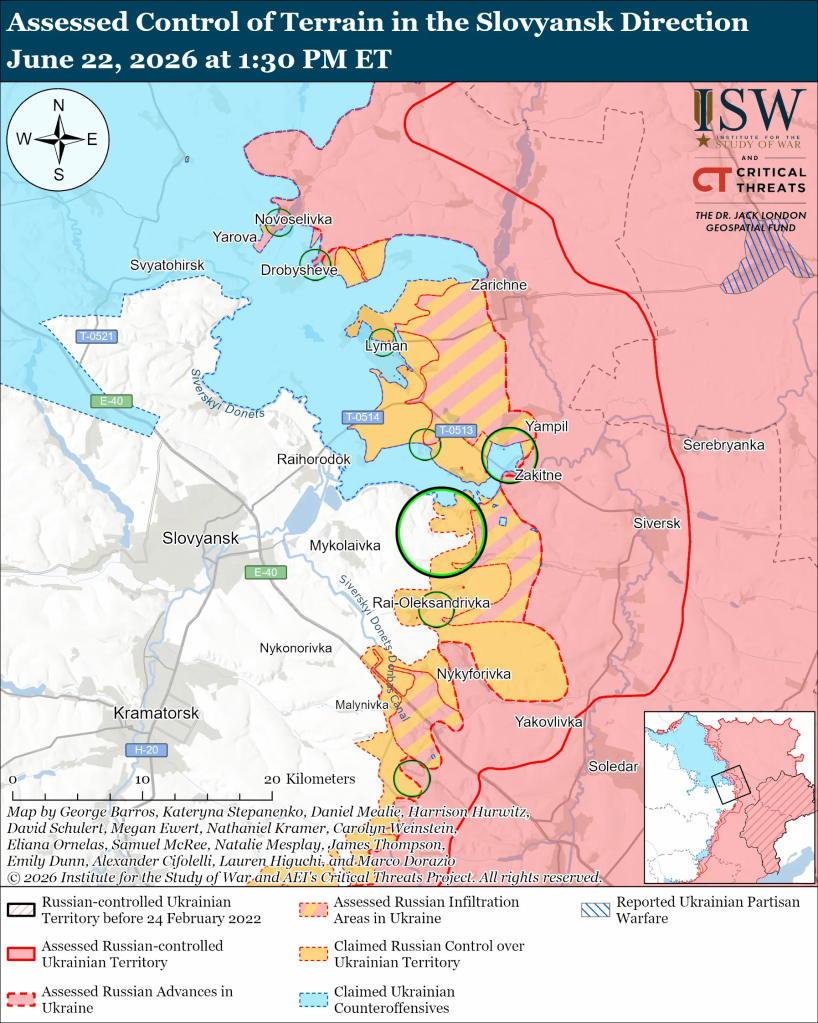
To advance in the Lyman sector, the invaders carried out 12 attacks in the areas of the settlements of Novoselivka, Novomykhailivka, and toward Borova, Drobysheve, Ozernyi, and Lyman. Two firefights are still ongoing.
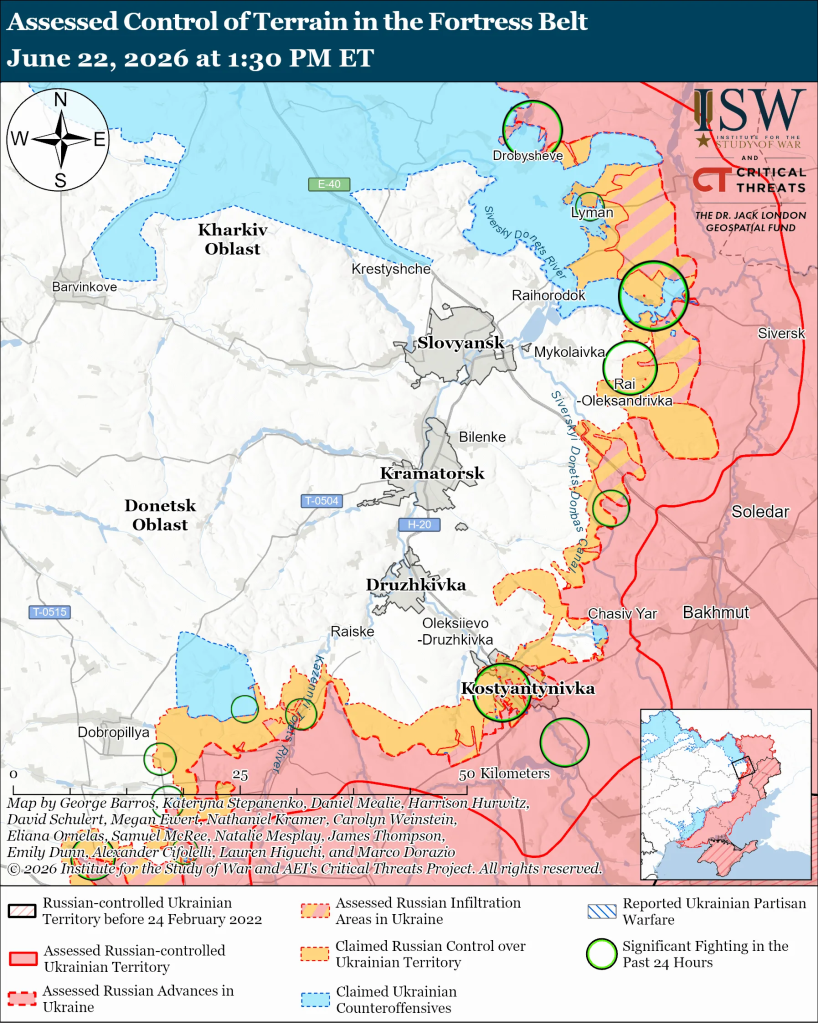
In the Sloviansk sector, the Defense Forces repelled 15 attempts by the invaders to advance near Riznykivka, Kaleniky, Zakitne, and toward the settlements of Rai-Oleksandrivka and Kryva Luka.
One enemy assault was recorded in the Kramatorsk sector, where the enemy attempted to dislodge our defenders from their positions near Nikiforivka.
In the Kostiantynivka sector, the Defense Forces repelled 11 enemy assaults near the settlements of Kostiantynivka, Ivanopillia, Pleshchiivka, Illinivka, and Sofiivka.
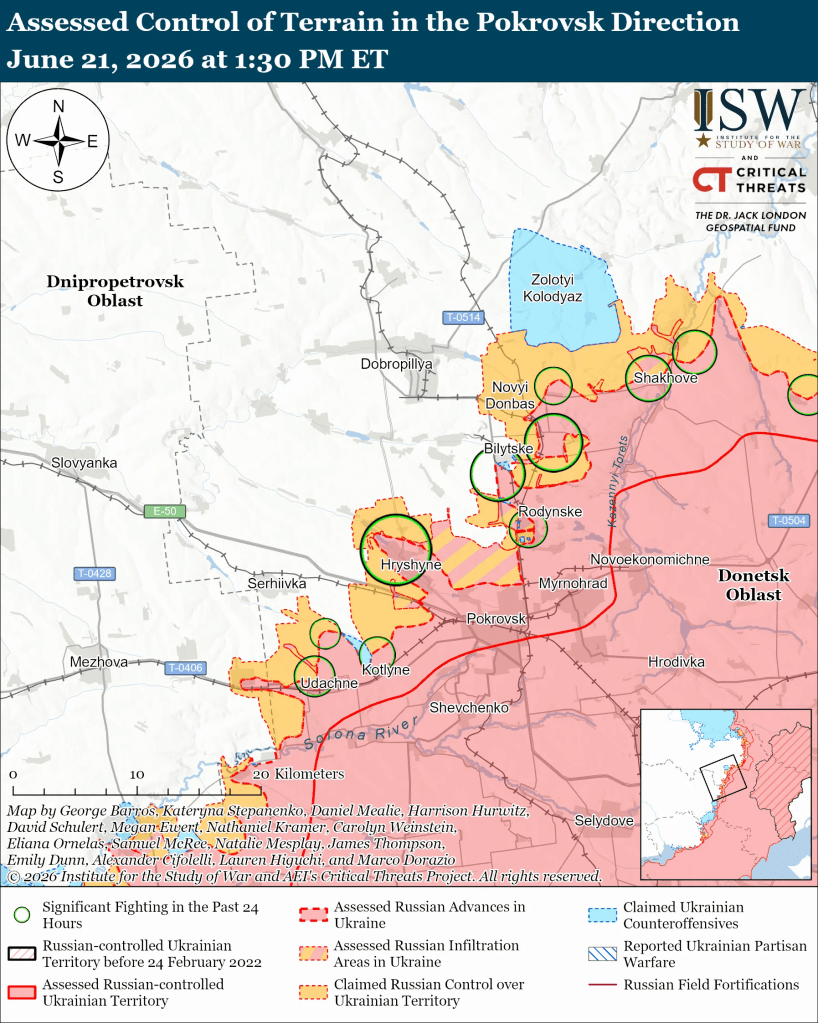
The enemy carried out a total of 25 attacks in the Pokrovsk sector. The occupiers attempted to advance in the areas around the settlements of Rodynske, Vasylivka, Kotlyne, Udachne, Novooleksandrivka, and Dorozhne, as well as toward the settlements of Serhiivka, Muravka, Shevchenko, Vilne, and Matyashieve. Two firefights are still ongoing.
According to preliminary estimates, 30 occupiers were killed and 10 wounded here today; four enemy vehicles and six pieces of specialized equipment were destroyed. An enemy UAV command post, four artillery systems, four vehicles, and 109 enemy shelters were damaged. A total of 245 unmanned aerial vehicles of various types were destroyed or neutralized.
In the Oleksandrivka sector, our defenders repelled three enemy attacks in the areas of Sichneve, Verbove, and Novozaporizhzhia.
In the Huliaipole sector, the occupiers launched 18 attacks near the settlements of Dobropillia, Zlagoda, and Olenokostiantynivka, as well as toward Huliaipole, Hirky, Vozdvyzhivka, Tsvitkove, Staroukrainka, and Charivne.
In the Orikhiv sector, the enemy launched a single assault on the positions of our defenders in the Stepove area.
Since the start of the day, no enemy assaults have been recorded in the Dnipro sector.
In other sectors, there have been no significant changes in the situation.
Let’s defeat the enemy and bring our Victory closer! Glory to Ukraine!
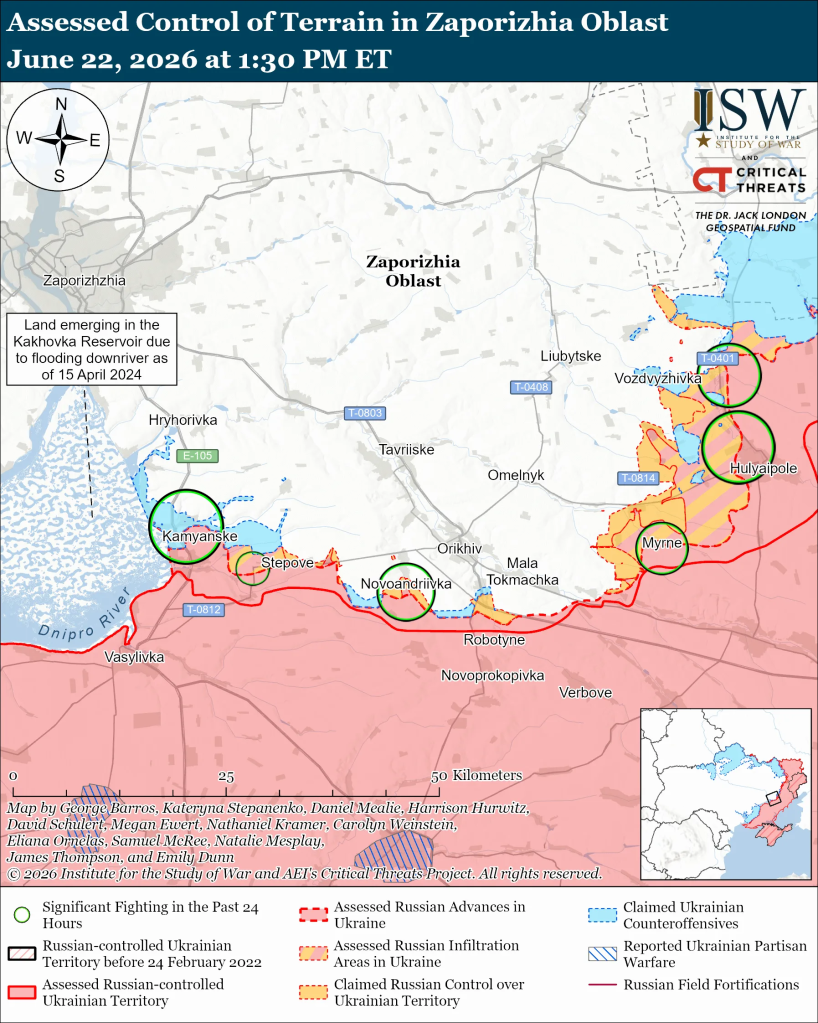
Ukraine’s Air Force just cut a key Russian supply route through occupied southern Ukraine. The strike hit the bridge over the Karachekrak river in occupied Vasylivka, Zaporizhzhia region – a crossing on the E105 highway, a main road Russia uses to move forces through the south.
— Meanwhile in Ukraine (@meanwhileua.bsky.social) 2026-06-22T23:20:42.404Z
We’ll get straight to the point: The financial hardships that Daily Kos is facing this year are tough.
We continue to be paywall-free. We continue to be supported by our readers, not billionaires or corporations. But we need to bring in more revenue. We are leaning on our community more than ever to help make ends meet.
Power matters.