
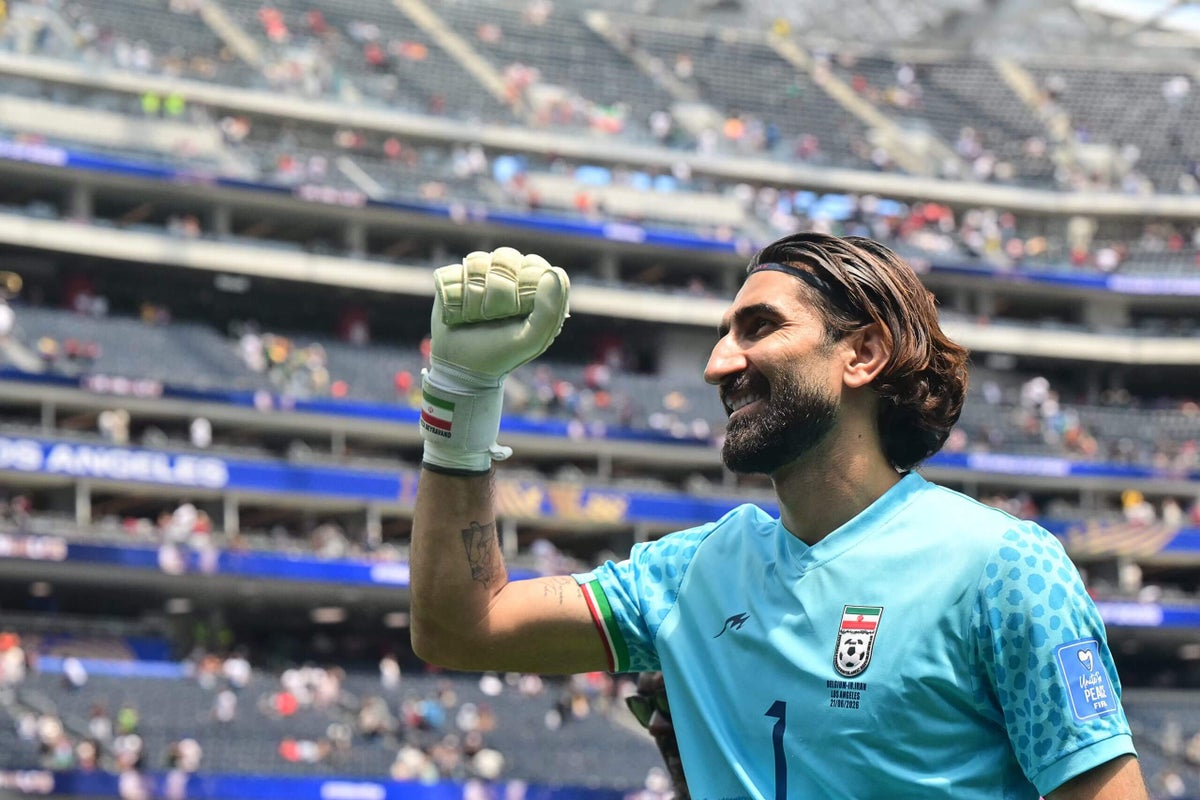
Alireza Beiranvand was 12 when everything changed.
The young boy decided to run away from home, giving up on his family, his school, the life he knew. His breaking point came when his father, Mortaza, told him that football was no job; it was a game. Worse still, football detracted from work.
To ram home his point, the father threw out Alireza’s training top and his new gloves, which Alireza had bought after his local side’s goalkeeper was injured and he volunteered to step in, desperate to play.
The young Beiranvand, like all children, loved games. One of his favourites was dal paran — a traditional folk competition which involves hurling stones off the side of a mountain. He had instinctive hand-eye co-ordination, and the game gave him upper-body strength. He made a natural goalkeeper.
He was the eldest child in a Kurdish nomad family from western Iran’s Zagros mountains, moving around Iran’s countryside to find grassland for their sheep. Aged three, Alireza began shepherding.
It was the tiny village of Sarab-e Yas — home to 2,500 residents and 300 miles south-west of Iran’s capital Tehran — where Alireza’s family settled, and where he could finally start playing with a football team. But then Alireza’s father denied him that opportunity, so the young boy asked a relative for money, took the next six-hour bus to Tehran, and never looked back.
Two decades later, Alireza Beiranvand is playing in his third World Cup for Iran, won the Man of the Match award in Sunday’s 0-0 draw against Belgium, and has secured two Guinness World Records.
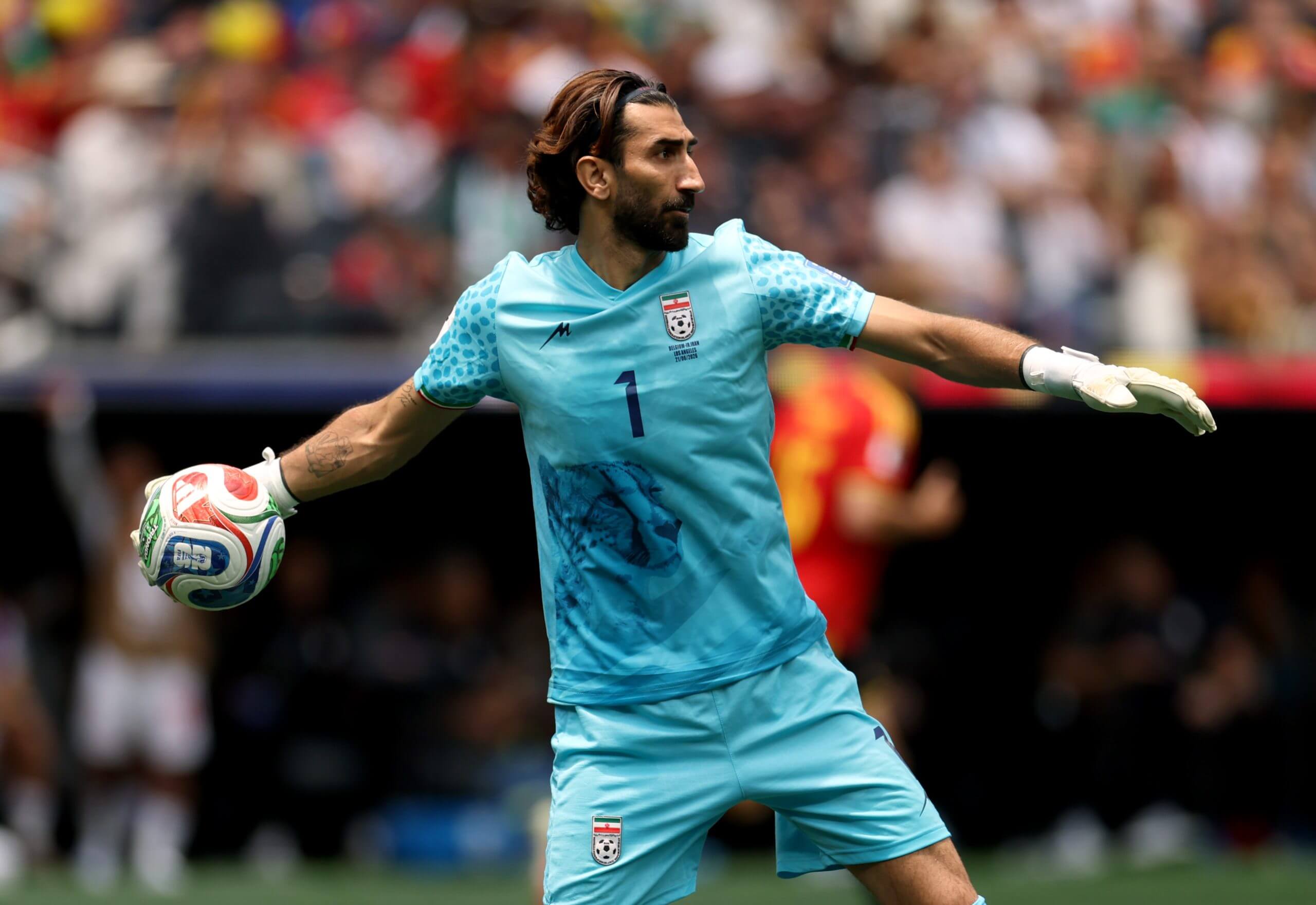
Alireza Beiranvand in action against Belgium (Harry How/Getty Images)
Beiranvand’s rise to stardom was not a fairytale and the remainder of his childhood years were tough. He spoke Laki, a Kurdish dialect with distinct differences from the predominant Persian language in Iran’s capital. But the young boy had more pressing concerns; he had neither money nor a place to sleep.
The future goalkeeper had, however, been conditioned by his nomadic family upbringing. He was used to moving from village to village and a life of constant work. He slept outside the training grounds of local football clubs and sought to earn trials, hoping for his big break.
Beiranvand would wake up to find coins left beside him by passers-by, money which would supplement his part-time work which ranged from being a street cleaner to shifts in a dressmaking factory and, later, in a carwash. Legendary Iran striker Ali Daei, widely recognised as one of Asia’s greatest ever soccer players, was once a client but Beiranvand felt too ashamed to introduce himself.
At 16, Beiranvand got his first big break. He joined the youth academy of the now-defunct Naft Tehran, at the time a rising power in the capital and a club bankrolled by the National Iranian Oil Company. One coach, aware of his homelessness, offered him the chance to sleep in a prayer room.
Yet Beiranvand still had no money, so he worked part-time in a pizzeria. When the youth team’s manager — unaware of Beiranvand’s background — came in to buy a pizza, Beiranvand panicked, refusing to be seen at the till. He was told not to return to work the following week.
Six years after moving to Tehran, at the age of 18, Beiranvand’s life began to take shape. He earned a professional deal at Naft Tehran and had enough money to find a home. He married his wife, Akram, with whom he now has two children.
Beiranvand soon became first-choice goalkeeper at Naft Tehran and won the first of his 88 caps for Iran in 2015. His shot-stopping ability earned the 1.95m goalkeeper the nickname ‘The Wall of Persia’. In the 2018 World Cup, he conceded just two goals across Iran’s three games against Morocco, Spain and Portugal — famously saving a Cristiano Ronaldo penalty.
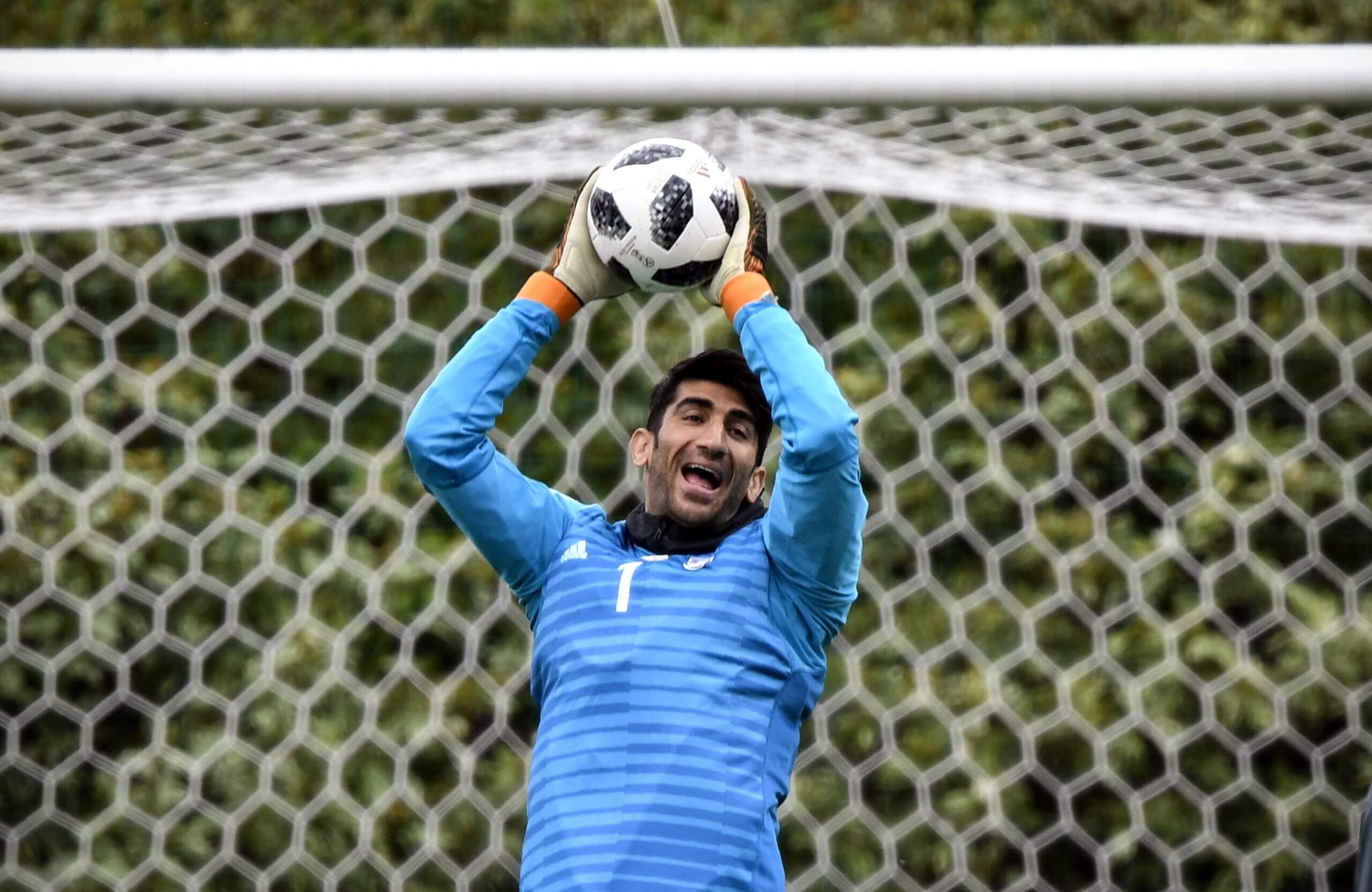
Alireza Beiranvand in training at the 2018 World Cup in Russia (Alexander Nemenov/AFP via Getty Images)
In October 2019, Iranian authorities allowed women to purchase tickets for Iran’s match against Cambodia at Tehran’s Azadi Stadium. It was the first time women had been allowed into a men’s match by the nation’s regime with Beiranvand’s wife Akram was one of the 3,000 women permitted to attend. “I hope one day all the women in my country can cheer on the national team and even our beloved club team together and watch games in the stadium,” Akram told Iranian media outlet Footballi.net.
The goalkeeper publicly supported his wife’s comments.
By this stage, Beiranvand had joined Tehran giants Persepolis and won four successive Persian Gulf Pro League titles, as well as reaching the AFC Champions League final. Short stints at Belgian club Royal Antwerp and Boavista in Portugal followed, before a return to Persepolis and two more league titles.
True to his childhood, Beiranvand’s nomadic nature took an unexpected turn in the summer of 2024. In a story that rocked Iranian football, he opted to forfeit the final year of his contract at Persepolis to join Tabriz-based Tractor, the club associated with Iran’s Azerbaijani Turkic population. Beiranvand’s first season at the club, in 2024-25, brought Tractor’s first league title and the goalkeeper’s seventh.
Yet Beiranvand’s life has been defined by his childhood years. His has been a constant battle to prove himself, an openness to a nomadic career and a refusal to allow criticism from others to define his decisions. He has forged his own path.
And, aside from league titles, he has other achievements to his name.
In October 2016, in a match against South Korea, Beiranvand threw the ball over 61 metres (200 feet) — the furthest recorded distance a football has been thrown in a competitive match. Those childhood days of playing dal paran shaped his playing style.
Remarkably, the goalkeeper also holds the Guinness World Record for the longest football drop kick, too, at over 78 metres (256 feet).

Beiranvand’s point-blank save earned Iran a point against Belgium (Frederic J. Brown / AFP via Getty Images)
Beiranvand has already produced one of the saves of this World Cup. In Sunday’s draw against Belgium, the goalkeeper — already on the ground — produced a stunning reaction stop to deny Maxim De Cuyper’s powerful strike from point-blank range.
“He’s a good goalie and today he proved it again,” Belgium and Real Madrid goalkeeper Thibaut Courtois said of Beiranvand, awarded Man of the Match, after the game.
Against Belgium, Beiranvand was on the ground and picked himself up to produce a defining moment. It was an action that has defined his life and career — and it all stemmed from one bold decision made at the age of 12.