
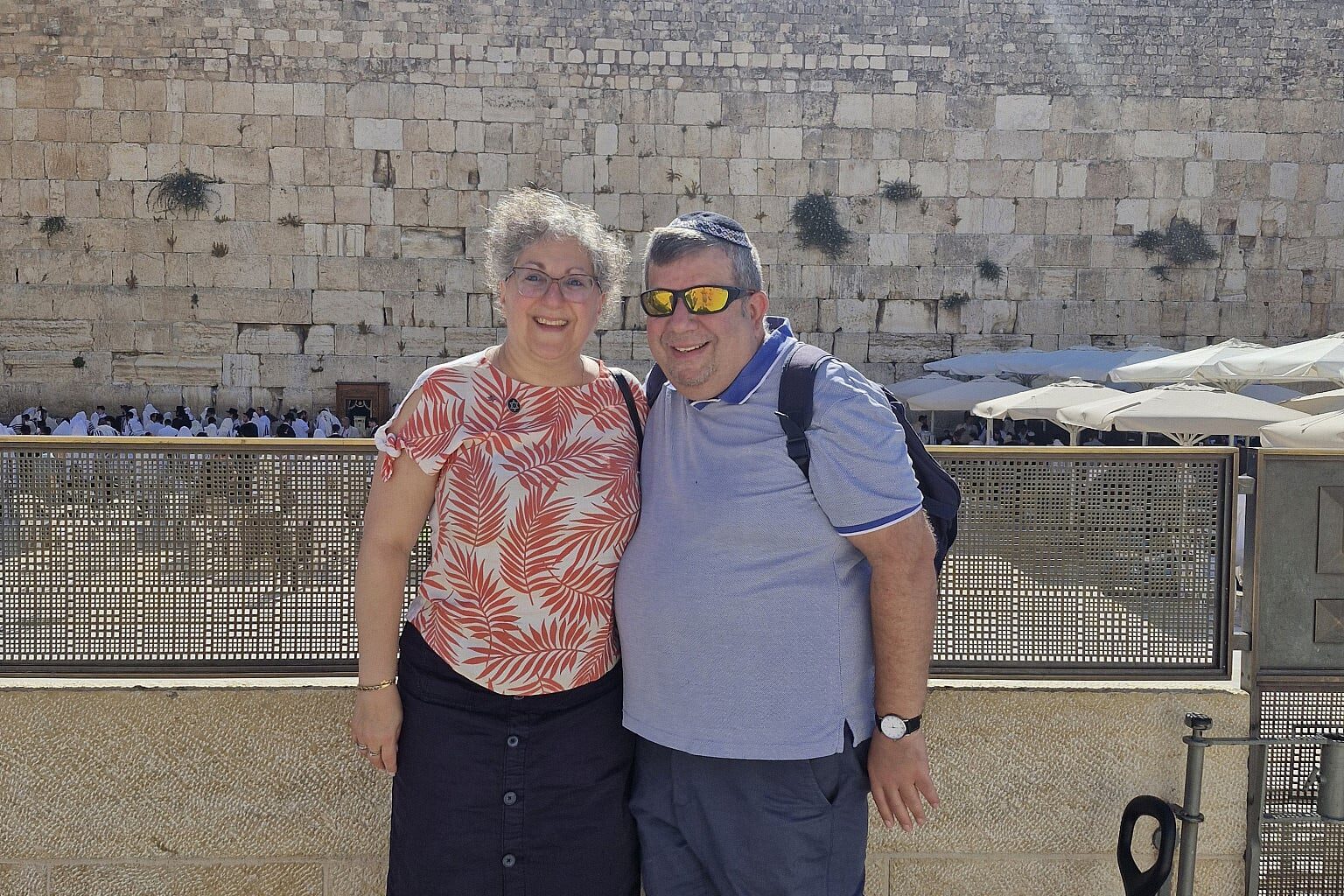
A week before our planned trip to Israel for a family wedding Iran launched several rockets towards Israel. We spent a week asking ourselves will we or won’t we be able to fly to Israel? We packed our suitcase after Shabbat and drove to Luton airport for our Wizzair flight, which took off, and landed on time at Ben Gurion airport. We took the train to Jerusalem where we were staying and caught a taxi to our hotel. The taxi driver was an Israeli Arab who spoke Hebrew and English and lives side by side with Jews, Christians and Muslims in Jerusalem. We took several taxi rides during our short stay in Jerusalem and almost every driver was an Arab Israeli who we found to be courteous, chatty and friendly.
We visited and prayed at the Kotel, which was very busy and we walked the streets of Jerusalem. It was wonderful to see the pavements and restaurants full of people shopping and eating. Jerusalem was a vibrant bustling city and I was struck by how normal life appeared. Constant news reports of conflict and war can create the impression of a city under siege, but the reality on the ground was very different. The streets of Jerusalem were bustling with activity. Cafés and restaurants were full, tourists and locals crowded the markets, and families enjoyed the warm evenings in public spaces. We visited the famous Machane Yehuda Market which was alive with its usual energy, with shoppers filling the aisles and vendors enthusiastically promoting their produce and goods.
In the city centre, the light rail, which we used on a daily basis, was busy, carrying commuters, students and visitors across the city. Hotels welcomed guests from around the world, while groups of tourists could be seen exploring the Old City, visiting the Western Wall and walking through the historic quarters.
Perhaps most striking was the resilience and determination of Jerusalem’s residents. Life continued. People went to work, children attended school and university, cultural events took place, and communities gathered as they always had. Security and the police were highly visible and people were naturally aware of the wider situation but daily life carried on with remarkable normality.
We “traveled” on the Time Elevator Jerusalem which was a fascinating journey through the history of Jerusalem. The Time Elevator is an educational tool that connects visitors to the city, guides the historical narrative and provides a meaningful starting point for exploring Jerusalem.
Jerusalem has always been a city that combines ancient history with modern vitality. During our visit, that vitality was evident everywhere. Restaurants and coffee shops were busy with customers enjoying meals and conversations late into the evening, shops were trading, and Jerusalem’s diverse communities were interacting in the ordinary rhythms of daily life.
We visited a friend who is staying at Kibbutz Tzuba, located in the Judean Mountains, on the western outskirts of Jerusalem, where we viewed the wonderful scenery and learnt about its nature, history and heritage including the amusement park and the chocolate workshop. We didn’t sample any of the wine from the Tzuba Winery but do fancy a stay at the Tzuba Hotel in the heart of the Kibbutz. The main business of Kibbutz Tzuba is the bulletproof windows/glass it makes and produces.
We thought we would find a city overshadowed by war but Jerusalem offered a different picture; a vibrant, functioning and welcoming city that continues to thrive despite the challenges facing the region. The resilience of its people and the determination to maintain everyday life are among the city’s most remarkable characteristics. Walking through Jerusalem last week, we saw a city not defined by conflict, but a city defined by life. The atmosphere in the city was one of resilience and determination. Businesses remained open, cultural activities continued, and religious worship continued uninterrupted at the city’s many holy sites.
Jerusalem is a city where people of different religions live side by side, sustaining the routines, relationships and shared experiences that make up daily life.
Before traveling I must admit that I was nervous. The news and the ongoing conflict left me uncertain about what I would find and I was nervous in case rockets were fired whilst we were there. However, my concerns quickly faded and from the moment we arrived we found a vibrant and busy city with little evidence of the conflict. I am so pleased our flight went and we had a short stay in Jerusalem. I was nervous to arrive, I was sad to leave Israel and now I can not wait for my next visit to Israel.
Sara Radivan is a frequent visitor to Israel. Originally from Liverpool, Sara now lives in Manchester. Sara is the Deputy and Community Engagement Manager for the Board of Deputies of British Jews.