
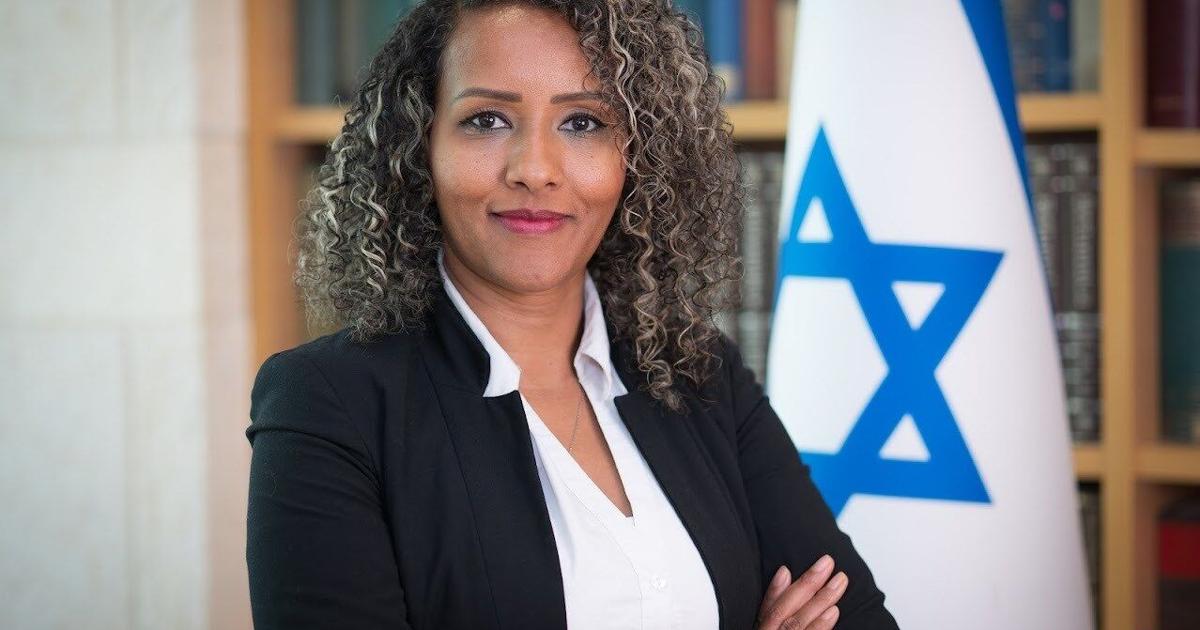
Ariella Rada remembers seeing all over news channels, newspapers and websites on Oct. 17, 2023 – just 10 days after the Oct. 7 Hamas-lead invasion of Israel – that an explosion that had taken place in the courtyard of Al-Ahli Arab Hospital in Gaza City was the result of an Israeli airstrike.
“It was viral, all the big media outlets were reporting this,” Rada told the Cleveland Jewish News. “Just to find out a few days later that it was a rocket of Hamas that exploded and hit the hospital. By the time that they corrected everything, it was already too late. It made me feel frustrated that there was so much misinformation like that and that journalists weren’t doing their job and investigating as they should.”
That exasperation led Rada to become the spokesperson and consul for media affairs at the Israeli Consulate in New York City.
“New York is the center of both media and social media – it’s where everything is happening,” Rada, who visited Cleveland on June 24 and June 25 to meet with local media outlets, said. “I thought that would be the place to start and talk with the media to try to show them our perspective. My team and I make sure that Israel is also represented and to say that what (the media is reporting) as what happened is not always correct.”
The Israeli consulate covers Ohio, New York, New Jersey, Pennsylvania and Delaware. Rada said this was her first work visit outside of New York, but she believes that trips like these are important to both explain the importance of accurately disseminating information and establish a rapport with media members.
It’s a crucial endeavor especially because while big media outlets have journalists on the ground in Israel, outlets in places like Cleveland don’t have a representative, according to Rada.
“They don’t have somebody with boots on the ground in Israel that can give them the facts about what is happening,” she said. “And places like Cleveland will usually deal with things that are more local and not necessarily global. But meeting with them, I saw that, unfortunately, there were a few antisemitic and anti-Israeli incidents here. Meeting with journalists, I told them I’m happy to give my two cents about what is happening, what led to it or what’s the feeling. I can give another perspective.”
Understanding the bigger picture is also a key element when outlets report on antisemitic or anti-Israeli incidents, Rada said. By explaining what has happened from Oct 7 through today, it gives “a better understanding of this trend of Jew hatred.”
Rada joined Israel’s Ministry of Foreign Affairs in 2015 and was appointed Deputy Ambassador of Israel to Peru in 2016. From 2018 to 2021, she was the Consul for Academic and Community Affairs at the Consulate General of Israel to the Midwest in Chicago. She then returned to Israel to work in the Palestinian department.
In her current role, Rada meets with as many journalists as she can, from the biggest outlets to the smallest ones to those in between.
“There is a lot of value in sitting with journalists that aren’t necessarily involved with everything that is happening in the Middle East or those that are, but are hearing one perspective,” she said. “You’re giving them a recap of the fronts that Israel is fighting with Lebanon, Syria, Gaza, Iran, the Houthis – it’s so many fronts. When you give them that perspective, it’s a very helpful context.”
If Rada sees an event or topic being inaccurately talked about in the media, she will call that organization to tell them what they got wrong, give them more background and encourage them to be more accurate and balanced.
“Sometimes they will change and correct it, and sometimes they won’t,” she said. “But at least I’m serving my purpose of trying to inform.”
One of the biggest challenges Rada and her team face is social media and influencers, who use platforms like TikTok, Facebook, YouTube and Instagram as an area to “bash Israel, demonize Israel and tell lies about Israel.”
“I met a few young people who told me personally that I needed to go and educate myself on Tik Tok,” she said. “Which is insane to me. Why don’t you read history books? We live in a very challenging time where most of the youth are being informed from what somebody is telling them on social media, and it’s not accurate or true, and a lot of times it can even be blood libels, stigmas or conspiracy theories that have nothing to do with reality.”
And while the work is neverending and challenging, Rada said there are times there are successes in getting the word out there that a story was portrayed inaccurately in the media.
“There was the story in The New York Times about starvation in Gaza that had a photo of a malnutritioned child,” she said. “The article basically said that this kid was starving in Gaza and that’s why he looked the way they did. So, we got information about that child and his mother and brother were perfectly healthy. It wouldn’t make sense that one is starving to death and the others are OK. If there’s no food, there is no food. A few publications that we found supported the fact that he had an existing medical condition that caused him to look that way. We notified them that what they published wasn’t correct, and they had to change it.”
Rada said when the correction was posted on X, it got “more than 70 million views.”
“It was because of the frustration,” she said. “You are the leading newspaper, people rely on you and you are so important. Why would you publish something like that with no verification and make sure it was accurate? So, we have challenges. But, we also have successes.”