
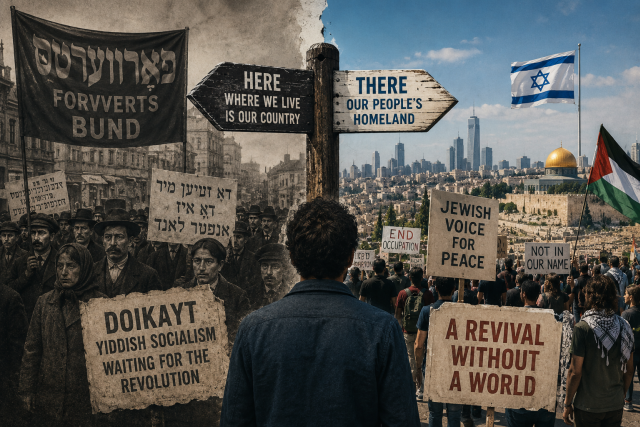
The continuing conflict between Israel and the Palestinians, accompanied by what many see as Israel’s excessive use of force, pushed many left-leaning Jews toward concluding that Zionism was no longer compatible with their moral convictions. In recent years, and especially since October 7, this internal tension has been complemented by growing external pressure from the broader progressive movements with which they had long identified. Continued support for Israel as the national homeland of the Jewish people came to carry significant political and social costs. Many chose to preserve their standing within those political circles by distancing themselves from Zionism.
These “old” and “new” Jewish antizionists alike faced, however, an ethical challenge. They had to reconcile their political choice with their own Jewish identity and consciousness. This required an intellectual and moral justification for their position: proof, to themselves as much as to anyone else, that by rejecting Zionism they were not “self-hating Jews,” but rather showed fidelity to an alternative and equally authentic Jewish political tradition.
The search for such a justification has taken several forms. Some look for it in Jewish ethics, invoking tikkun olam, the prophetic demand for justice, or Judaism’s universal moral mission. Others look for it in history, going back to Bundism and the doctrine of doikayt (“hereness”), presenting them as an authentic alternative to Zionism.
Attempts to revive Bundism in progressive Jewish circles have increasingly come to serve precisely this function, and Molly Crabapple’s book “Here Where We Live Is Our Country” has become its most visible and influential expression. Leaving the ethical and theological questions to those better qualified to address them, I want to focus on this Bundist revivalist movement drawing on my experience as a student in the Soviet Union, where I spent countless hours studying the history of the Russian revolutionary movement.
As a work of history, Crabapple’s book performs an important service by recovering the largely forgotten story of the Jewish Labor Bund. Yet this is not why it has become much celebrated in progressive antizionist circles. The main reason is that it also advances an attractive political message, claiming that the Bundist doctrine of doikayt still offers a viable present-day political alternative to Zionism. That message has been enthusiastically echoed in essays, interviews, podcasts, and social media, where Bundism is increasingly presented not simply as an important chapter in Jewish history but as a political vision for the Jewish future rooted in the half-forgotten Jewish past. However, Jewish history is not the Hollywood blockbuster “Back to the Future,” and its 20th century cannot simply be written out of the script.
Neither Crabapple nor those promoting her book ever seem to ask simple questions: Did the political philosophy of the Bund survive the upheavals that destroyed the world in which it arose? Can it be transplanted from 20th-century Tsarist Russia to 21st-century United States and Europe? Despite the considerable attention devoted to Crabapple’s book and to the broader attempts to revive Bundist ideas, I have yet to encounter a broadly accessible rebuttal of its central thesis that addresses these questions. This essay is an attempt to provide one.
I will begin with the title of Molly Crabapple’s book because it already reveals a profound disconnect between the world in which we live and the political imagination from which it emerged. Here Where We Live Is Our Country expresses an idea with deep roots in Jewish historical experience, but it resonates very differently in the 21st century. Surprisingly, no one appears to have paused to pose an obvious question:
Would anyone choose the same title for a book about any other nation without exposing themselves to ridicule?
Millions of Americans of German, Italian, Mexican, Indian, Armenian, and countless other backgrounds proudly call the United States their home. At the same time, no one expects them to deny Germany, Italy, Mexico, India, or Armenia as the national homes of their respective peoples. The two ideas are not merely compatible; they are perfectly complementary. One may feel completely at home in one country while recognizing another as the national home of one’s people. Indeed, for virtually every diasporic community in the world, the suggestion that the two are somehow incompatible would seem not merely puzzling but absurd.
Why, then, should the principle suddenly change when the nation in question is the Jews?
The defenders of the book would probably dismiss the question itself as preposterous. Germany, Italy, and Mexico, they would argue, are “old” countries that emerged “naturally” through long historical processes. Israel, by contrast, is routinely portrayed as an artificial colonial project, imposed upon an indigenous population and brought into existence only in 1948. In their eyes, it simply does not belong in the same category as “normal” nation-states.
The trouble with this argument is that history rarely cooperates with tidy political narratives.
Israel did not simply pop into existence in 1948. Like Germany, Italy, and many other modern nation-states, it emerged as a culmination of a long and complex process. Political Zionism certainly did not begin with Herzl, whose main achievement was to transform an existing current of Jewish political thought into an organized mass movement. But the idea of Jewish national revival long predated him, just as the Jewish connection to the Land of Israel long predated Zionism itself.
Decades before independence, Zionist institutions had already laid much of the foundation of a future state through settlement, agriculture, education, self-government, labor organizations, financial institutions, and self-defense. By the time Israel declared independence, it was not creating a society from scratch but giving political expression to a national community that had been taking shape for generations.
Israel’s birth was not a historical anomaly. It belonged to the same great wave of nation-state formation that reshaped Europe, the Middle East, and South Asia following the upheavals of the two World Wars. The first half of the 20th century was an age of collapsing empires, emerging nation-states, shifting borders, and mass population transfers.
Across the Middle East, the dissolution of the Ottoman Empire gave rise to new states whose borders were drawn, negotiated, and often arbitrarily adjusted by the victorious colonial powers. In Europe, the collapse of the Austro-Hungarian and Russian Empires, followed by the Second World War, produced new states, new borders, and the expulsion or resettlement of millions of people, including the forced transfer of millions of ethnic Germans and Stalin’s deportations and population engineering in the newly annexed territories of eastern Poland and northern Romania. In South Asia, the partition of British India created India and Pakistan through one of the largest and bloodiest population movements in modern history, while the later emergence of Bangladesh was likewise accompanied by war and mass displacement.
None of these processes was peaceful. None was free of injustice or human suffering. Yet none of these founding tragedies is treated as delegitimizing the states that emerged from them: the traumatic origins of Iraq, Jordan, Lebanon, Syria, Germany, Poland, the Czech Republic, Hungary, India, Pakistan, or Bangladesh do not, in themselves, call into question those states’ right to exist. Israel was born inside that history. It did not stand outside it.
Once Israel is recognized as part of the same historical process that gave birth to dozens of other modern nation-states, the title of Molly Crabapple’s book ceases to sound profound. It begins to sound strangely parochial. Why should an idea that would invite ridicule if applied to almost any other people suddenly be treated as a moral revelation merely because it concerns the Jews?
The same double standard is applied to the Jews whenever the question of the “right of nations to self-determination” is brought up. Jewish Voice for Peace, the largest Jewish anti-Zionist organization in the United States, makes the move explicitly on its own platform: “While Zionism is often referred to as a movement of ‘Jewish self-determination,’ the Zionist movement defined this term in a narrow political sense”; JVP offers instead “our own understanding of Jewish safety and self-determination.” Stripped of the euphemism, this is a noble aspiration — safety and cultural continuity secured without sovereignty. It is also a definition of self-determination that would be rejected for virtually every other nation on earth.
Try suggesting that Palestinian self-determination consists simply in the ability of Palestinians to flourish, practice their religion, and preserve their national identity wherever they happen to live. Suddenly, the entire case for a sovereign Palestinian state, and with it the claimed right of return, collapses entirely. Such a redefinition would immediately be recognized for what it is: an attempt to empty Palestinian self-determination of its political content.
Or suggest that Ukrainians should abandon their fight for political independence from Russia and agree to the role of a minority under Russian domination and you would rightly be denounced as a Kremlin apologist, if not a Putin puppet.
And yet, somehow, this perfectly clear understanding of what national self-determination actually means suddenly breaks down the moment the Jews become the subject of the conversation. Only in the Jewish case is the “right of nations to self-determination” quietly reduced from political self-government to permission to live safely, practice Judaism, and preserve Jewish identity wherever Jews happen to reside.
The title of Molly Crabapple’s book was the easiest point to begin because its contradictions become apparent almost as soon as one asks whether anyone would seriously choose the same title for a book about any other nation. The deeper problem with the contemporary revival of Bundism, however, lies elsewhere. Its modern apologists increasingly present Bundism as though it were a timeless philosophy of Jewish political existence, a permanent alternative to Zionism that history somehow overlooked. It was nothing of the sort.
Bundism was born of a very particular moment in Jewish history and in a very particular Jewish geography. During the nineteenth century, the Jewish Enlightenment (Haskalah, or di Haskole in Yiddish) and the gradual emancipation of European Jewry transformed Jewish life. In Western and Central Europe, Jews were increasingly accepted as individual citizens while continuing to be denied recognition as a collective nation. In Eastern Europe, where millions of Jews still lived in densely populated Yiddish-speaking communities, the same historical forces produced a different political dilemma.
The great political debates within modern Jewry among Zionists, Bundists, Territorialists, assimilationists, and the advocates of national-cultural autonomy led by Simon Dubnov and other Jewish autonomists were all attempts to answer the same fundamental question: how should the Jews organize themselves politically in a world prepared to emancipate Jews as individuals but unwilling to recognize them as a nation?
The Bund’s answer was doikayt — “hereness.” It argued that the future of Jewish collective life should be built where Jews already lived, above all in the Yiddish-speaking communities of the Russian Empire and later Poland. This was not a timeless philosophy of Jewish existence. It was a specifically socialist political strategy devised for one particular Jewish civilization living under a specific set of circumstances.
The Bund was not simply asking Jews to stay where they lived. Its core disagreement with Zionism was the rejection of political self-determination through a separate Jewish state, in favor of legally chartered national-cultural autonomy within the country Jews already inhabited — an idea developed in tandem with Dubnow’s diaspora nationalism and elaborated by the Bund’s own theorist, Vladimir Medem, who made clear the rift ran deeper than statehood alone: “between Zionist activity and Socialist activity,” he wrote in 1920, “there is a fundamental and profound chasm.” Secure Jewish national life, in the Bundist view, was inseparable from the socialist revolution it never stopped awaiting. To detach doikayt from that revolutionary horizon is to transform Bundism into something its founders would scarcely have recognized.
This was not merely proposed; it was, once, realized. Interwar Estonia’s 1925 Law on Cultural Autonomy for National Minorities granted its Jewish community exactly this: a chartered, self-governing cultural autonomy, with its own administered schools and institutions, officially recognized by the state. It is the closest thing history offers to the Bundist program fully achieved. In 1941, the Nazis arrived, and Estonia became one of the first territories in Europe declared Judenfrei. Chartered autonomy did not slow them down by a day.
Estonia’s fate shows that History does not care about political doctrines; it follows its own path. The world for which Bundism had been designed did not gradually evolve. It disappeared. The Holocaust annihilated the largest Jewish civilization on earth. Stalin destroyed what remained of independent Jewish political life in the Soviet sphere. At precisely the moment when the great Yiddish-speaking world was collapsing, the State of Israel emerged as the political, demographic, and eventually cultural center of Jewish life. The argument between Bundism and Zionism was not settled by an academic debate or a party congress. It was settled by the emerging reality.
The fate of the Bund’s own leaders illustrates this transformation with particular clarity. Henryk Erlich and Victor Alter escaped Nazi occupation only to be arrested by the NKVD and ultimately murdered on Stalin’s orders. The revolution the Bund had staked its future on did, eventually, arrive. And it devoured them. On the opposite side of the border, thousands of Bund activists perished under Nazi rule. These men were not simply the victims of two totalitarian regimes. They also witnessed the destruction of the world that had made Bundism possible.
One may regret that outcome. But one cannot simply pretend that it never happened. The contemporary revival of Bundism asks 21st-century Jews to inhabit a political universe that disappeared with the destruction of Eastern European Jewry. That is not historical continuity. It is historical nostalgia masquerading as political philosophy.
It is also worth remembering that even at the height of its influence, Bundism was never a philosophy of the Jewish people as a whole. It was the political ideology of one particular Jewish civilization: Yiddish-speaking Ashkenazi Jewry of Eastern Europe.
Its assumptions reflected the experience of that world. It spoke the language of the Russian Empire and later Poland. It addressed the political realities of socialist movements, labor organizations, antisemitism in Eastern Europe, and the future of Yiddish-speaking communities. Those were real and important questions. But they were not the questions confronting Jews in Baghdad, Aleppo, Fez, Sana’a, Bukhara, Tbilisi, Tehran, or Addis Ababa. Sephardi, Mizrahi, Yemenite, Bukharian, Persian, Georgian, Mountain, and Ethiopian Jews developed under profoundly different historical, political, linguistic, and cultural conditions. Bundism was not their political language because it did not reflect their experience.
Ironically, the contemporary revival of Bundism often reproduces precisely the provincialism it claims to oppose. It elevates one regional Jewish experience into a universal model for Jewish political life while paying remarkably little attention to the histories of the majority of the Jewish world. A political philosophy that arose among Eastern European socialists is retrospectively presented as though it were the authentic voice of Jewish history itself. It never was.
But isn’t modern political Zionism also an Eastern European phenomenon?
Certainly — in its organizational form. Most of its principal ideologues, political leaders, and institutions emerged in Central and Eastern Europe. But that observation overlooks the essential distinction. Political Zionism was new; the national aspiration to which it gave political expression was not. Long before Herzl, Sephardi rabbis such as Judah Bibas and Yehuda Alkalai were already calling for the restoration of Jewish national life in the Land of Israel. In 1881, before the First Zionist Congress convened in Basel and before Herzl had entered Jewish politics, hundreds of Yemenite Jews began what later became known as the Yemenite Aliyah, motivated not by European nationalism but by centuries-old religious ties to the Land of Israel.
Jewish communities had maintained a continuous presence in Jerusalem, Safed, Tiberias, and Hebron for centuries, sustained by Jews from across the Diaspora. Whatever one’s views on modern political Zionism, the civilizational attachment to the Land of Israel was never an exclusively Ashkenazi idea.
Even Ahad Ha’am, perhaps Herzl’s most important ideological opponent, never questioned where the Jewish national center should be. He disagreed profoundly with Herzl about what kind of center should be created, not about its location. For him no less than for Herzl, the Land of Israel remained the indispensable center of Jewish national renewal.
Unlike Bundism, which universalized a local historical experience, Zionism transformed a shared civilizational memory into a modern political program. Although its institutions emerged in Europe, its central premise resonated far beyond Europe because it rested on traditions common to Ashkenazi, Sephardi, Mizrahi, Yemenite, Bukharian, and many other Jewish communities.
The establishment of Israel transformed what had been an unresolved intellectual debate into reality. Before 1948, Bundism and Zionism could plausibly compete as alternative visions of the Jewish future. After 1948, Israel became the principal demographic, political, cultural, and increasingly religious center of Jewish life, fundamentally altering the conditions under which the Bund-Zionist debate had once been conducted. History changed the question itself.
This is why contemporary attempts to revive Bundism inevitably differ from the historical Bund. They no longer compete with Zionism as rival proposals for creating a Jewish political center; that question has already been answered by history. In practice, they become attempts to deny the legitimacy of Israel as the principal organizing center of contemporary Jewish life or to minimize the spiritual connection between the Jewish people and the Land of Israel. One may sharply criticize particular Israeli governments or policies without questioning Israel’s legitimacy as a Jewish state. But a comprehensive revival of Bundism today is no longer simply an act of historical recovery; it is an attempt to replace a civilizational center that has already come into existence.
The appeal of doikayt is understandable. Many progressive Jews turn to Bundism for answers to the ethical and political dilemmas posed by the Jewish state. They will not find them there. Bundism cannot answer the questions of the 21st century because it was devised to answer the questions of a vanished world. Setting the history aside, the institution Bundism actually sought — state-chartered communal self-government — has no home in the American constitutional order its revivalists now inhabit.
Even Orthodox and Hasidic communities, which come closer than any other American Jewish population to functioning as a state within a state, have built that autonomy entirely from generally available civil liberties — private schools, voting, arbitration — not from any special legal status as a national group. When New York came closest to granting that status explicitly, chartering a school district along the boundaries of the Satmar community of Kiryas Joel, the Supreme Court struck it down: the state cannot delegate civic authority to a group defined by religious or national identity. The doctrinal seriousness has not disappeared.
The most committed strand of today’s revival draws explicitly on that same anti-capitalist tradition, seeing Jewish safety as bound up with a broader transformation of American economic life. But the Bund’s wager on revolution was placed in a collapsing empire, amid mass strikes, on the eve of a war that would in fact produce one within 20 years. The same wager, placed today against the most stable and entrenched political and economic order in modern history, is delusion, rooted in historical amnesia, pretending to be conviction.
Intellectual rigor and intellectual honesty demand accepting that doikayt is not the answer American Jews are looking for. Whatever form Jewish self-determination takes in the 21st century, the historical conditions that made doikayt possible are gone, and no revival of it, however sincere, can substitute for reckoning with that fact. One has to accept that in the 21st century, Jewish self-determination is only possible in the form of the Jewish State. Pretending otherwise is a fool’s game — self-deception dressed as political philosophy.