
History matters. Facts matter. Identity matters. And when history is rewritten for political purposes, everyone loses.
One of the most successful political rebranding campaigns of the modern era has been the transformation of the word “Palestinian” from a geographic description into an exclusive national identity that, in my view, has often been used to erase the longstanding Jewish connection to the Land of Israel.
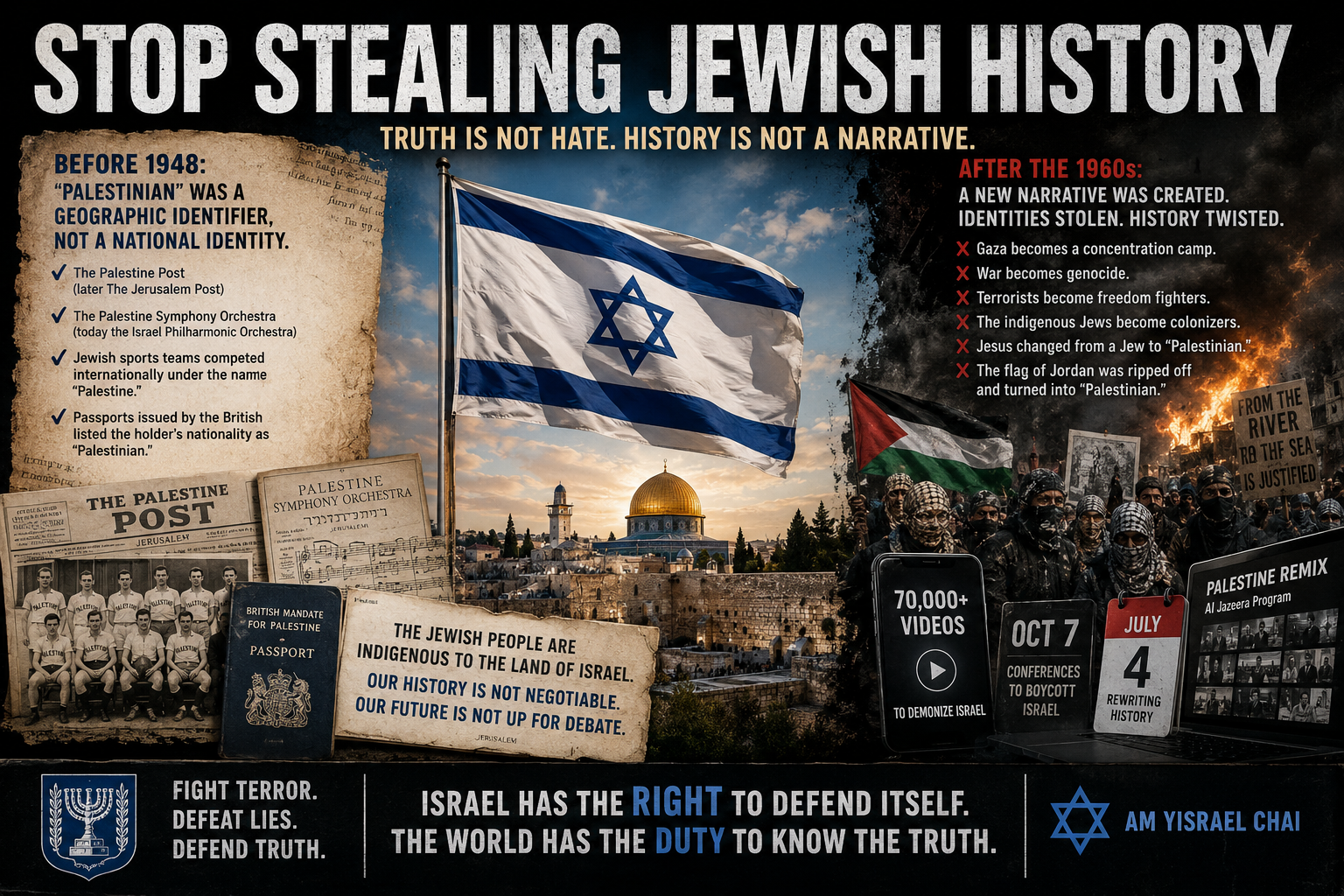
Before 1948, “Palestinian” was primarily a geographic identifier within the British Mandate for Palestine. Jewish institutions proudly carried the name. The Palestine Post later became The Jerusalem Post. The Palestine Symphony Orchestra became the Israel Philharmonic Orchestra. Jewish athletes competed internationally under the name Palestine. British-issued passports listed residents as Palestinian because they lived in Mandatory Palestine, not because the term represented a distinct modern national identity.
Many Zionist Jews referred to themselves as Palestinians in that geographic sense while identifying nationally as Jews and supporting the restoration of a Jewish homeland.
At the same time, many Arabic-speaking inhabitants identified themselves primarily as Arabs, Muslims, Christians, members of local families, villages, cities, or as part of the broader Arab world. Historians continue to debate how and when a distinct Palestinian national identity developed, but it is clear that identities evolved significantly during the twentieth century.
In my view, the political narrative changed dramatically during the 1960s. I believe that under the leadership of Yasser Arafat and with Soviet influence, particularly through KGB-backed political messaging according to various historical accounts and analyses, the word “Palestinian” became the centerpiece of a new international campaign. From that moment onward, the narrative increasingly shifted away from Jewish historical identity toward portraying the conflict through an entirely different lens.
Since then, language itself has become a battlefield.
In that narrative, Gaza becomes a concentration camp.
War becomes genocide.
Terrorists become freedom fighters.
The indigenous Jewish people become colonizers.
Even Jesus is increasingly described in some activist circles as “Palestinian” rather than as a Jew living in Roman Judea, despite the historical realities of his time.
The Palestinian flag itself is often presented as an ancient national symbol, although its design closely resembles the flag of the Arab Revolt and later inspired several Arab national flags, including Jordan’s.
Whether one agrees with these interpretations or not, the broader pattern is impossible to ignore. Political messaging has enormous power, and repeated narratives eventually become accepted as truth by people who never examine the historical record.
Today, this battle is no longer limited to identity. It increasingly extends to history itself.
Important dates are being repurposed to advance political narratives.
In the Netherlands, I watched with concern as National Remembrance Day and Liberation Day increasingly became platforms for pro-Palestinian activism. Events intended to commemorate victims of the Second World War and celebrate freedom were, in my opinion, overshadowed by contemporary political messaging.
We now see attempts to organize conferences and international events on October 7, the anniversary of the Hamas massacre in Israel, that seek to isolate Israeli institutions rather than acknowledge the significance of that day for Israeli society.
Most disturbing of all was seeing an activist organization launch a massive online archive on July 4, containing tens of thousands of videos intended to portray Israel as uniquely evil. In my opinion, much of this material is heavily curated to support a predetermined conclusion, with footage drawn from multiple conflicts and presented in ways that deserve rigorous scrutiny. Whether every clip is authentic, contextualized, or fairly represented should concern anyone who values honest documentation.
I alerted several people in Israel because I believe information warfare has become one of the greatest strategic threats facing the country. Yet I fear that such campaigns are too often dismissed as background noise rather than recognized as long-term efforts to shape global public opinion.
That would be a serious mistake.
Military victories alone cannot defeat propaganda. When falsehoods are repeated often enough, they become accepted as historical fact. Once that happens, reversing the damage becomes exponentially harder.
Israel has world-class intelligence capabilities. Those capabilities should also be directed toward combating organized campaigns of disinformation, incitement, digital manipulation, and coordinated efforts to delegitimize the Jewish state. Whether through a specialized unit within existing security agencies or a dedicated new department, there should be serious investment in identifying networks that deliberately spread fabricated or manipulated material intended to incite hatred or violence.
Freedom of expression is a cornerstone of democracy. Deliberate disinformation designed to fuel antisemitism, justify terrorism, or erase Jewish history is something entirely different.
History deserves better.
Truth deserves better.
The Jewish people deserve better.
And if Israel does not defend its own historical narrative with the same determination that it defends its borders, others will continue rewriting that history until fiction replaces fact.
CEO of Time to Stand Up for Israel, a nonprofit organization with a powerful mission: to support Israel and amplify its voice around the world. With over 200,000 followers across various social media platforms, our community is united by a shared love for Israel and a deep commitment to her future.
My journey as an advocate for Israel began early. When I was 11 years old, my father was deployed to the Middle East through his work with UNTSO. I had the unique experience of living in both Syria and Israel, and from a young age, I witnessed firsthand the contrast in cultures and realities. That experience shaped me profoundly.
Returning to the Netherlands, I quickly became aware of the growing wave of anti-Israel sentiment — and I knew I had to speak out. Ever since, I’ve been a fierce and unapologetic supporter of Israel. I’m not religious, but my belief is clear and unwavering: Israel has the right to exist, and Israel has the duty to defend herself.
My passion is rooted in truth, love, and justice. I’m a true Zionist at heart.
From my first breath to my last, I will stand up for Israel.