
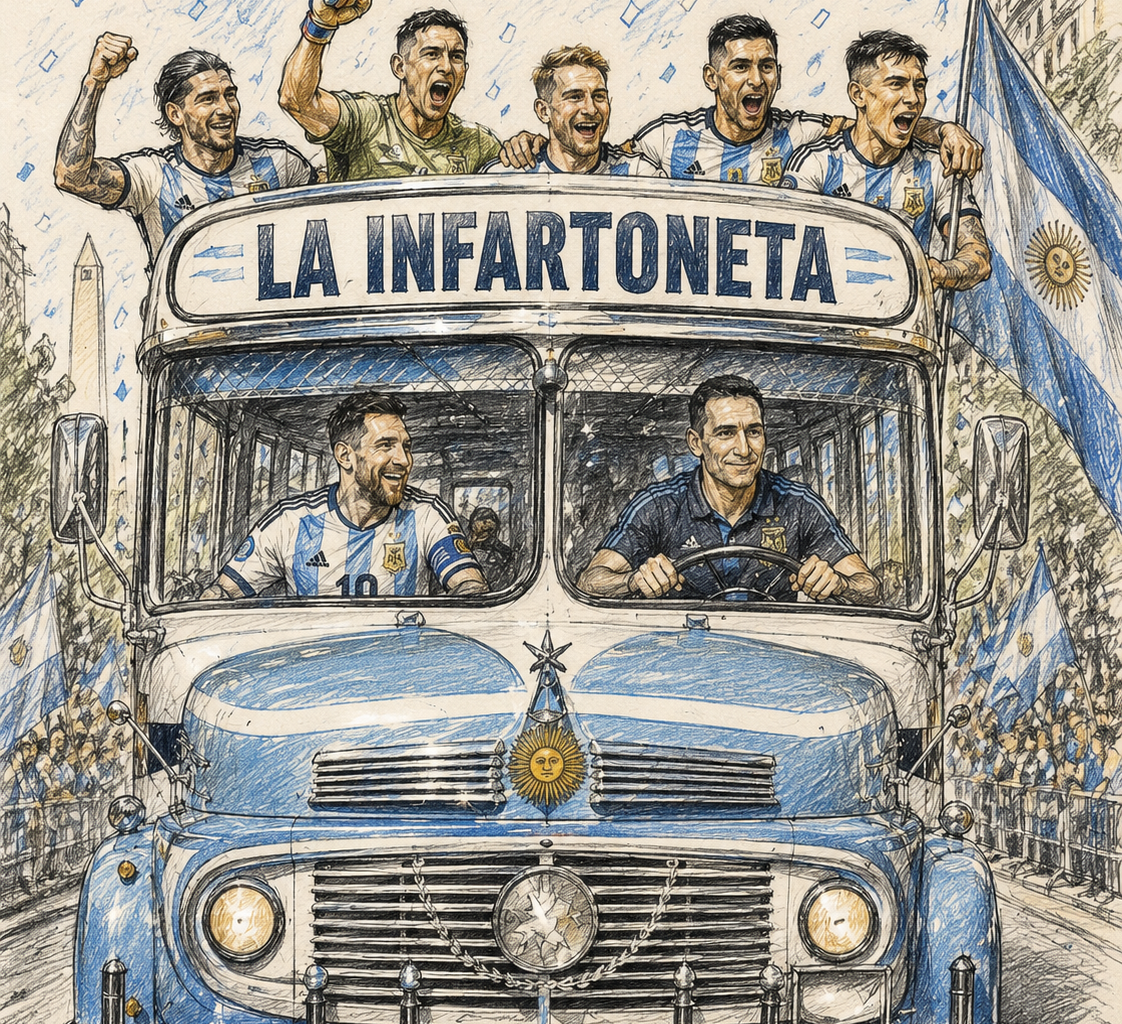
Another World Cup, another opportunity to get excited and dream again.
For those readers who are new, let me introduce myself. I’m Ariana, and I’m a die-hard Argentinian fan of La Selección. One thing people may not know about us is that Argentinians are very serious about our soccer—always, but especially during the World Cup.
After all, we’re the defending world champions. Argentina won its third World Cup in Qatar, and we have the privilege of watching the one and only King of Football, as the world has crowned him—rightfully so: Lionel Messi. We are all privileged to witness him play, and we’re even luckier that he’s ours.
Lionel Messi deserves an article of his own. His exemplary sportsmanship, his once-in-a-generation talent, and skills that seem to come from another galaxy have earned him a place among the greatest athletes in history. But beyond football, he is an extraordinary human being.
To truly understand what Messi means to Argentina, you have to walk through the streets of Buenos Aires. Everywhere you look, you’ll find murals—one after another—with his face. They are more than works of art; they are monuments to what he gave an entire nation.
Messi gave Argentinians back the ability to dream. After decades of waiting, heartbreak, and near misses, he led Argentina back to the top of the football world and reminded us what it feels like to believe again.
And now, in this World Cup, Argentina has already reminded us of something else: being an Argentine fan is not for the faint of heart.
Argentinians always joke that we have to suffer. It is an inside joke among us. If we don’t suffer, somehow it doesn’t feel like Argentina. Suffering is simply part of the experience.
But against Egypt, they took that suffering to another level.
For those of you who have been living under a rock, the match was unbelievably tight. Argentina found itself down 2–0, and it looked as though our World Cup dreams might be slipping away.
Then came one of the most incredible comebacks any of us have ever witnessed.
In the final minutes of the match, Argentina scored three goals. In a matter of moments, despair turned into absolute euphoria. We went from tears of sadness to tears of joy. We screamed. We laughed. We hugged whoever happened to be next to us, because somehow this team always finds a way to make us suffer before rewarding us.
We affectionately call Scaloni’s team La Scaloneta. But after that match, many Argentinians jokingly renamed them La Infartoneta. “Infarto” means heart attack in Spanish, and honestly, after what they put us through, the nickname could not have been more appropriate.
Now you may be wondering why I am telling you all these little anecdotes.
Believe me—I have a point.
Argentina is a country that has endured tremendous hardship. Economic crises have come and gone. Political instability has become almost a constant companion for generations of Argentinians. We know what it means to struggle. We know disappointment. We know uncertainty.
That is precisely why the World Cup means so much to us.
For Argentinians, football is far more than a sport. Some people say it is our second religion, and honestly, that is not much of an exaggeration.
Every four years, the World Cup reconnects us with our childhood. It reminds us of our fathers sitting in front of the television with their lucky rituals and superstitions. Our uncles shouting at the screen as though the players could hear them. Families gathering together. Entire neighborhoods celebrating in the streets. Those memories become part of who we are. They become part of our identity.
Watching the reaction to the Egypt match also made me reflect on something much bigger than football.
As I followed the conversation online, I saw countless accusations that Argentina had cheated, that the match had been stolen, or that the outcome had somehow been manipulated.
Yet modern football is scrutinized like never before. Every goal, every offside decision, every possible foul is reviewed through technology, cameras, and video systems before major decisions are confirmed. Whether people like the outcome or not, those decisions are no longer based only on one referee’s opinion.
What fascinated me was not simply the criticism itself. It was how quickly so many people accepted a narrative without stopping to examine the facts for themselves.
As someone who strongly supports Israel, I could not help but notice what, to me, felt like a similar pattern. It reminded me of the way narratives often spread during the Israel-Hamas conflict, where public opinion can form almost instantly, long before many people have taken the time to examine the available evidence.
That parallel stood out to me—not because football and war are the same, of course they are not—but because both show how quickly emotionally charged narratives can shape public perception.
I even saw one commentator summarize it by saying, “Messi is living the Israel experience.” Whether or not someone agrees with that comparison, it captured exactly how I felt watching the online reaction unfold.
The question is not whether Argentina deserved to win.
We won.
That is unarguable.
The real question is why so many people were willing to believe otherwise without first looking at the facts. In an age where technology scrutinizes every major decision on the field, why are so many still willing to accept a narrative before examining the evidence for themselves?
Because if we stop doing that, then the problem is not only those spreading misinformation.
It is also those of us willing to believe it without question.
As concerning as this is in soccer, it’s way more concerning when it comes down to the Israel conflict with the Palestinians, because that puts people at risk. And also, these crazy reactions feed the already existing global antisemitism crisis.
Food for thought.
Ariana Mizrahi is an author, educator, and doctoral candidate originally from Buenos Aires, Argentina. She serves as Assistant Principal of Barkai Yeshivah Middle School in New York. Her writing, including The Blue Butterfly of Cochin and Super Cactus, explores language, coexistence, and diversity, reflecting her belief that storytelling and education can bridge cultures and illuminate the shared essence of humanity.