
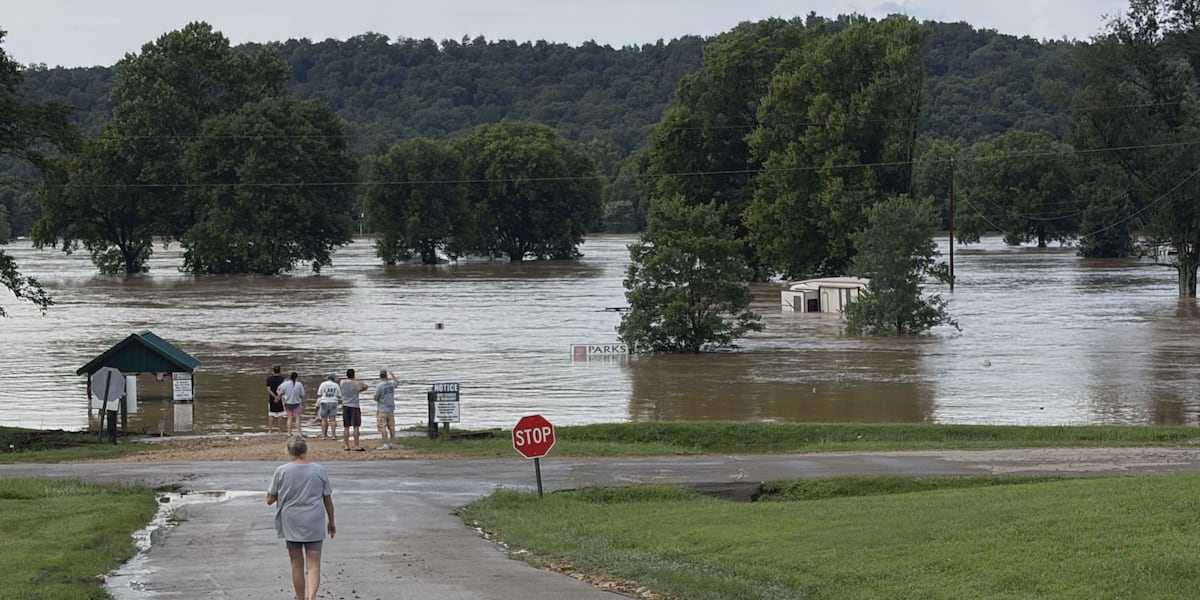
ST. LOUIS, Mo. (First Alert 4) — When a flash flood warning pushed to Dan Schult’s phone in the middle of the night, campground staff at Parks Bluff Campground along the Black River were already knocking on doors, ordering families to evacuate.
Schult said his first thought was getting his two young children to safety.
“We stepped out of the camper around 3 a.m. and saw the water was already to the steps,” Schult said. “As we got out, in the matter of five minutes, it took us to get everybody in the truck, the water rose at least another 4 to 5 inches in that length of time.”
Two alerts, two hours apart
The National Weather Service issued a considerable flash flood warning at approximately 2:35 a.m., which they explained triggers a wireless emergency alert to all cell phones in the affected area. By 4:16 a.m., the NWS escalated to a flash flood emergency, pushing a second phone alert.
Ben Herzog with the National Weather Service said the situation was unlike most flooding events.
“This is something that almost never happens,” Herzog said. “It’s really catastrophic.”
Herzog said rainfall totals drove the escalating alerts.
“When we issued the considerable warning, we had something like 6 inches of rain that had fallen, which is already a lot,” Herzog said. “By the time we issued the flash flood emergency, it had gone up to about 9 inches at that point. It’s the increased amount of rainfall. And that’s also the first time that we got a report that something pretty bad was happening.”
‘You never take them seriously’
Schult said he received both alerts and credited them, along with the campground director, with making it possible for his family to get out safely.
“You get the National Weather Service alert and you never take them seriously,” Schult said. “Now, here on out, if I get one on my phone, I won’t be doing that anymore.”
“It’s hard to think about what could have been had we not woken up or got out when we did,” he added.
How to stay prepared
The National Weather Service recommends having more than one way to receive warnings. Officials suggest the following:
Keep wireless emergency alerts turned onCarry a NOAA weather radio when camping, especially in areas with poor cell receptionUse a trusted weather app
The NWS also reminds the public: if you come across a flooded roadway, turn around — don’t drown.
Copyright 2026 KMOV. All rights reserved.