
On Thursday I traveled to the West Bank with Alon, a young guy who’s pursuing a PHD in the USA and is just in Israel on a visit. We both met in Givatayim to pick up a car that belongs to an activist who’s abroad. During the ride I asked Alon about his experience being an Israeli student in the US these days and he called a shop to inquire about refilling a fire extinguisher. The car we were driving was equipped with lots of things that might be useful. The previous Friday night a settler set an empty den on fire and so the fire extinguisher came in handy. Apparently the mitzva of terrorizing Palestinians overrides the mitzva of observing the Sabbath.
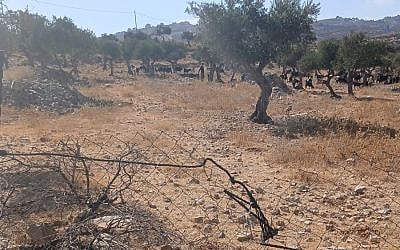
When we arrived at a small homestead outside of Tayibe, we greeted a pair of activists who were just leaving. They said that the “blondini” is coming with sheep or goats. Alon pointed in the direction of the horizon and showed me the dark shapes of animals approaching. They bring the goats as an excuse to be here. The goats also eat olive branches, which is why none of the trees have low branches, but camels are more effective if you want to seriously take out a mature olive grove.
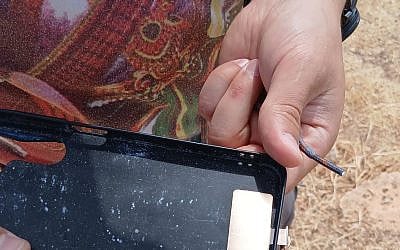
Alon taught me how to attach my phone to a string and then put it around my neck. The “blondini” steals phones. He stole the phones of two people and he stole Alon’s camera. He also hit a female activist in the face and caused her to bleed.
A woman invited us into her home. Alon did the talking because my Arabic is nonexistent. Alon gave a little boy a birthday present. It’s not Alon’s first time visiting this family.
 Our goal is to not let them come close to the compound. If they come close, they might throw stones and harass the people, and start to feel comfortable enough to do worse things.
This is an empty goat shed. When an outpost is set up nearby, Palestinians know that it’s time to get rid of the goats. They may sell them to be slaughtered or to people who have a safer place to graze them, or just lease them and hope to be able to take them back in the future.
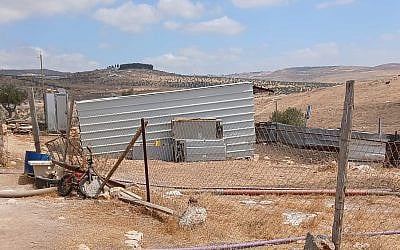 The settler approached the fence around the compound. It’s a weird experience. We look at him. He looks at us. We film him. By holding my phone and taking pictures, I declare myself to be his enemy. I’m a gentle soul. I don’t declare myself to be people’s enemies very often. A goat nibbles a little from an olive tree.
Alon called the police and asked me to film him so we have documentation of the conversation. He put her on speaker phone.
“I’m here at Tamir’s home near Tayibe. There is a settler named _____. He came here before and stole some phones. He’s approaching the fence with goats.”
“I can’t talk to you. I’m disconnecting. Bye.”
To Alon this was just a routine procedure, but it would take me another day to fully process what just happened. This was my first time recording evidence that the state is complicit in what is happening. Now, as I go about my life, I carry with me in my phone the recorded words of a nervous young woman, perhaps half my age, testifying that this is an oppressive country.
The settler rested under a tree and let the goats graze for some time, then he led them to the adjacent compound that belongs to the same family.
A teenage girl walked out of one of the structures and headed to the first compound and we continued where we left off. We needed to shoo away goats that were too close to the fence because if one crawls under then the settler will have an excuse to cross to the other side of the fence.
I looked away for a second and I felt something hit me. The settler threw a rock at me. After more time passed, he led the herd away and we went back inside.
I returned to the house in the first compound. The teenage girl was there. We figured out that we can communicate in English. “The settler go?” she asked. I responded in the affirmative.
For these kids, this is their daily life.
Alon offered a teenager named Yousef a ride to a local store and I came along. On the way back we got a call that some help is needed in a nearby village called Jaba.
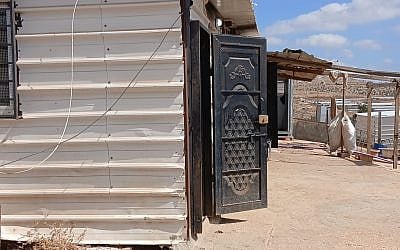
We convened at a lookout point together with some other Israeli activists and a bunch of Palestinian teenagers. An outpost was recently set up. This is problematic because they don’t have a fence. They are completely exposed. They need to have Israeli/international volunteers stationed there 24/7 for the time being. Yesterday a drone came down over their houses.
Alon and I walked in the direction of where there were some caravans, the start of a new outpost, and saw this camera set up.
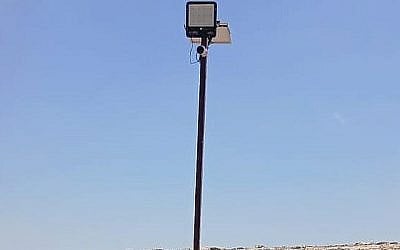
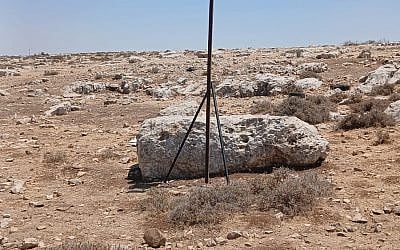 I wanted to walk farther but one of the more experienced activists had told Alon that we can’t because it might look like we are being friendly with the settlers and that could damage the trust between the Palestinians and the organization.
We went back to Tayibe and rested in a room with a lot of couches. I sat outside the door and did some research on my phone. I saw a rock land nearby and we heard some rocks hit the building the other activists were in (at this point, Yoel who I volunteered with last time had joined us).
This time we were much closer to the settler. He filmed us with one phone and talked on another phone at the same time.
“You must have a lot of phones,” Alon said. The settler didn’t respond.
I felt a burning curiosity. hat is he thinking? How does he feel about us? He was a really young guy. He snickered at us when we shooed the goats away from the fence.
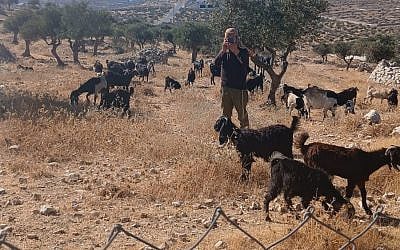
It’s a weird situation. We are three and he is one, but he has the upper hand because the military is behind him. He can throw rocks at us and he could even assault us. We need to find the best way to balance doing our job with avoiding a physical confrontation, and so we mostly keep the fence between us.
I couldn’t help but notice how cute the goats were. I love goats! I love agriculture. I love the way that plants and animal connect people to the land. It’s weird seeing goats used for the purpose of uprooting people from their land.
During the course of our stay there, the family served us a lot of food and tea, confirming the rumors about Palestinians being very hospitable. Before we left, we met some other activists who came to spend the night.
Tom lives a life full of contradictions and is fascinated by the nuances and contradictions behind the headlines. Tom has been back and forth between the USA and Israel throughout his adult life. For his Masters thesis in creative writing at Bar Ilan University, Tom wrote a series of memoirs about his experience of finding himself in the adult world while navigating the political scene in Israel. In recent years, he has worked as an environmental educator in the USA and teacher of English to native speakers in Israel.