
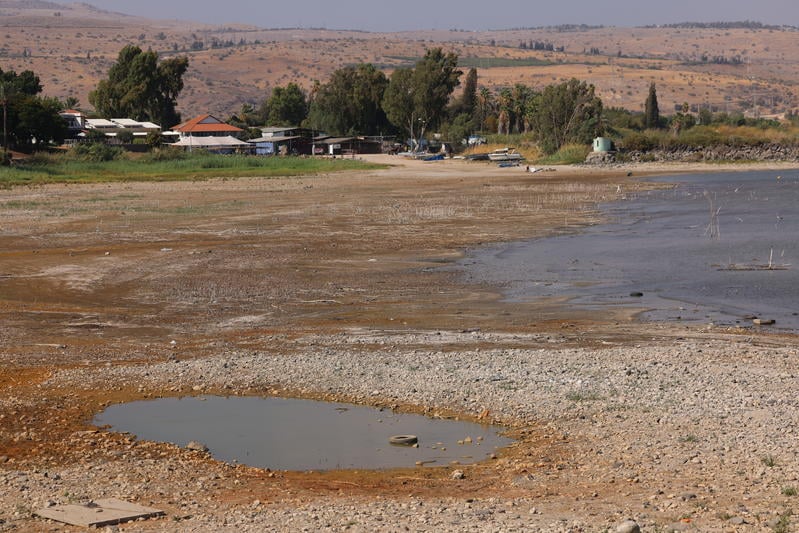
While the world focuses on the Pacific Ocean for signs of a possible “Super El Niño,” new research from Jerusalem’s Hebrew University suggests that temperature patterns in the Indian Ocean may influence prolonged dry winter spells in the Eastern Mediterranean, months in advance.
The findings could improve seasonal forecasting of drought risk in one of the world’s most water-stressed regions.
The study, due to be published in Atmospheric Research, was carried out by doctoral student Victor Murphy and Assaf Hochman of the university’s Earth Sciences Institute, with Sigalit Berkovic of the Israel Institute for Biological Research.
Forecasting dry spells lasting weeks during the Levant’s winter is difficult.
The team examined how the Indian Ocean Dipole (IOD), a recurring pattern of warming and cooling across the tropical Indian Ocean, might be connected to these arid spells.
Get The Times of Israel’s Daily Edition
by email and never miss our top stories
By signing up, you agree to the terms
By analyzing more than 70 years of climate observations and atmospheric data, the researchers discovered that positive phases of the Indian Ocean Dipole are linked to large-scale shifts in atmospheric circulation spanning the Indian Ocean, Eurasia, and the Eastern Mediterranean.
During a positive phase, warm waters are pushed to the western part of the Indian Ocean, and cold waters from the deep rise to the surface in the Eastern Indian Ocean. These shifts favor stable high-pressure systems that suppress rainfall and increase the likelihood of prolonged winter dry spells. The study also found that conditions in the Indian Ocean during December connect with an increased chance of especially long dry spells later in the winter.
People sit at a waterfront coffee shop near Ulee Lheue beach, one of the areas hardest hit by the 2004 Indian Ocean tsunami, in Banda Aceh, Aceh Province, Indonesia, December 14, 2024. (AP Photo/Achmad Ibrahim)
“When we think about drought in the Eastern Mediterranean, we rarely think about the Indian Ocean,” said Berkovic. “Yet our research shows that what happens thousands of kilometers away can reshape the atmospheric circulation that determines whether our region experiences weeks without rain. This highlights just how interconnected Earth’s climate system really is.”
“Weather in the Mediterranean is not controlled only by local conditions,” said Hochman. “Our results show that changes in the tropical Indian Ocean can trigger atmospheric processes that ultimately shape winter rainfall in the Levant. Understanding these long-distance climate connections gives us valuable insight into predicting weather extremes months in advance.”
Rather than focusing on El Niño alone, the study emphasizes that multiple tropical oceans contribute to seasonal climate variability and that incorporating Indian Ocean conditions into forecasting systems could improve predictions of drought risk and other weather extremes in the Eastern Mediterranean.

Fire and Rescue Services operate in the coastal city of Ashkelon during widespread flooding in southern Israel overnight on December 12, 2025. (Courtesy/Fire and Rescue Service)
The Israel Meteorological Service warned earlier this month that life-threatening urban flooding, wind gusts of up to 150 kilometers (93 miles) per hour, oversized hailstones, and extensive lightning storms could hit Israel as the El Niño phenomenon tightens its grip.
El Niño is a phenomenon that occurs every two to seven years, during which surface temperatures in the central and eastern equatorial Pacific Ocean warm up and the global jet stream is disrupted.
We can’t do this work alone.

The war with Iran has been draining for all of us in Israel. But when I heard about a high casualty incident – ballistic missile impacts in Arad and Dimona that left nearly 200 people wounded – I drank a cup of coffee, packed a bag, and headed south.
There, I spoke with Shilgit, the head of an after-school program for underprivileged youth. Standing outside her destroyed center, Shilgit said it was a miracle that no children were hurt and spoke about the community coming together in the hours since.
As a Times of Israel reporter, I’m committed to telling stories of resilience like Shilgit’s. But my colleagues and I can’t do this alone. If you value work like this, please consider joining our reader support group, The Times of Israel Community. Your financial support is essential to keep real human reporting like this going.
— Stav Levaton, military reporter
Already a member? Sign in to stop seeing this
You’re a dedicated reader

That’s why we started the Times of Israel – to provide discerning readers like you with must-read coverage of Israel and the Jewish world.
So now we have a request. Unlike other news outlets, we haven’t put up a paywall. But as the journalism we do is costly, we invite readers for whom The Times of Israel has become important to help support our work by joining The Times of Israel Community.
For as little as $6 a month you can help support our quality journalism while enjoying The Times of Israel AD-FREE, as well as accessing exclusive content available only to Times of Israel Community members.
Thank you,
David Horovitz, Founding Editor of The Times of Israel