
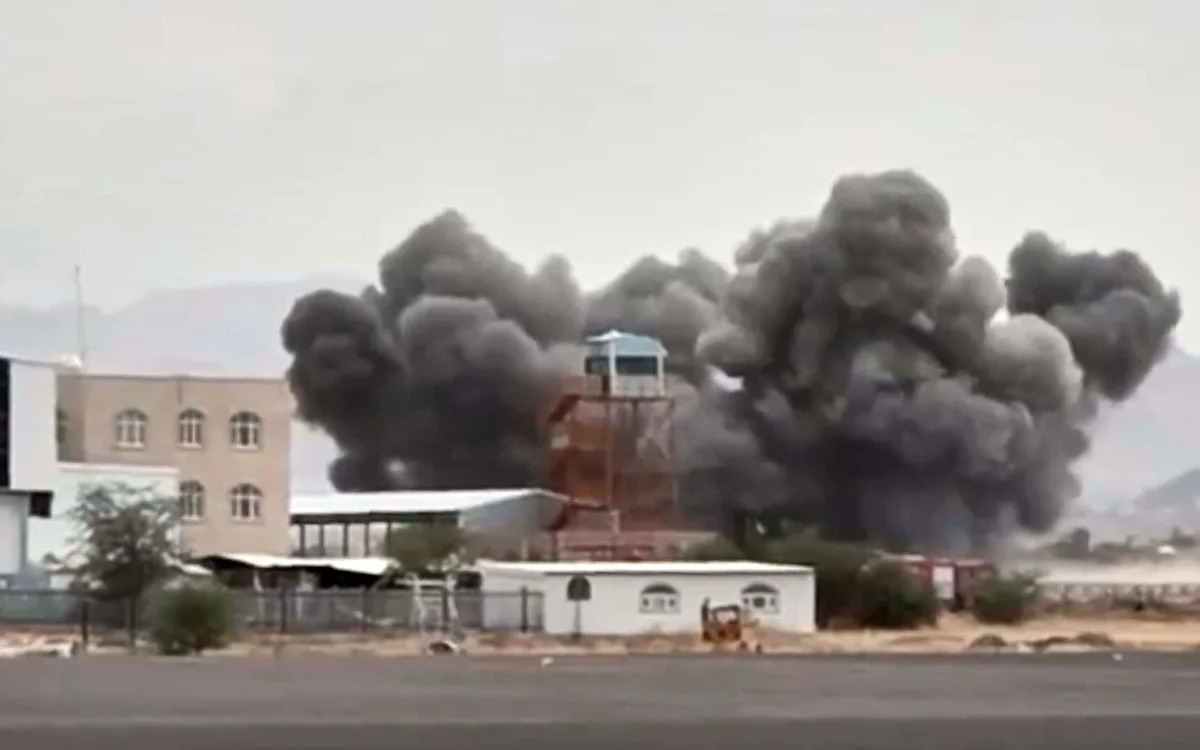
Saudi Arabia has opened a new front in the Iran war after bombing Sana’a airport in Yemen.
The strike on Monday damaged the runway and prevented an Iranian airliner from landing in the Yemeni capital, which is controlled by the Houthis, a pro-Tehran proxy militia.
The airport bombing was claimed by the internationally recognised Yemeni government, which is heavily backed by Riyadh.
However, the Yemeni administration lacks a functioning air force and a Houthi spokesman accused Saudi Arabia of conducting the attack.
Two US officials told Axios that Donald Trump gave Crown Prince Mohammed bin Salman of Saudi Arabia his support for the military action.
The Houthis later fired missiles towards southern Saudi Arabia, which the kingdom said it intercepted.
The incident breaks a four-year truce between Riyadh and the Shia militia, which followed a decade-long war that killed approximately 377,000 people, according to United Nations estimates, most of which were caused by starvation and the collapse of infrastructure.

An image from Houthi media shows damage to the airport runway
There has been an informal but broadly stable ceasefire since March 2022, with the Houthis retaining control of the capital Sana’a and port city of Hodeidah, among other territory.
Tensions reignited on July 3 after an Iranian airliner landed at Sana’a, despite reported warnings from Saudi warplanes not to.
The Houthis claimed this was to fly a delegation to Tehran for the funeral of Ali Khamenei, the former supreme leader, as well as for medical evacuations.

Houthi supporters demonstrate against airstrikes on Sana’a airport – Reuters
The following day the Yemeni government said that the “Iranian regime’s operation of a direct flight” to Sana’a had been a “flagrant violation” of Yemen’s sovereignty.
The potential re-establishment of an airbridge between the Islamic republic and its proxy in Yemen has prompted alarm in parts of the Middle East, including Israel, which has been repeatedly targeted by Houthi ballistic missiles.
Monday’s flight diverted and landed safely at Hodeidah airport, in the west of the country, on the Red Sea, according to Iran’s state broadcaster.

Members of a Houthi delegation arrive at the Yemeni city of Hodeidah having travelled to Tehran – Al-Masirah TV
Tehran has threatened to use the Houthis to impose a maritime blockade in the Red Sea.
Vessels using the Suez Canal must pass through the relatively narrow Bab el-Mandeb between Djibouti and Yemen, where they are vulnerable to land and sea-based Houthi attacks.
A second blockade on top of the violence in the Strait of Hormuz would escalate the economic crisis prompted by the war, which started with the US-Israeli attacks on Tehran on Feb 28 – and probably hand the Iranian regime a further bargaining chip.
Yemen is effectively divided into two states: the Houthi-controlled zone and the territory controlled by the Saudi-backed government, which has its seat in the southern city of Aden.

Saudi Arabia has not commented on the bombing of Sana’a airport.
A spokesman for the Saudi-led military coalition in Yemen said the kingdom had intercepted missiles “launched by the terrorist Houthi militia towards the southern region”.
Yahya Saree, the Houthis’ military spokesman, said the group had targeted the international airport in Abha, capital of Saudi Arabia’s mountainous southern region where many Saudis visit to escape the summer heat.
In a video statement, he also warned airliners against flying through Saudi airspace, saying the warnings should be “taken seriously until the blockade on Sana’a International airport is lifted”.
