
The Knesset plenum passed into law on Wednesday the contentious bill that seeks to significantly weaken the attorney-general’s power to influence and oversee the government.
The bill passed in its final second and third readings with 65 lawmakers in favor and 51 against.
The bill is considered one of the flagship pieces of legislation that Prime Minister Benjamin Netanyahu’s coalition has been pushing to pass in the government’s term.
Its passage comes amid the government’s ongoing rift with the judiciary and Attorney-General Gali Baharav-Miara.
The legislation was sponsored by MK Simcha Rothman (Religious Zionist Party) – who leads the Knesset’s Constitution Law and Justice Committee where the bill was advanced – along with other coalition MKs.
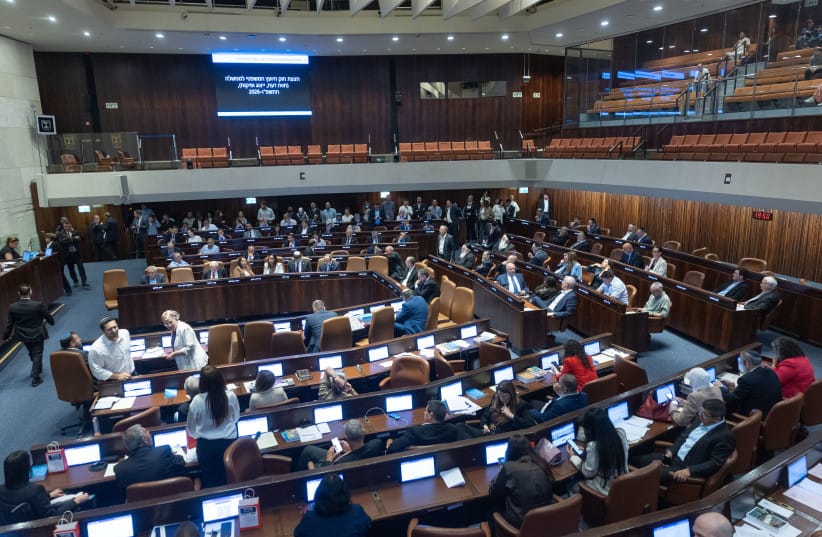 MK’s attend a plenum session and a vote on a bill to split the duties and powers currently held by the attorney general between two separate officeholders, at the assembly hall of the Knesset, the Israeli parliament in Jerusalem, July 15, 2026. (credit: YONATAN SINDEL/FLASH90)Coalition passes contentious attorney-general reform bill
A main proposal of the legislation will grant the government the ability to disregard the attorney-general’s legal opinions, which are generally treated as binding on the executive branch unless a court rules otherwise.
Another core proposal removes the A-G’s exclusive authority to present the state’s position in court.
The legislation also allows the government to determine how to appoint and dismiss the attorney-general.
The current method of firing the A-G requires a committee led by a retired Supreme Court justice.
The government voted to fire Baharav-Miara last August, though the High Court subsequently struck down that decision.
The Israel Democracy Institute (IDI) has noted that the functions being altered by the legislation are the primary tools enabling the attorney-general to safeguard the rule of law.
IDI added that the bill could “undermine the independence of the law enforcement system, strengthen the government, and remove checks on its power in a manner that would destabilize Israeli democracy and its protection of the rule of law and human rights.”
Legal scholars have also warned that the bill would place unprecedented power in the government’s hands over its principal legal challenge.
The legislation is scheduled to be enacted on January 1, 2027, after the upcoming elections.
Within 30 days of the law taking effect, it requires the government to adopt a new decision on the procedure for appointing and removing the attorney-general from office.
What does Israel’s attorney-general do?
Israel’s attorney-general is not simply the equivalent of the US or UK attorney-general. The Israeli role combines several functions: legal adviser to the government, interpreter of the law for the executive branch, representative of the state in court, head of the state prosecution system, and final authority on major criminal decisions involving senior public officials.
The current government has repeatedly clashed with Baharav-Miara, claiming that she was intentionally blocking policy initiatives. She has been accused of conducting “witch hunts” by ministers and coalition MKs.
Two core disagreements the government has had with Baharav-Miara were over her refusal to cancel the trial against Netanyahu midstream and her insistence on enforcing High Court decisions to seize funds of haredi (ultra-Orthodox) draft dodgers.
Baharav-Miara was appointed to the position during the previous government’s tenure. She has also warned against the legislation.
The bill has been amended in Knesset committee meetings since its first reading to expedite the legislative process before the Knesset recess ahead of the upcoming elections.
The coalition has been on a legislative blitz to advance as many bills as possible this week before the recess. Another contentious bill, soon set for a vote, seeks to enact sweeping reforms to Israel’s broadcasting sector, which is led by Communications Minister Shlomo Karhi.
A key aspect removed from the bill was the attempt to split the duties and powers currently held by the attorney-general between two separate officeholders: an attorney-general and a prosecutor-general.
The Knesset’s Constitution Law and Justice Committee has been holding marathon meetings for months on the legislation to advance it before the end of the government’s term.
For supporters, the bill is a democratic correction to an overly powerful legal office. For opponents, it is one of the most consequential parts of the government’s legal overhaul and strips the attorney general of their role.
Immediately after its passage, petitions were filed to the High Court of Justice to strike down the legislation.
Petitions were filed by the Movement for Quality Government in Israel (MQG), the Association for Civil Rights in Israel, and MK Gilad Kariv (the Democrats) and the Zulat Institute.
MQG condemned the legislation, calling it “another link in the chain of the regime overhaul: a law that allows the government to decide for itself that a legal opinion ‘does not reflect the law.'”
Justice Minister Yairiv Levin and other coaltion lawmakers praised the passage of the bill.
Levin said that “the law approved today is another central pillar of the judicial reform.”
Opposition party leaders in the bloc seeking to replace Netanyahu condemned the passage of the bill and pledged to repeal it after the upcoming elections.
Yashar Party leader Gadi Eisenkot stated that the bill was “a blatant attempt to neutralize Israel’s gatekeepers and dismantle the rule of law.”
He warned that the move sets a dangerous precedent in which the government “places itself above the law and abandons the most fundamental obligation of any democratic state.”
Yonah Jeremy Bob contributed to this report.