
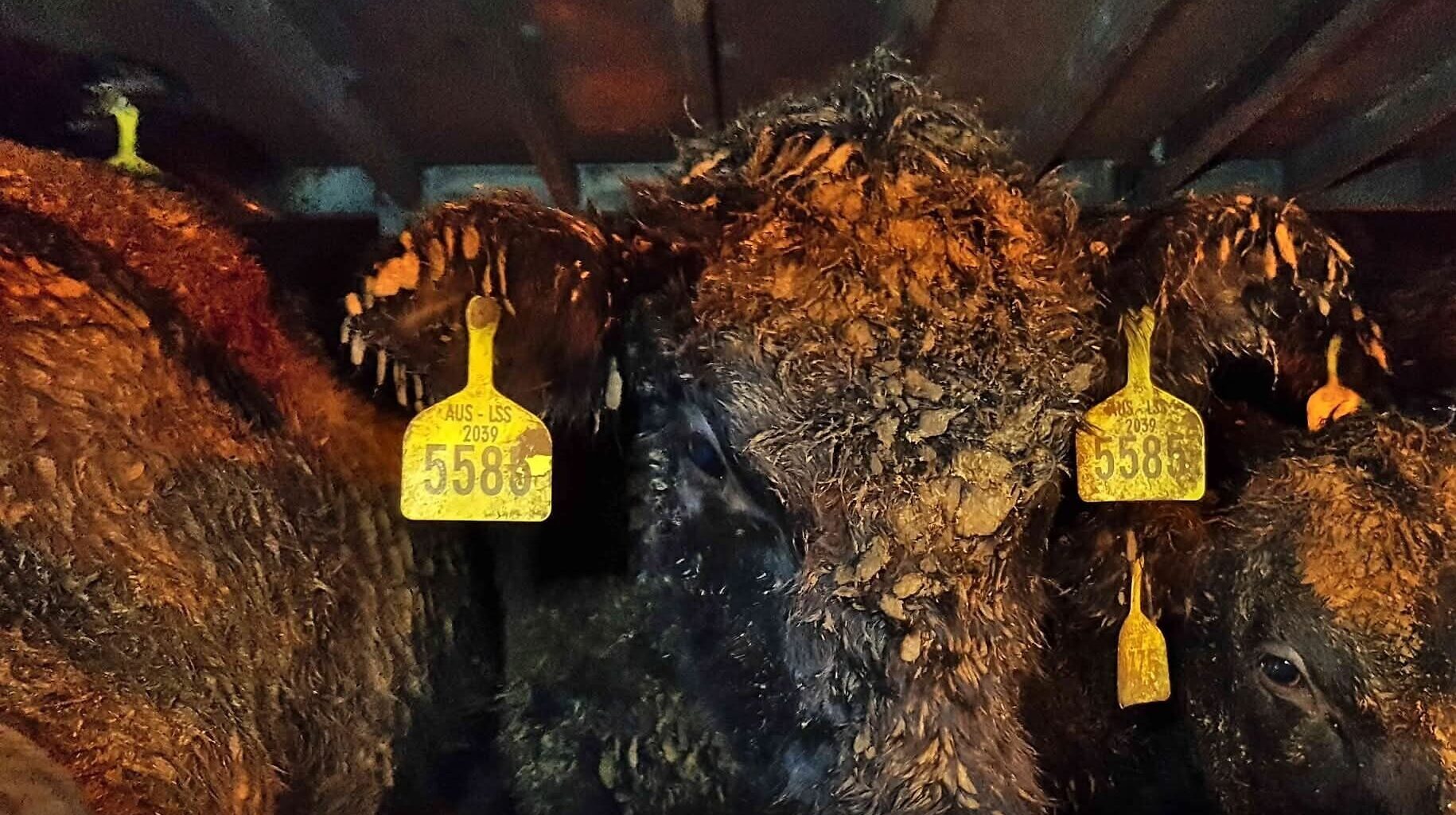
Animal welfare activists are once again petitioning the High Court to stop the transport of live animals by sea to Israel for fattening and slaughter on the grounds of severe animal cruelty.
Freedom for Animals, which is behind Israel Against Live Shipments, on Thursday submitted a nearly 500-page document that includes the harrowing testimonies of three individuals with experience in the industry.
The petition demands the gradual cessation of such live transports over three years, with interim regulations to stipulate that conditions for animals in sea transport should not be worse than the minimum animal welfare standards established under Israeli law. It also seeks an immediate halt to maritime transport lasting over 10 days.
“Today, there is no longer any dispute that the live shipments constitute severe animal abuse,” the petition says. It describes extreme stress; disease; extreme heat “that cooks the animals while they are still alive”; lack of access to food and clean water; high ammonia concentrations generated by urine that damage the mucous membranes of the animals’ eyes and noses; and extreme crowding, which exacerbates stress, causes injury, and prevents rest and access to food and water for weaker animals.
Until the 1990s, Israelis had access to locally grown and slaughtered meat as well as to imports of frozen and chilled meat.
Get The Times of Israel’s Daily Edition
by email and never miss our top stories
By signing up, you agree to the terms
In the 1990s, the state began reducing tariffs on the import of livestock, scrapping them completely from 2014, while still taxing imports of frozen and chilled meat. Since then, live shipments have expanded exponentially, peaking in 2021-2022, with the import of almost 300,000 calves and over 540,000 lambs per year.

Gasping for air on a ship transporting animals for fattening and slaughter in Israel. (Israel Against Live Shipments)
The shipments used to depart from Europe on 4- to 11-day journeys, or from Australia on trips lasting up to 18 days. In the wake of Houthi terror attacks in the Red Sea and legislation in Australia that will gradually ban live animal exports, Israel has licensed the import of livestock from Uruguay, which can take up to 27 days.
In a 2017 ruling, the High Court refused to order a halt to live shipments, but ruled that animal suffering should be reduced as much as possible. The Veterinary Services subsequently introduced regulations governing multiple conditions, such as ship ventilation and the minimum daily supply of food and clean water.
In 2018, the Knesset greenlighted a bill in its preliminary reading to phase out live shipments over three years.
According to this month’s petition, however, the regulations were not only formulated in breach of the law, but have dismally failed to reduce animal suffering. The petitioners and their expert witnesses say the animals still wallow in their own feces, which cake their bodies and fill their water troughs, and suffer from broken limbs as they are tossed around at sea, with many left to die from injuries or lack of food and water.

Animals on a live shipment. (Israel Against Live Shipments)
“Not only is it (the set of regulations) not enforced… even if it were enforced, it anchors rules that deviate massively from any minimum standard of animal welfare established in Israel,” the petitioners charge.
The petition cites a 2022 Knesset Information and Research Center report, which found that encouraging the import of chilled meat rather than live animals would bring meat prices down after an initial increase.
Since the 2017 High Court petition, New Zealand has banned live animal exports, as have Britain (except for Northern Ireland), Australia (by 2028), and India.
We can’t do this work alone.

The war with Iran has been draining for all of us in Israel. But when I heard about a high casualty incident – ballistic missile impacts in Arad and Dimona that left nearly 200 people wounded – I drank a cup of coffee, packed a bag, and headed south.
There, I spoke with Shilgit, the head of an after-school program for underprivileged youth. Standing outside her destroyed center, Shilgit said it was a miracle that no children were hurt and spoke about the community coming together in the hours since.
As a Times of Israel reporter, I’m committed to telling stories of resilience like Shilgit’s. But my colleagues and I can’t do this alone. If you value work like this, please consider joining our reader support group, The Times of Israel Community. Your financial support is essential to keep real human reporting like this going.
— Stav Levaton, military reporter
Already a member? Sign in to stop seeing this
You’re a dedicated reader

That’s why we started the Times of Israel – to provide discerning readers like you with must-read coverage of Israel and the Jewish world.
So now we have a request. Unlike other news outlets, we haven’t put up a paywall. But as the journalism we do is costly, we invite readers for whom The Times of Israel has become important to help support our work by joining The Times of Israel Community.
For as little as $6 a month you can help support our quality journalism while enjoying The Times of Israel AD-FREE, as well as accessing exclusive content available only to Times of Israel Community members.
Thank you,
David Horovitz, Founding Editor of The Times of Israel