
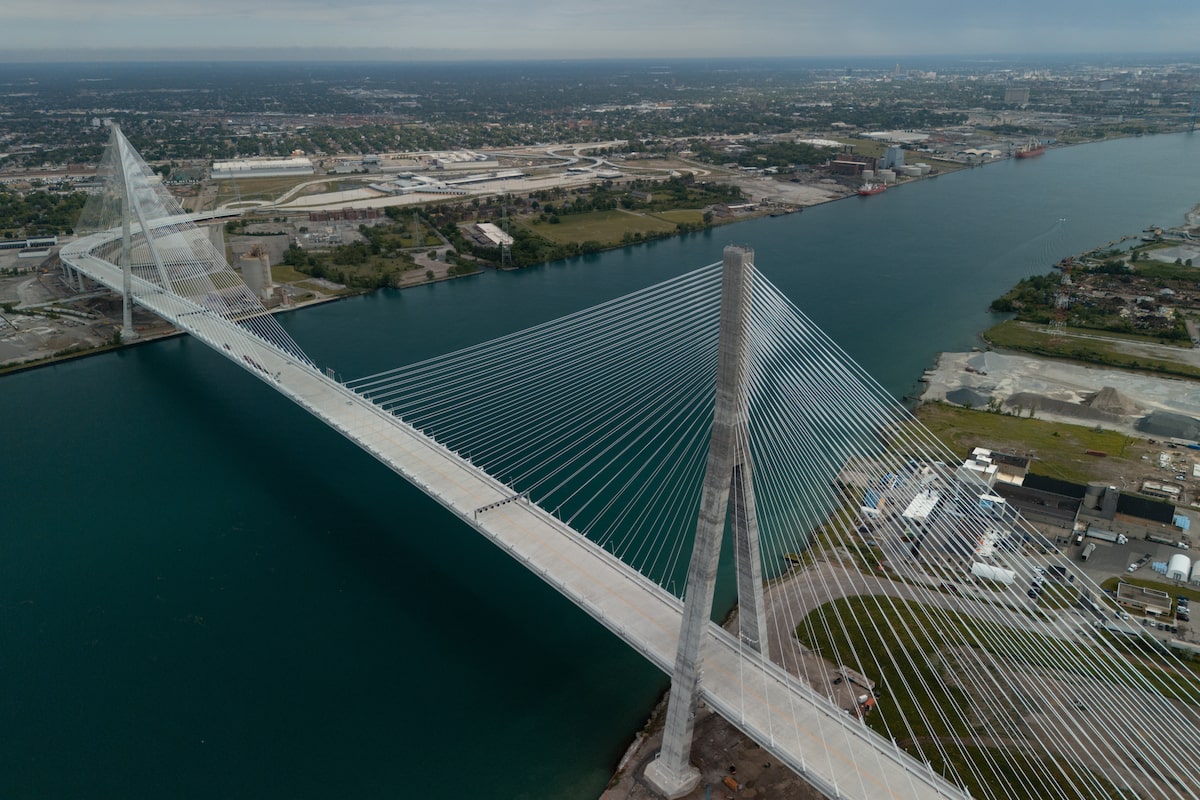
The Gordie Howe International Bridge between Windsor, Ont., and Detroit is scheduled to open July 27.Dax Melmer/The Globe and Mail
Prime Minister Mark Carney says the cross-border Gordie Howe International Bridge might run at a loss in the first few years of operation and defended a deal last week with Donald Trump that directs some of its revenue to bolster Michigan’s economy.
This would mean that Canada won’t have much, if any, toll proceeds from the new bridge to share with the United States at the outset.
Mr. Carney was attempting to clear up questions about a deal announced July 10 with Mr. Trump that satisfied the President’s objections to the bridge toll proceeds.
The Prime Minister said net revenue from tolls, after expenses are stripped out, could be negative at first.
The new Windsor-Detroit crossing, along one of Canada’s most important trade corridors, is set to open after months of uncertainty stemming from a threat by the U.S. President to block its debut.
Mr. Carney, speaking to reporters Thursday during an unrelated news conference in London, Ont., played down the costs to Canada of pacifying Mr. Trump.
Canada, which solely financed the $6.4-billion cost of building the bridge, based on a 2012 agreement with Michigan, was planning to recoup this money over decades by collecting the entirety of the tolls. This would have covered both the money it advanced and the funds borrowed to finance construction.
But in the new agreement announced last week, Canada will share some toll proceeds with the United States for the next decade and a half. Mr. Trump, in a social-media post over the weekend, called this a “MUCH BETTER DEAL for America.”
According to Ottawa, for 15 years Canada will send half of the toll revenue that’s left over, after expenses, to an economic development fund that will benefit the U.S. regional economy near the bridge – namely Michigan.
Explainer: What to know about the Gordie Howe bridge deal
On Thursday, Mr. Carney offered more detail on the deal, calling the money to be split the “net revenue after operational expenses.” He said expenses include staffing toll booths, maintenance, snow removal and other costs.
There may be nothing to share with the United States in the first few years, he suggested.
“We expect that after those costs, for the first few years, net revenues will be modest – in fact, we expect them to be negative,” Mr. Carney said. This would be because bridge traffic has only started growing, “so negative to modest in the first few years.”
His explanation Thursday left many details unclear, particularly when the Prime Minister suggested at one point that “any sharing of the toll revenue won’t happen until all of the debt – all of the debt – is repaid.”
Conservative MP Shuvaloy Majumdar, the party’s critic for Canada-U.S. relations, accused the Prime Minister of sowing confusion on the bridge deal and urged him to release the text of the new agreement with Mr. Trump.
He said the public record of statements about the Trump deal have become a “giant dumpster fire mess that does not explain clearly to Canadians what exactly” was agreed upon.
Mr. Majumdar said he has sympathy for the federal government because “they’re dealing with a very tough and unpredictable negotiator” in Mr. Trump. “Yet they owe the country transparency on what they conceded” in the talks on opening the Gordie Howe Bridge, he said.
In 2012, the Canadian government agreed to pay the full $6.4-billion price tag for the bridge after the Michigan legislature refused to chip in. The Moroun family, which owns the existing Ambassador Bridge between Windsor and Detroit, had been lobbying against the Gordie Howe bridge.
The 2012 agreement between Canada and Michigan suggested that it could take the Canadian government 50 years to recoup the money it had spent on the Gordie Howe bridge. That was before the profit-sharing deal with the United States announced last week.
Campbell Clark: A U.S. bridge shakedown in a rough world
The Prime Minister on Thursday said the underlying 2012 deal with Michigan is still intact. He said it’s wrong to characterize the Trump agreement as toll-sharing because in fact it’s only sharing net revenue after expenses.
“The underlying agreement that we have with Michigan remains the same, and so no sharing of tolls until all the debt is repaid.”
Mr. Carney defended the fact that part of the net revenue will flow to Michigan even before the full cost of the bridge is paid off, suggesting any boon to the regional economy could ultimately benefit trade with Canada.
“All of the portions that go to the U.S. government will be reinvested in economic development, regional economic development in the area, the U.S. side of the area, obviously, which is pro-cyclical,” he said.
“It reinforces, you know, more traffic, higher revenues, more investment, and that’s the way it moves forward.”
Podcast: What Canada gave up to (hopefully) open the bridge
Mr. Carney made no commitment to release the text of the agreement with Mr. Trump.
As The Globe and Mail reported earlier this week, citing an unnamed source, the deal also includes a provision requiring U.S. approval to lower tolls below a regional average. The Globe is not naming the source because they were not authorized to confirm the details publicly.
The timing of the Gordie Howe bridge’s debut was thrown into doubt in February, when Mr. Trump threatened in a social-media post to prevent it from opening and said Canada should give the U.S. government “at least one half” of the asset.
Mr. Trump’s threat came shortly after Matthew Moroun, chairman of the company that owns the Ambassador Bridge, donated US$1-million to a pro-Trump campaign group and reportedly met with U.S. Commerce Secretary Howard Lutnick.
A later planned opening in June was again delayed by the White House. As The Globe reported at the time, citing a U.S. industry source, the American government slammed the brakes on the opening because Mr. Lutnick and Pete Hoekstra, Washington’s ambassador to Canada, wanted to first negotiate a deal to help Michigan’s Moroun family mitigate their losses from competition by the new, publicly owned bridge.
The bridge is named after Canadian hockey legend Gordie Howe, who played for the Detroit Red Wings for 25 seasons.