
Until this week, I had never heard of an influencer named Clavicular.
Then he came to Israel, and Jewish social media erupted. Some were furious that a person associated with notorious antisemites was being treated as a guest.
I was not following the debate, and honestly, it meant nothing to me. Until people began arguing about what the Rebbe would have said about engaging with antisemitic people, and that caught my attention.
Despite some loud voices claiming (incorrectly) that the Rebbe would have never approved of publicly touring Israel with a non-Jewish influencer who has been on video doing anti-Jewish things, The Rebbe consistently taught that public confrontation can sometimes make matters worse.
When Jews protested against French then-president Pompidou for selling fighter jets to Libya in 1970, France responded by ending even its small, quiet arms sales to Israel. Years later, when Senator Jesse Helms (then a longtime opponent of Israel) was honored at a Chabad event, the relationship helped transform him into a strong supporter.
When Alan Dershowitz criticized that decision, the Rebbe responded: “it does no good to engage in a cold war which often turns into a hot war. Nor does it serve any useful purpose to brand one an enemy or an antisemite, however tempting it is to do so. It can only be counter-productive… We haven’t too many friends and attaching labels will not gain us any.”
It may feel very righteous and satisfying to “say it as it is” but it almost never changes the other person. The goal of our actions should not be to make us feel better, but to influence the other person, and try to bring out something better within them.
That doesn’t mean every invitation is wise. It just means that labeling people and declaring them beyond hope is not the Rebbe’s way. Nor is it effective.
For the past two weeks, I have been teaching (and studying deeply) the events that led to the destruction of Jerusalem by the Romans.
The story of Roman occupation began when two brothers, Hyrcanus and Aristobulus, both felt they should rule over Israel. On the brink of a civil war, each brother sent a delegation to the Roman general Pompey asking Rome to fight on their behalf. And then a third delegation of Jews who couldn’t stand either prince asked Rome to ignore them both.
What none of them realized, is that once Rome became the mediator, it would soon become the master. Rome entered Jerusalem because the Jews living there could not get along. And once Rome entered, they never left.
A century later, during the siege of Jerusalem, the internal fighting became even more horrifying.
Jerusalem was surrounded by the Roman army who had come to quash the rebellion of Jews who could no longer handle the Roman taxes and oppression. According to Josephus, over a million Jews were crowded into the holy city, many fleeing the invading army, and many more who had come for Pesach before the siege began.
But these Jews were not only trapped by the Roman legions outside the walls of Jerusalem. Inside were Jewish factions fighting one another. The Zealots wanted to free Israel and fight Rome at any price. The more moderate leadership wanted to surrender to Rome, ensuring they would be able to live as Jews in their own land.
In the eyes of the fighters, anyone considering surrender was a Jewish traitor. To prevent surrender, the Sicarii (the most zealous Zealots) killed thousands of Jews within Jerusalem to take control of the besieged city. The Jews inside were now trapped by Roman soldiers outside the walls, AND by the Jewish extremists inside the walls.
Yet despite the enormous population and the tightening siege, Jerusalem had food. Three extraordinarily wealthy men had filled massive storehouses with wheat, barley, oil, wine, salt and wood. The Talmud (Gittin 56a) says there were enough supplies to sustain the city for 21 years.
Jerusalem had food and time. It could have negotiated an end to the siege from the overwhelmingly powerful Roman army. This would have saved Israel. But to the Zealots, surrender was a betrayal of G-d. To them, every “believing Jew” had to fight Rome until the very end.
The problem was that if the people had food, they would not become desperate enough to join the Zealots in battle.
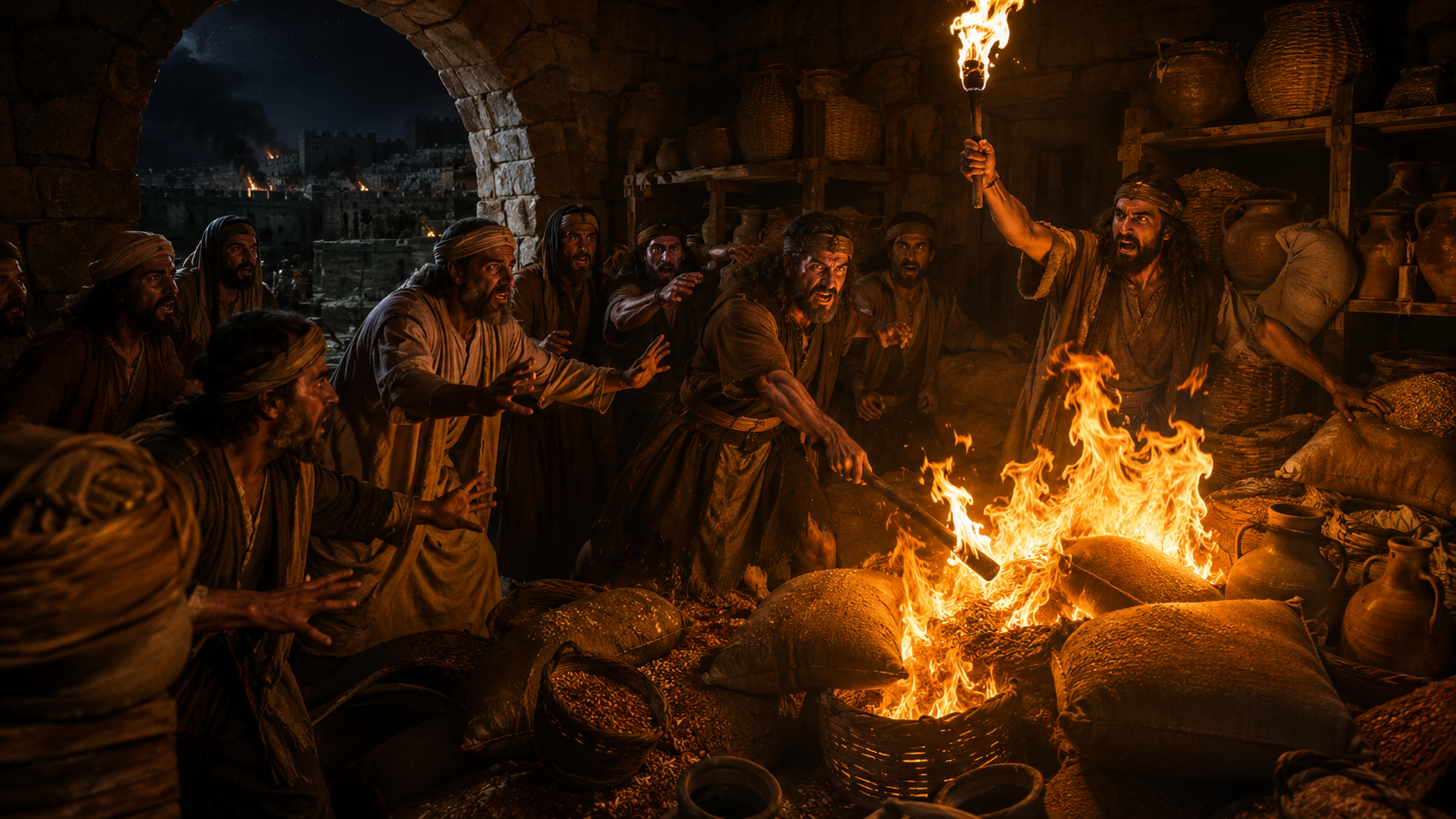
So the Zealots burned the storehouses.
Understand what this means.
The city is packed with starving citizens and terrified refugees. The Roman army has surrounded the walls, trapping everyone within. And then, from within the city itself, Jewish hands set fire to the warehouses containing their food and their ability to survive.
It was not Romans, but Jews, who burned the supplies that could have fed starving children, and forced a famine upon us.
To us, it sounds insane. How could Jews knowingly starve their own people?
But in their minds, it made perfect sense. They did not see themselves as cruel. They saw themselves as courageous.
They did not believe they were endangering the Jewish people. They believed they were saving the Jewish people – from their own dependence and fear.
They were so certain of the righteousness of their cause they could justify almost anything done in its name. If hunger would force the people to fight, then hunger was justified.
This, in short, is the historical background to the famous talmudic teaching (Yoma 9b) that unlike the First Temple which was destroyed because of our idolatry and sinful ways, the Jews living during the Second Temple were far more religious and learned. The reason the Second Temple was destroyed was “sinas chinam” – senseless hate between Jews.
Sounds pretty bad to hate someone senselessly, doesn’t it.
But I must say, that in all my years as a rabbi I don’t think I ever once met someone who admitted to being guilty of senselessly hating someone “for no reason.” What I have heard many times are passionate explanations of why that person is so terrible, and why they deserve to be hated forever.
So what does “senseless” hate even mean? Is there anyone who can’t justify their hate?
“Senseless hate” does not mean hatred without an explanation. The Zealots had reasons. The moderates had reasons. Hyrcanus and Aristobulus had reasons. Each side was convinced that the other was endangering the Jewish people.
Everyone who hates has a just and noble “cause” that justifies their behavior.
Hatred becomes “senseless” when I no longer merely believe that your position is wrong, but that you, the person, are evil.
On Monday, as I taught this story of Jews burning the storehouses, people in the class were in shock. How could wise Jews have become so blinded to the danger of their deeds?
But are we really so different today?
How many people do you know who have labels and name tags for anyone who holds a political opinion with which they disagree. Where the other is branded a “stupid liberal,” or a “hate-filled fascist,” or maybe even the all-time derogatory title of “self-hating Jew.”
I know way too many who see those on the other side of their political viewpoints as traitors or enemies of the Jewish people.
As a society, we no longer debate ideas. We destroy the person. We ridicule their intelligence, and we question their morality.
Worst of all, we convince ourselves that this is not hatred. No, it is righteous anger. We are “standing up for truth,” protecting Israel, defending democracy, saving the Jewish people.
And once our cause feels holy, almost anything becomes permissible. We can embarrass another Jew publicly, socially ostracize them, and destroy their reputation.
We can burn the storehouses.
And all the while, we tell ourselves that we are doing it for the sake of Jerusalem.
Jews have always disagreed, often very loudly. The danger begins when disagreement becomes dehumanization.
Calling someone evil does not help him understand your side. Calling him stupid does not make him wiser. And calling her a self-hating Jew will not make her love the Jewish people more.
I already know what some will respond to this. But do you know what that person said? How could you defend such a lowlife?
So let me be clear: Unconditional love is not unconditional approval. You can oppose someone’s views, refuse to give him a platform and protect your community.
But you cannot declare that another human being is beyond hope.
The Rebbe never ignored danger or excused wrongdoing. But he refused to surrender a human being to his worst moment.
The Rebbe taught us to see the person. To remember that beneath every political position is a Jewish soul. Beneath every angry argument is a human being created in the image of G-d.
I honestly do not know whether welcoming Clavicular to Israel was wise. What I do know is that we need to learn how to disagree without burning the storehouses.
We can challenge dangerous ideas while still believing that the person expressing them is inherently good and may yet change. We can defend what we believe without humiliating every Jew who chooses a different strategy.
So before we attach our next label, ask yourself: Am I trying to influence this person, or merely defeat him?
Am I helping rebuild Jerusalem, or am I lighting another match?
With prayers for a Happy Tisha B’av, celebrated together with Moshiach, in the third Temple!
Good Shabbos!
Rabbi Yankie & Chana Denburg