
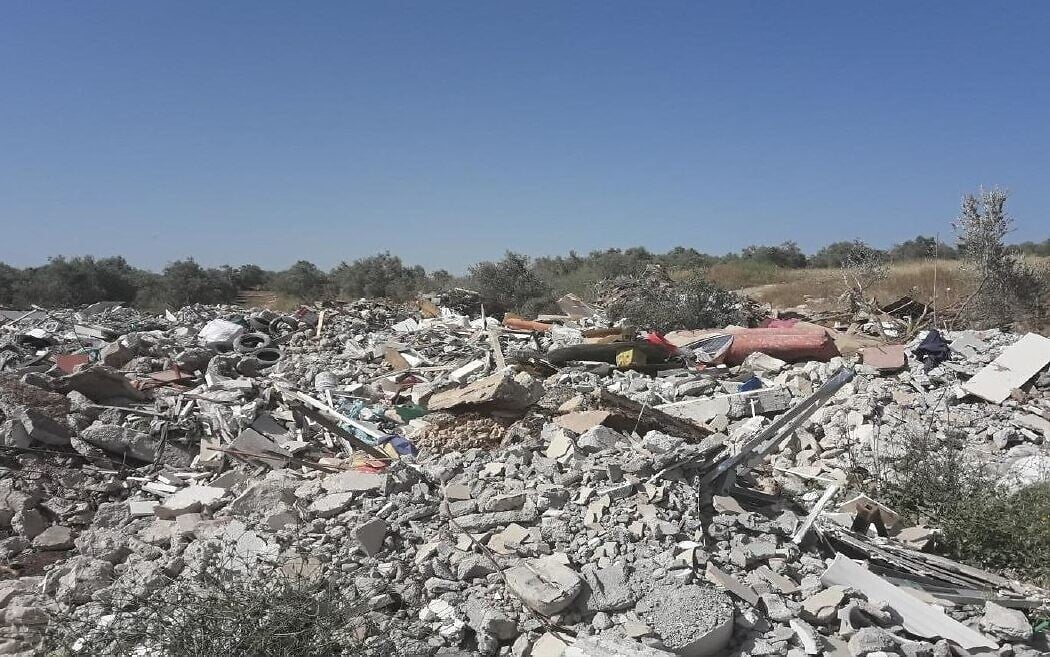
The Knesset on Thursday passed a long-awaited bill to curb the illegal dumping of construction debris in Israel’s countryside.
By strengthening regulation, supervision and enforcement of waste disposal, the legislation seeks to minimize environmental damage and transform construction waste into a resource for reuse.
However, how the law’s implementation will be funded remains unclear, as the measure was not included in the 2026 state budget.
Some 7.5 million tons of construction waste — including concrete, asphalt, tiles and glass — are generated in Israel annually. Of this, nearly one million tons are illegally dumped in open spaces by haulers intent on avoiding the costs of transporting materials to distant sorting and landfill facilities.
This practice causes environmental damage, as waste leaches into soil and groundwater, attracts pests and creates hazardous conditions when burned.
Get The Times of Israel’s Daily Edition
by email and never miss our top stories
By signing up, you agree to the terms
Environmental Protection Minister Idit Silman hailed the law as a “true revolution” that will finally place the waste economy under a single regulatory umbrella.
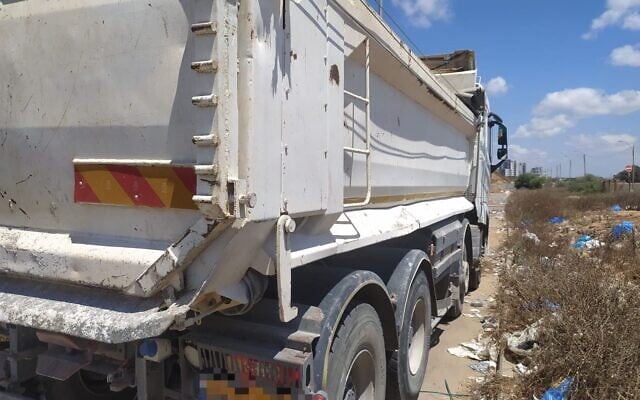
One of 12 vehicles seized by the Environmental Protection Ministry’s Green Police and the Tel Aviv District fraud unit on suspicion that they were used for the illegal dumping of building waste in Ramat Hasharon, central Israel, August 8, 2023 (Green Police)
The law, scheduled to take effect in 18 months, seeks to establish a comprehensive framework for the entire waste lifecycle, from creation at the building site through documentation, transport and final processing.
All participants in the construction sector, including waste producers and haulers, will have to be registered and licensed.
To ensure waste is not dumped en route, payments to haulage companies will be processed through a government clearinghouse. Funds will be released only once the waste has been confirmed to have reached an authorized sorting, landfill, or recycling site.
The law mandates the use of GPS and other digital tools to track transport trucks to ensure they reach regulated facilities before haulers are paid.
Instructions will be issued to promote the separation of waste at construction sites to encourage higher recycling rates. Between 70 percent and 90% of building waste currently arriving at authorized sorting sites is successfully earmarked for reuse, according to the Environmental Protection Ministry.
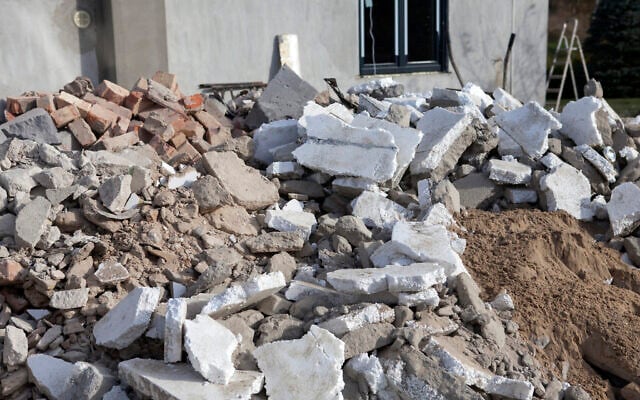
Illustrative: Construction waste. (lusia599; iStock by Getty Images)
For the first time, local authorities will be authorized to collect construction waste from small producers for a fee, and their enforcement capabilities will be expanded.
Fines are mentioned in the law, but without specifying amounts.
The law, however, does not apply to the West Bank, whose jurisdiction falls under the Israeli Civil Administration, and building waste dumping is extensive.
The issue of illegal dumping and the subsequent illicit burning of waste became a flashpoint late last year following intense protests from Israelis living near the Green Line. Citizens reported respiratory issues and severe air pollution caused by the burning of waste.
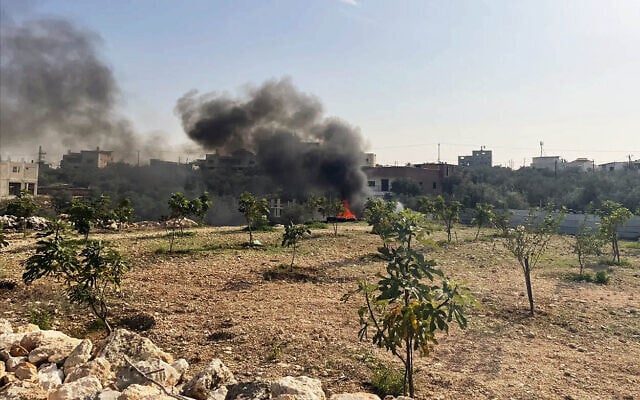
Illegal burning of electronic waste near Azzoun, northern West Bank, November 24, 2025. (Sue Surkes/Times of Israel)
Environmental groups have welcomed the law as a historic achievement.
The Society for the Protection of Nature in Israel noted that the law addresses a “national plague” that has damaged public health and natural landscapes for two decades.
The advocacy group Citizens for Clean Air highlighted the law’s potential to reduce waste fires, which it said are responsible for roughly 75% of carcinogenic air emissions in the country, provided that the government ensures rigorous implementation.
We can’t do this work alone.

The war with Iran has been draining for all of us in Israel. But when I heard about a high casualty incident – ballistic missile impacts in Arad and Dimona that left nearly 200 people wounded – I drank a cup of coffee, packed a bag, and headed south.
There, I spoke with Shilgit, the head of an after-school program for underprivileged youth. Standing outside her destroyed center, Shilgit said it was a miracle that no children were hurt and spoke about the community coming together in the hours since.
As a Times of Israel reporter, I’m committed to telling stories of resilience like Shilgit’s. But my colleagues and I can’t do this alone. If you value work like this, please consider joining our reader support group, The Times of Israel Community. Your financial support is essential to keep real human reporting like this going.
— Stav Levaton, military reporter
Already a member? Sign in to stop seeing this
You’re a dedicated reader

That’s why we started the Times of Israel – to provide discerning readers like you with must-read coverage of Israel and the Jewish world.
So now we have a request. Unlike other news outlets, we haven’t put up a paywall. But as the journalism we do is costly, we invite readers for whom The Times of Israel has become important to help support our work by joining The Times of Israel Community.
For as little as $6 a month you can help support our quality journalism while enjoying The Times of Israel AD-FREE, as well as accessing exclusive content available only to Times of Israel Community members.
Thank you,
David Horovitz, Founding Editor of The Times of Israel