

Chelsea have reached a verbal agreement with Aston Villa to sign Morgan Rogers.
A bid of £117million (€137m, $157m) has been accepted, although the deal for the attacking midfielder is still being finalised, according to sources briefed on the situation, speaking on the condition of anonymity.
Personal terms are in place on a six-year contract through to 2032 with the option of a further 12 months, and a medical is scheduled for Monday.
Rogers, 23, wants to move to Chelsea, with new manager Xabi Alonso and the club’s project a major appeal.
Arsenal were also interested in a move for the England international, but he has chosen Chelsea as his preferred destination.
The anticipated deal would represent a record transfer for Chelsea, surpassing the €121m (£106m, $131m at time of the deal) paid to Benfica for Argentina midfielder Enzo Fernandez in the 2023 winter window.
It would also eclipse the British record fee of £116m agreed by Manchester City with Nottingham Forest for the signing of England midfielder Elliot Anderson this summer.
Morgan Rogers creates the perfect midfielder
The Athletic reported in June that there is an expectation Rogers will leave Villa this summer, with Arsenal and Chelsea among his admirers.
Rogers’ existing Villa contract runs until 2030, after he signed fresh terms in November 2024. That deal added a year to his previous contract and brought his salary more in line with his standing in Unai Emery’s squad.
He moved to Villa Park from Middlesbrough in February 2024 for an initial fee of £7m plus a further £8m in add-ons, and the Championship club also has a 20 per cent sell-on clause as part of that deal.
The former West Bromwich Albion and Manchester City academy player has established himself as one of the Premier League’s most in-form attacking midfielders over the past two seasons, scoring 31 goals and adding 29 assists in 125 appearances for Villa.
Rogers provided 14 goals and 12 assists in 55 appearances across all competitions during the 2025-26 campaign as Villa qualified for the Champions League and won the Europa League.
He received his first senior England call-up in November 2024 and has featured in all six of his country’s games at the World Cup so far, starting the final group-stage match against Panama and the defeat to Argentina.
Rogers, who set up England’s only goal of the semi-final with a cross for Anthony Gordon, is with the England squad in the U.S. for Saturday’s third-place play-off against France.
A unique talent
Analysis from Aston Villa correspondent Jacob Tanswell
The Athletic previously reported that there was an expectation Rogers would leave Aston Villa.
Chelsea have been long-standing admirers, with Arsenal and a number of clubs, both in the Premier League and in Europe, closely following his situation.
Rogers is a unique talent, able to play in multiple positions and with a ball-carrying ability that continues to be refined.
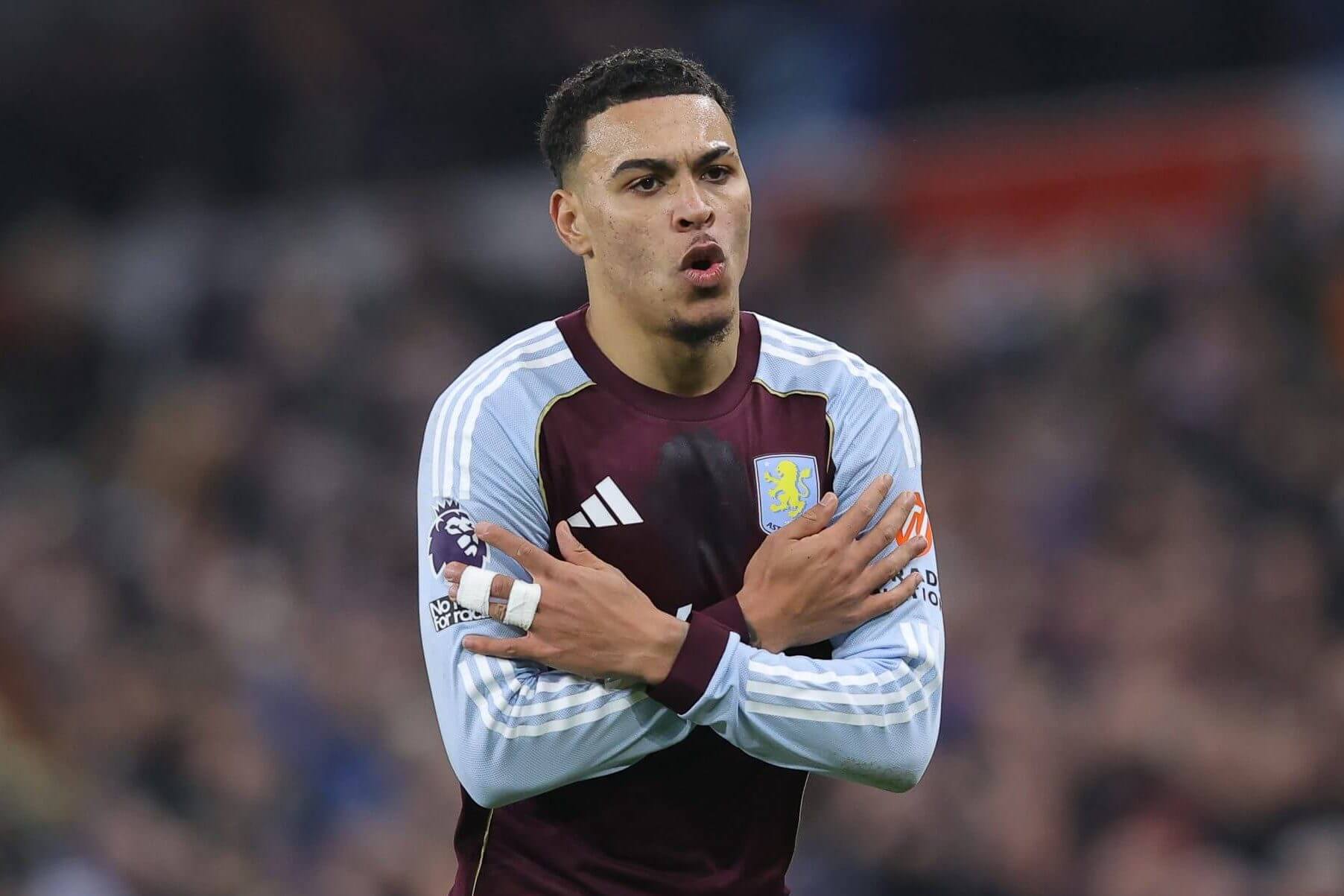
Rogers enjoyed a hugely impressive spell at Villa Park. (James Gill – Danehouse/Getty Images)
Villa were fully aware they would likely lose Rogers, but only for a fee that exceeded £100m.
They will reinvest some of that money by signing a winger, with Paris Saint-Germain’s Ibrahim Mbaye and West Ham United’s Crysencio Summerville among the leading targets, and have spent in excess of £50m for Johan Manzambi, who is a similar profile to Rogers, and £35m for Wolverhampton Wanderers midfielder, Joao Gomes, who underwent his medical on Friday.
How could Rogers and Palmer play together?
Analysis by Thom Harris
Rogers has flourished in recent campaigns for Aston Villa, consistently one of their most threatening attacking players, having racked up 28 goals and 24 assists across the last two seasons. He is at his best in open games, a powerful dribbler who can drive through midfield with the ball at his feet, while he also packs a punch from distance, scoring five times from outside the box since his Premier League debut.
The critical question is how does a player of his skillset fit into Chelsea’s side?
As pointed out by our German football correspondent Seb Stafford-Bloor, incoming Chelsea boss Xabi Alonso preferred a 3-4-2-1 attacking system at Bayer Leverkusen, where wing-backs offered width and two No 10s — namely Jonas Hoffman and Florian Wirtz — occupied the half-spaces and looked to feed the sole striker in-behind.
That could offer clues for what Alonso has in mind for Rogers. On the right, Hoffman would often drift wide to link-up with the overlapping Jeremie Frimpong, comfortable carrying the ball forward in wide spaces. That would suit Rogers, who may form a relationship with fellow new signing Marco Palestra, known for his adventurous off-ball running and full-blooded wing-back play. Meanwhile, Cole Palmer is given more freedom to drift in the ‘Wirtz’ role on the opposite side.
As we can see from their pass networks last season, both should be able to play alongside each other in those No 10 roles.
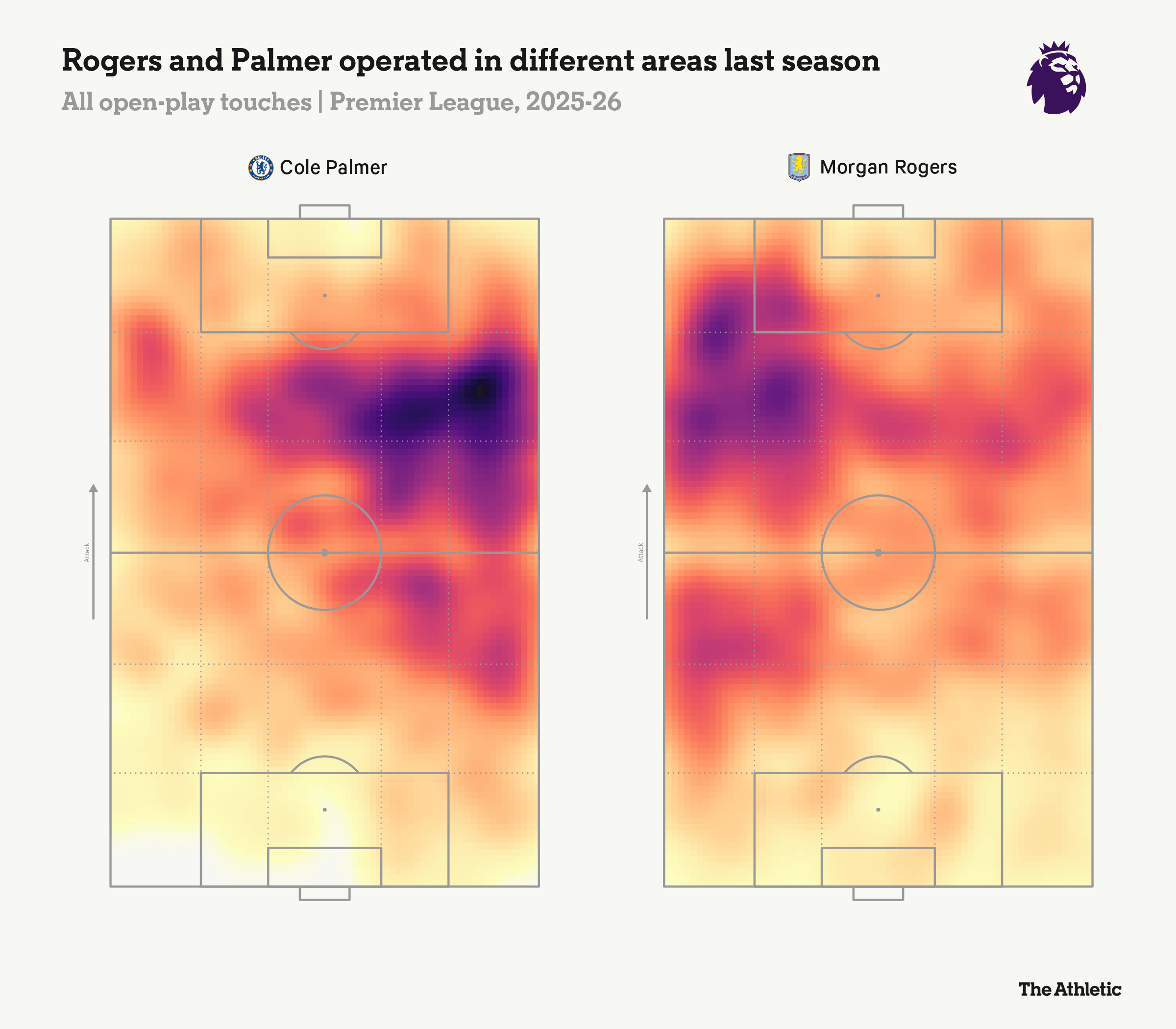
Alonso has proven his tactical flexibility across his coaching career, switching between formations throughout his stint at Real Madrid. But the acquisition of Rogers along with Palestra suggests that he is looking to recreate a winning formula and return to an expansive back-three system.
What now for Arsenal?
Analysis from Arsenal correspondent James McNicholas
Rogers was believed to be among Arsenal’s top targets for the window.
Mikel Arteta is hoping for players to bring quality and threat to the Arsenal attack, particularly from the left-hand side. Rogers was seen as a player with the versatility to contribute in a number of different roles.
The price point for Rogers however escalated significantly beyond Arsenal’s expectations. With Arsenal assessing their options, Chelsea have moved aggressively to secure the player’s signature.
Arsenal are likely to turn their attention to alternatives, such as Bradley Barcola of Paris Saint-Germain.