
Weapons buried with ancient Egyptian princesses have long puzzled archaeologists. Many believed bows, arrows, and daggers placed beside royal women served only as symbols of power or status. A new study of royal skeletons from Dahshur now points to a different answer. Some of these women likely trained with and used those weapons during their lives.
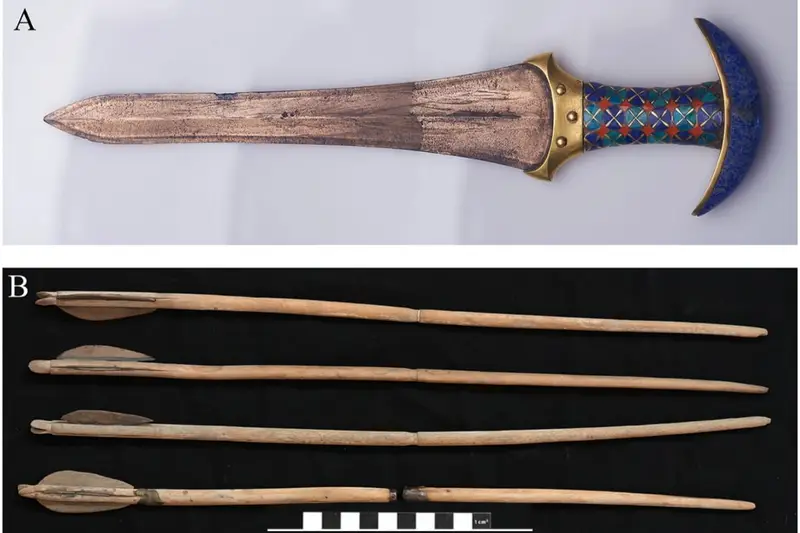 (A) Dagger of Princess Ita, courtesy of the Egyptian Museum; (B) Arrows of Princess Noub Hotep, courtesy of Eman Shawky, from Hashesh, Z., Gabr, A., & Walker, R., Frontiers in Environmental Archaeology (2026)
The research, published in Frontiers in Environmental Archaeology, reexamined the remains of six members of Egypt’s royal family from the late Middle Kingdom, about 1850 to 1700 BCE. The group included King Hor and five princesses whose tombs were uncovered at Dahshur during excavations in the 1890s. After disappearing from view for many years, the remains were rediscovered in the Egyptian Museum during a collections project in 2020.
The team combined traditional bone analysis with X-ray imaging and chemical tests of embalming materials. Together, these methods helped rebuild biological profiles, identify disease and injury, study activity patterns, and compare burial practices across the royal group.
Four of the women were daughters of Pharaoh Amenemhat II. They were buried in matching underground chambers with objects often linked to male warriors, including bows, arrows, and finely made weapons. Princess Ita’s burial even contained an ornate dagger, raising questions about whether these items reflected real experience or royal ceremony.
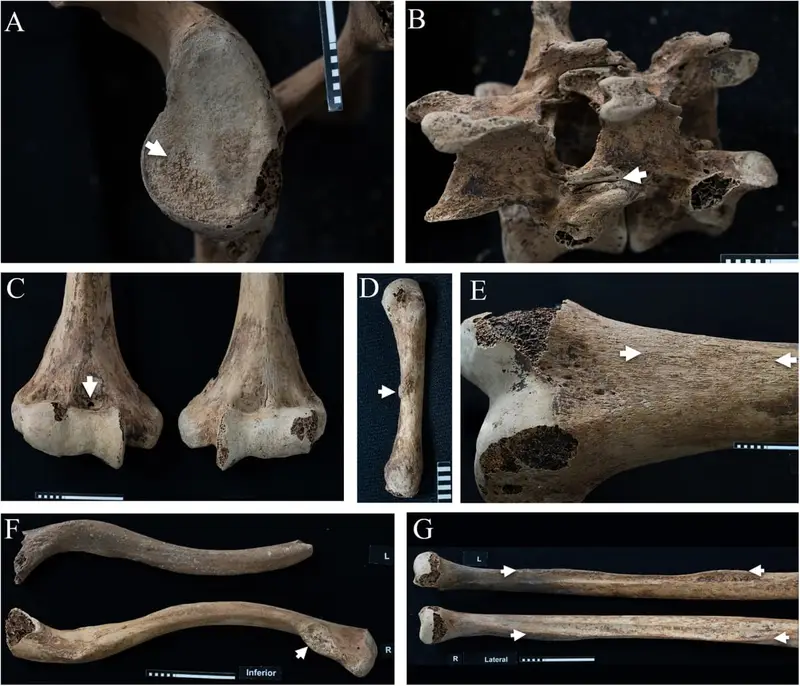 Bone changes in Princess Ita showing signs of physical activity and repeated weapon use. Credit: Hashesh, Z., Gabr, A., & Walker, R., Frontiers in Environmental Archaeology (2026), CC BY
The bones offered an answer. Several princesses showed strong muscle attachment points in their shoulders and arms, signs of repeated physical effort over many years. Those changes closely match movements used while drawing a bow or handling weapons.
Princess Ita, who died between the ages of 28 and 34, had powerful upper body muscle attachments consistent with frequent weapon use. Princess Itaweret, who died between 20 and 34 years old, displayed similar skeletal features linked to archery. She also survived broken ribs and fractures in her foot, injuries that healed before her death. Princess Khenmet, who lived into her late 30s or 40s, showed bone thinning along with strong ligament attachments, suggesting she also remained physically active.
King Hor and Princess Noub-Hotep displayed similar patterns, adding weight to the idea that archery formed part of elite royal training rather than serving only military purposes.
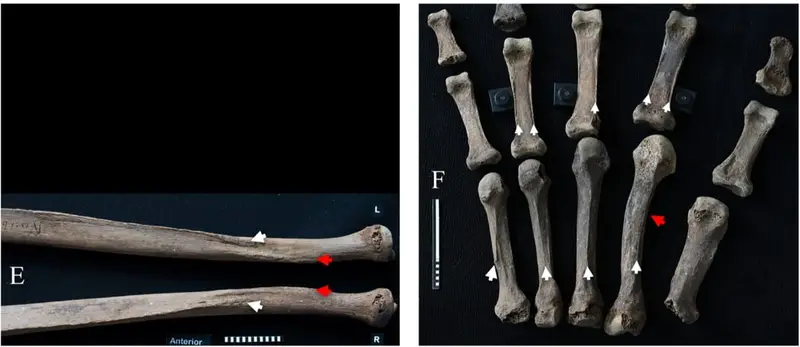 Muscle attachments in Princess Noub Hotep’s arm bones linked to archery movements. Credit: Hashesh, Z., Gabr, A., & Walker, R., Frontiers in Environmental Archaeology (2026), CC BY
The skeletons also revealed other parts of royal life. Several individuals carried healed injuries, including fractures and damage from heavy impacts or falls. Their bones showed complete healing, pointing to skilled medical treatment. Researchers say the evidence fits ancient Egyptian medical knowledge described in the Edwin Smith Surgical Papyrus.
The study found signs of childhood nutritional stress in King Hor and adult metabolic disease in Princess Khenmet. At the same time, the royal family appears to have benefited from better food and healthcare than most people of the period, allowing them to survive illnesses and injuries that might otherwise have proved fatal.
Researchers also identified several rare spinal and developmental traits shared among the royal family. These inherited features suggest close biological relationships within the Twelfth and Thirteenth Dynasty royal lines, supporting historical evidence that marriages between close relatives were common. Chemical analysis also showed the same mixture of frankincense and juniper resin was used to embalm every individual in the group.
Some questions remain unanswered because the princesses’ skulls were lost more than a century ago, limiting further analysis. Future studies using ancient DNA and stable isotope analysis could reveal more about family relationships, diet, and geographic origins.
The findings shift attention away from royal treasures alone and place new focus on the people buried beside them. Instead of viewing the princesses’ weapons as ceremonial objects, the study presents evidence that at least some royal women spent years mastering demanding physical skills such as archery and hunting.
Publication: Hashesh, Z., Gabr, A., & Walker, R. (2026). Bioarchaeological reassessment of Dahshur royal skeletal remains from the Late Middle Kingdom (c. 1850–1700 BCE). Frontiers in Environmental Archaeology, 5(1844402). doi:10.3389/fearc.2026.1844402