
Part 1 — Why This, Why Now.
There are 57 streets, squares, and parks named after Ze’ev Jabotinsky in Israel — more than Theodor Herzl (52) and more than David Ben-Gurion (48), the state’s own founder. Likud’s headquarters sits inside a building, Metzudat Ze’ev, dedicated entirely to him. Whatever else is true about Jabotinsky’s place in Israeli memory, “forgotten” does not apply. That ranking should stop you, because it doesn’t track the history it summarizes. Jabotinsky died in 1940, eight years before the state existed and before Ben-Gurion built a single one of the institutions that founded it. So why does the man who wasn’t there outrank the man who was?
The answer isn’t 1923 or 1940. It’s what happened after. Ben-Gurion didn’t just disagree with Jabotinsky — he called him “Vladimir Hitler” and titled a pamphlet chapter “Jabotinsky in the Footsteps of Hitler.” When Jabotinsky died, his will stipulated his remains return to Palestine only “at the express order of the Jewish government” once one existed. Ben-Gurion, by then that government’s Prime Minister, refused for the rest of his time in office: “the country needs living Jews, not bones.” It took his 1963 resignation and Levi Eshkol’s approval — secured by Menachem Begin — before the remains reached Mount Herzl in 1964, twenty-four years after his death.
For three decades, the man who actually governed Israel kept Jabotinsky’s memory as small as institutional power allowed. That changed in 1977, when Begin’s Likud broke Labor’s twenty-nine-year hold on government, and commemoration accelerated under governments eager to elevate their founder. Fifty-seven streets are the record of a decades-long political correction, still underway — which is why the real question isn’t why Jabotinsky is honored. It’s why, having already won that argument decisively, this year’s ceremony still needed to be fought as though it were freshly urgent.
Jabotinsky Day falls automatically each year on 29 Tammuz, the Hebrew date of his death — this year, July 14, by calendar coincidence, not political staging. Given that the platform exists every year regardless of politics, why did Netanyahu fill it with a version of Jabotinsky built almost entirely around the sword?
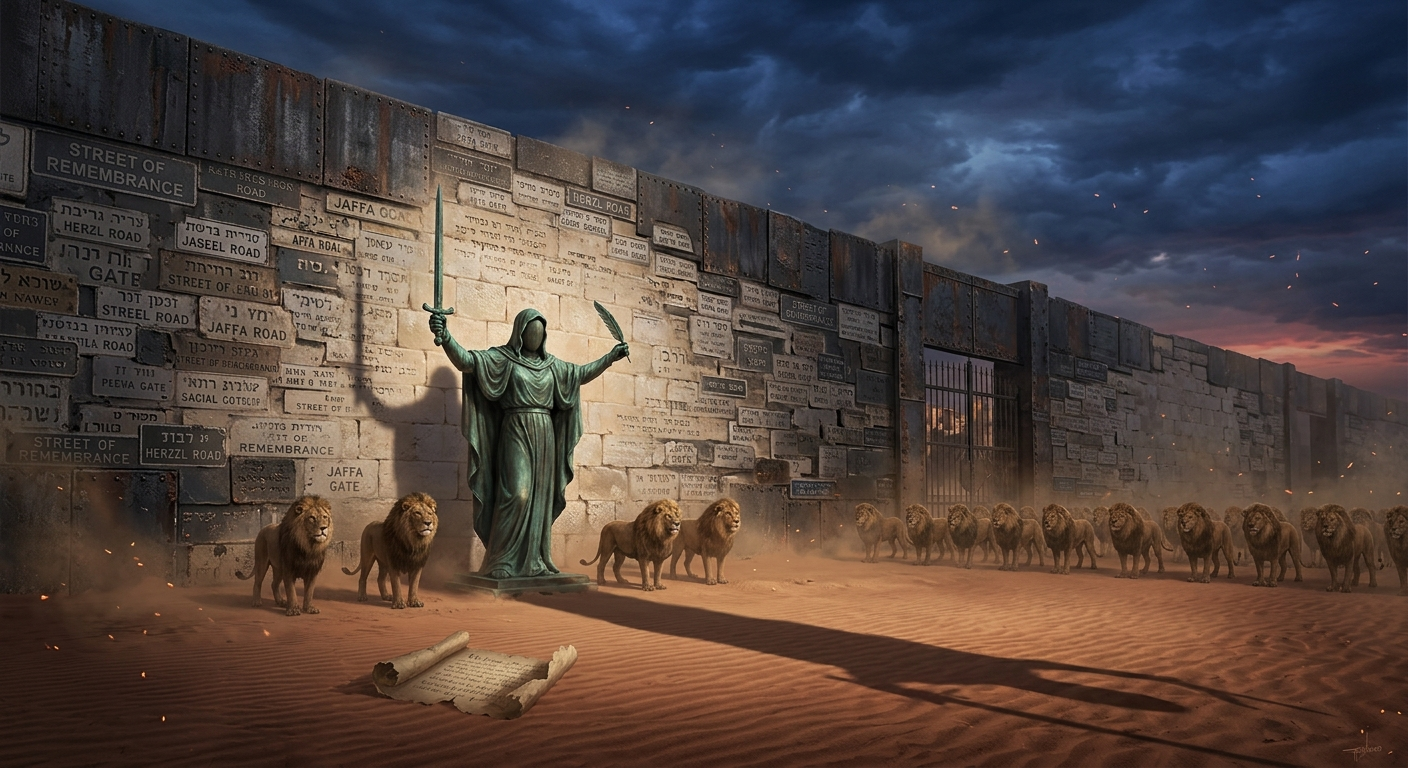
That’s a factual question, and the speech supplies the evidence. Netanyahu opens with “the sword or the pen,” then resolves that tension almost entirely toward the sword: Samson tearing apart a lion as a metaphor for Operations Rising Lion and Roaring Lion against Iran; “gather iron” read as instruction to build domestic weapons manufacturing; a “War of Redemption” invoked as a three-year vindication of offensive doctrine; the Iron Wall reinterpreted as “dynamic,” borderless, moving “from theater to theater” with no stated endpoint. Jabotinsky gets one gesture toward nuance — “not a bloodthirsty militarist” — before the speech moves on without elaboration.
“War of Redemption” isn’t a term with deep pedigree in Israeli public life; it’s theological language applied to an ongoing campaign and repeated as if it were the campaign’s name. That move lifts the conflict from the register of policy, where reasonable people can disagree, into sacred narrative, where disagreement looks like a failure of faith.
I’m writing this as a partisan, not a neutral observer. My political lineage runs through Herzl and Ben-Gurion as much as through Lieberman, Lapid, and Bennett — and through Judah Magnes, Martin Buber, Ernst Simon, and Henrietta Szold, thinkers who believed Jewish nationhood had to answer to a moral standard, not only a military one. I don’t claim objectivity. I claim evidence, and the right to contest history with better history.
Part 2 — What the Speech Gets Wrong
The false unity of “sword and pen.” Netanyahu frames Jabotinsky’s relationship to force and ideas as seamless. Anita Shapira’s Land and Power tells a different story: a movement that began under a “defensive ethos” and only shifted to an “offensive ethos” after the 1936 Arab Revolt exposed that posture’s limits — a contested, decades-long transformation, not a settled philosophy from the start.
The Iron Wall Netanyahu describes is not the Iron Wall Jabotinsky wrote. This is the speech’s most consequential distortion. Netanyahu’s Iron Wall is “dynamic,” moving “from theater to theater,” with buffer zones inside Gaza, Lebanon, and Syria — no stated terminus. But Jabotinsky’s 1923 essay argued sequence, not perpetuity: Arab leadership would never accept a Jewish national home while hope remained of removing it by force, and only once that hope was extinguished would “moderate groups” come forward “with proposals for mutual concessions.” The wall was a means to negotiation, not a substitute for it — Jabotinsky wrote a companion piece, “The Ethics of the Iron Wall,” within a week, specifically to defend that strategy’s morality. He also insisted his position wasn’t born of hostility: “my emotional relationship to the Arabs is the same as it is to all other peoples — polite indifference,” a claim historians still contest, since convincing a people that resistance is futile isn’t obviously indifferent to them at all. That’s a different thing from permanent conquest with no stated endpoint — a wall with no far side isn’t the Iron Wall Jabotinsky described, it’s a permanent state of siege wearing his name.
Lumping socialism, cosmopolitanism, and communism together erases real people. The speech dismisses “territorialism, cosmopolitanism, Marxism, communism, anarchism” in one breath. These are different questions entirely. Communism sought to abolish private property; the socialism that built the kibbutz movement and the Histadrut never did — it built a welfare state alongside markets. Cosmopolitanism asks how far moral obligation extends beyond the nation, not how property should be organized. Territorialism, the movement Israel Zangwill led out of the Zionist Congress in 1905 after the Uganda Program vote, was a dispute purely about geography. Four unrelated questions, collapsed into one contemptuous list.
Socialist Zionism was the institution-building tradition that founded the kibbutz system, the Histadrut, and much of the state apparatus Israel still runs on. Cosmopolitan Zionism has its own serious lineage, and this is where the speech’s silences are loudest: Judah Magnes, founding president of the Hebrew University; Martin Buber; Ernst Simon; and Henrietta Szold founded Ihud in 1942, building on Brit Shalom, established in 1923 — the same year as “The Iron Wall,” and formed in direct reaction against Jabotinsky’s trajectory. Magnes told the American Jewish Congress in 1937: “Partition means force, force means war, and war means defeat.” He warned of “winning the land but losing our soul.” Einstein publicly supported Brit Shalom’s aims. These weren’t fringe figures; their argument that Jewish return had to be morally defensible lost politically in 1948 — losing an argument isn’t the same as being wrong to have made it.
“Not a bloodthirsty militarist” is an assertion, not an argument. Whether Jabotinsky’s program amounted to militarism is a live historiographical question — it’s the central question of Shapira’s book. Brit Shalom’s founders were his contemporaries, organizing against the trajectory they saw him pulling Zionism toward in real time. A speech that wants credit for nuance needs to show the argument, not just assert its conclusion.
The line from Jabotinsky through Begin to today’s coalition is real, but precision matters. Jabotinsky, a civic nationalist who believed in individual rights and parliamentary democracy for all citizens of a future Jewish state, did not map onto the ethno-religious chauvinism of Meir Kahane’s movement — conflating the two would repeat the same flattening this speech commits. Otzma Yehudit and its leadership descend directly from Kahanist organizing, a lineage never disavowed. Netanyahu’s political home has absorbed, not resisted, that current.
Every distortion in this speech runs the same direction. Jabotinsky’s own Iron Wall pointed toward negotiated peace; Netanyahu’s doesn’t. His contemporaries who argued for a different path get erased into a list of discarded fads. And the speech’s one concession to nuance is asserted, never shown. This is selective retrieval, aimed at a specific political end.
Part 3 — What This Is Actually For
Myth-making is a political tool. Framing three years of continuous war as a “War of Redemption” is what political scientists Ole Wæver and Lene Hansen call securitization: casting a contestable policy choice as an existential necessity above ordinary political debate. Once a policy is framed that way, disagreeing with it stops looking like politics and starts looking like disloyalty — at exactly the platform that reaches the widest audience for it, once a year, indefinitely.
The consequences aren’t abstract. In 2024, the V-Dem Institute downgraded Israel from “liberal democracy” to “electoral democracy” for the first time in over fifty years, citing the 2023 law stripping the Supreme Court’s power to invalidate government decisions as “unreasonable” and the broader erosion of judicial constraint. Whatever one’s position on the judicial overhaul, the downgrade is a measured decline, tracked over years, not a matter of opinion. A political culture that narrates permanent war as vindication and treats dissent as disloyalty is not a coincidental backdrop to that decline. It’s a contributing cause.
Perpetual security-first politics isn’t even strategically wise, let alone morally sufficient — that was Magnes’s position in 1937, and it’s mine now. Security doctrines with no stated exit tend to produce exactly what they claim to prevent: not an end to conflict but its indefinite renewal, radicalizing each generation raised inside it. Jabotinsky, on his own terms, understood a wall is only worth building if someone can eventually stop needing it.
The alternative reading has been sitting in the Zionist tradition the whole time. Ben-Gurion built institutions, not just an army, and negotiated as readily as he fought. Magnes, Buber, Simon, and Szold insisted a return to this land answer to conscience, not only to power. None of that is softness; it’s a harder standard than “gather iron” alone. A Jewish state, and a Jewish people who built, funded, and defended it, deserves a politics built on that fuller inheritance — not a selective highlight reel of whatever policy is currently underway.
Jabotinsky doesn’t need one more ceremony to be remembered. He is already the most remembered man in the country’s history, fifty-seven times over. What Israel needs is the argument his own contemporaries were already having in 1923 — the one Brit Shalom lost, the one Magnes kept making anyway — brought back into the room, in public, where a Prime Minister’s remarks at Mount Herzl currently leave no space for it at all.
Buy Globalize Zionism: Am Israel United — the time for unity of the Jewish people beyond political division has come: https://www.amazon.com/Globalize-Zionism-Next-Thinkers-Book-ebook/dp/B0H3LL5JLW
–
Read this article in full here: https://www.linkedin.com/pulse/bejamin-netanyahu-speech-jabotinsky-yearly-celebration-frederic-eger-egvqf – Netanyahu’s full speech: https://www.linkedin.com/pulse/bejamin-netanyahu-speech-jabotinsky-yearly-celebration-frederic-eger-egvqf/