
I watched the World Cup final on Sunday evening – Spain suffocating Argentina 1-0 on a Ferran Torres strike deep into extra time, Messi ghosting through what was almost certainly his last major tournament, Emiliano Martínez making eleven saves and still losing.
The first thought that crossed my mind, irrationally but insistently, was not about La Roja’s tactical brilliance or about the end of Messi’s era, but about Benjamin Netanyahu, who had spent the previous week publicly declaring his support for Argentina on The Mojo Podcast, not because of Messi but because of his “great friend” Javier Milei.
And, obviously, against Spain – a country whose prime minister, Pedro Sánchez, recognized Palestinian statehood in May 2024, joined South Africa’s genocide case at the ICJ, imposed an arms embargo on Israel, called for a sports ban on Israeli teams, and sent a military vessel to accompany the Sumud Flotilla, making La Roja not just a football rival but, in Netanyahu’s eyes, something closer to a political enemy.
He was gifted an Argentine national team jersey by Buenos Aires’s ambassador to Tel Aviv on the eve of the match and chanted “Vamos Argentina” on camera – and I thought: this is a man whose own country’s football team cannot qualify for anything, cannot compete with anyone, cannot beat anyone who matters, and yet he roots for a team 12,000 kilometers away because its president is one of the few world leaders who still takes his calls.
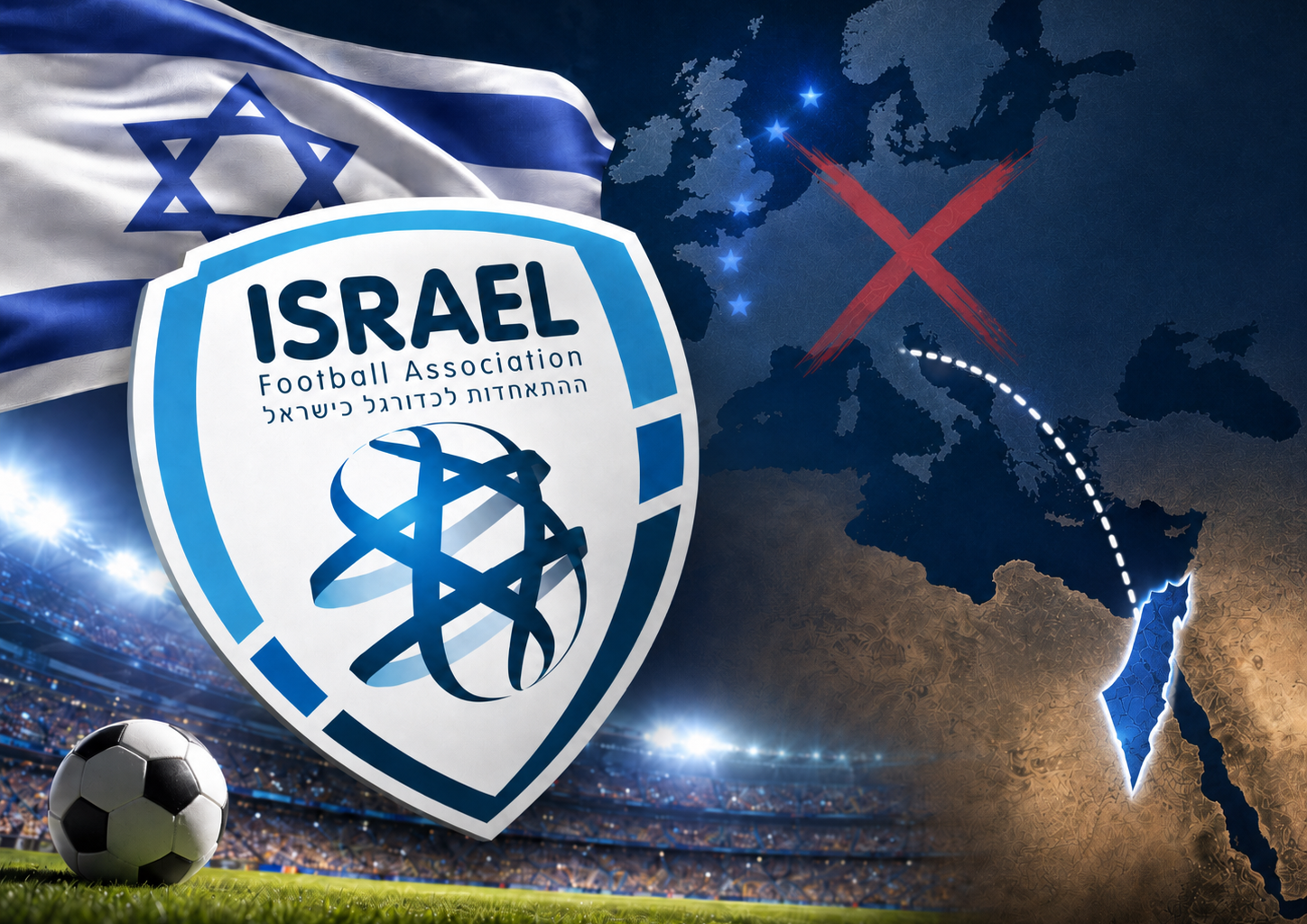
The question that followed was one that has nagged at me for months but that the spectacle of the World Cup – football’s most concentrated expression of national identity, geopolitical allegiance, and soft power – made suddenly impossible to ignore: why does Israel still play in Europe?
The answer, once you trace the history, reveals less about football governance than about the fundamental contradiction at the heart of the Israeli project itself.
Israel was a founding member of the Asian Football Confederation (AFC) in 1954. It finished runner-up at the inaugural Asian Cup in 1956, runner-up again in 1960, and then won the tournament outright as host in 1964 – the only continental championship Israel has ever won.
It qualified for the 1970 FIFA World Cup through the Asian zone, its sole appearance in the tournament’s history. For two decades, Israel existed in Asian football as it existed in Asian geography: as a fact. But that fact became intolerable to its neighbors. Beginning in 1958, Arab and Muslim nations systematically refused to play against Israel, producing cascading withdrawals, walkovers, and diplomatic crises at every tournament Israel entered.
The final rupture came at the 1974 Asian Games in Tehran, where Israel lost the football final 1-0 to Iran before 100,000 hostile spectators, and then, at the AFC’s annual congress, Kuwait introduced a motion to expel Israel from the confederation. It passed 17-13 with 6 abstentions. After 20 years as a founding member, Israel was cast into footballing exile.
What followed was a wandering that mirrored the Zionist narrative itself – except in reverse. Israel drifted through the Oceania Football Confederation (OFC) for the 1986 and 1990 World Cup qualifications, traveling 16,300 kilometers to play New Zealand in qualifying matches that satisfied no one.
In 1991, UEFA began the process of absorbing Israel into European competition. By 1994, it was a full member. It has remained there ever since – competing in European Championship qualifiers, European club competitions, and the UEFA Nations League, as though geography were a bureaucratic detail that could be overridden by a committee vote.
And here is the paradox that no one in Israeli football – or Israeli politics – seems willing to confront. Zionism was born as a response to European persecution: the pogroms of Eastern Europe, the antisemitism of the Dreyfus affair, the civilizational catastrophe of the Holocaust. The entire moral architecture of the Israeli state rests on the premise that Europe was not safe for Jews, that Jewish survival required a homeland in the Middle East, in the ancestral land, among the peoples of the region, however hostile.
And yet, when the region’s football confederation expelled Israel in 1974, Israel did not fight to return. It did not lobby, negotiate, or build the relationships that might have reopened the door. It fled – back to Europe, the very continent it had defined itself against, and asked for shelter in a confederation to which it has no geographic, cultural, or historical connection. If Europe was the problem, why is Europe now the solution? If the Middle East is home, why does Israel refuse to compete there?
The sporting results alone should force the question. In 32 years of UEFA membership, Israel has never qualified for a European Championship – not once, across 8 tournament cycles. It has not appeared at a World Cup since 1970 – 56 years ago, when it still played in Asia.
It is currently ranked 76th in the FIFA world rankings, routinely eliminated in the early rounds of European qualification by nations a fraction of its size and budget. Israel in UEFA is not a competitor; it is a permanent also-ran, collecting losses in a confederation where it does not belong and achieving nothing that justifies its continued presence.
Meanwhile, football has evolved into something far larger than a game – and no country understands this better than Israel, a nation that has elevated lobbying into an art form and that has wielded its influence inside FIFA’s corridors with a precision that its football on the pitch has never matched.
When the Palestinian Football Association formally requested Israel’s suspension at the 74th FIFA Congress in Bangkok in May 2024 – citing the war on Gaza, the destruction of Palestinian football infrastructure, and the inclusion of settlement-based clubs in Israeli domestic leagues – FIFA President Gianni Infantino declined to put the matter to an immediate vote. Instead, he referred it to a panel of “independent legal experts” whose findings were then delayed, extended, and ultimately buried across two years of procedural stalling.
The Israel Football Association’s (IFA) president, Moshe Zuares, had written to Infantino that May praising his “significant contribution” to the creation of the Abraham Accords and calling him a “full partner” in the process – a revelation that left little doubt about the nature of the relationship.
Even within UEFA, where a majority of the 20-member executive committee was reportedly prepared to support suspending Israeli teams, the expected vote was paused after Donald Trump and Netanyahu announced a Gaza peace plan on September 29, 2025 – an intervention conveniently timed to deflect the mounting pressure.
Israel knows exactly how football governance works, knows how to exploit its mechanisms, knows how to buy time and silence votes – and yet it deploys all of this institutional cunning not to build sporting bridges with its own region but to preserve the comfortable fiction that it belongs in a European confederation 3,000 kilometers from its borders.
Football has evolved into something far larger than a game. It is now one of the most potent instruments of soft power, national branding, and geopolitical positioning available to any state – and Israel, by hiding in Europe, is squandering it entirely.
Consider Morocco, my own country, which reached the World Cup semifinals in Qatar in 2022 – the first African and Arab nation ever to do so – and which will co-host the 2030 World Cup with Spain and Portugal, using its footballing success to project an image of modernity, stability, and cultural confidence to billions of people worldwide.
Football, for Morocco, is diplomacy by other means – a way of building relationships, earning respect, and occupying space in the global imagination that no trade agreement or defense pact could ever achieve alone.
Israel could have had this. The Abraham Accords, for all their limitations, opened a diplomatic corridor that could have led, eventually, to Israel’s reintegration into Asian football – to matches against the UAE, Bahrain, and perhaps even Saudi Arabia, to participation in the AFC Champions League, to the kind of sporting engagement that builds familiarity and normalizes contact at the level where it matters most: among ordinary people watching a match on a screen.
Instead, Israel continues to play in a European confederation where it is unwanted by a growing number of member associations, where its home matches have been moved to neutral venues due to security concerns, and where its presence increasingly feels less like integration than like asylum.
Everyone remembers what happened in Amsterdam in November 2024. Maccabi Tel Aviv traveled to play Ajax in the Europa League, and what followed was a night that shattered whatever illusion remained of Israeli football existing comfortably in Europe: dozens of Israeli fans were ambushed across multiple locations in the city center, chased through streets, beaten, pelted with fireworks, hunted through alleyways by groups coordinating attacks through messaging apps.
Netanyahu initially ordered the dispatch of two military rescue planes to evacuate Israeli citizens from a Western European capital – not from Beirut, not from Tehran, but from Amsterdam, the liberal heart of the continent that was supposed to be Israel’s footballing safe haven. If this is what belonging to UEFA looks like, one is entitled to ask what, exactly, Israel is being protected from by refusing to return to Asia.
The 1974 expulsion was an injustice – a political act disguised as a sporting decision, driven by Cold War alignments and Arab nationalist pressure rather than by anything Israel had done on the pitch. But 1974 was half a century ago. The geopolitical landscape has been remade several times over. Israel has peace treaties with Egypt and Jordan, normalization agreements with four Arab states, and quiet intelligence relationships with half the Gulf.
The conditions that produced the expulsion no longer exist in the same form. What does still exist – and what Israel’s continued flight into European football reinforces – is the perception that Israel does not see itself as part of the Middle East, does not want to be part of the Middle East, and will always prefer the comfortable irrelevance of European competition to the difficult, necessary work of belonging to its own region.
Netanyahu can chant “Vamos Argentina” all he likes. But the question Israel’s football exile poses is the same question its diplomacy refuses to answer: if this is your home, why do you keep running from it?