
Get The Gavel
A weekly SCOTUS explainer newsletter by columnist Kimberly Atkins Stohr.
I do remember, though, that he did not come back from Lebanon with a victor’s glory. Always curious about other cultures, he’d embraced the chance to see a country he could not access in any other way; Lebanon was, and still is, considered an enemy by Israel.
If he had witnessed any atrocities, he did not tell us. Still a child, I was under the impression that the Israeli army — my good-hearted father included — had visited Lebanon for a few months, stayed in some local people’s homes, and come back with Swiss chocolate boxes and friendly letters from their kids. Alongside the joy of my father’s return, I felt some sadness about the fact that I could not meet and play with the Lebanese girl who sent me such nice gifts.
In Israel, I’d had some pen pals whom I’d met in various summer camps and with whom I’d stayed in touch for a while. That was not possible here. “One day,” my father promised, “it will be.”
When liberal Israelis think about the state of their country, the historical analogy they tend to reach for is Germany in the 1930s, after Hitler came to power. Where are we on that timeline? we ask ourselves repeatedly. What year is it now — 1933? Perhaps already 1938? How far has the country traveled down this road? How deeply have authoritarian and exclusionary ideas become embedded in the institutions of the state and in public consciousness?
Many think constantly about leaving the country. This tendency intensified after the last elections, when Prime Minister Benjamin Netanyahu formed his ultra-right-wing coalition with Jewish supremacist, nationalistic, messianic, and antidemocratic figures such as Itamar Ben-Gvir, the head of the extreme-right party Otzma Yehudit (“Jewish Power”).
 Demonstrators unfurled a giant banner protesting Israeli Prime Minister Benjamin Netanyahu’s judicial overhaul plan in Tel Aviv in September 2023. Hamas’s assault on Israel would come not long after. JACK GUEZ/AFP via Getty Images
The war of revenge Israel launched in Gaza following Hamas’s devastating terrorist attack on October 7, 2023, only deepened the sense of alienation. Everyone, it seems (that is, in the secular middle-class liberal circles I travel in), is talking about leaving.
According to official surveys, about 200,000 Israeli citizens (out of a population of 10 million) have left the country in the last three years. Some unofficial estimates suggest the number could be even higher. For years, according to these estimates, approximately 40,500 Israelis left the country annually. In 2024, that number more than doubled, reaching nearly 83,000.
My only brother is one of them. After nearly three decades of protesting against racism and the oppression of Palestinians, he reached a point where he could no longer imagine a future in Israel. He emigrated to Berlin with his wife and children, becoming part of what I have come to think of as an emigration of conscience: people who leave their countries not primarily for economic or professional reasons but because they can no longer reconcile living there with their moral convictions.
I was not part of such an emigration. I just went to Harvard for a one-year journalism fellowship. At least that was my intention.
Even before my feet left the ground of the Holy Land, I was bombarded with the same question by nearly everyone I know: Are you coming back?
My husband and I agreed that if we had any thoughts about staying abroad longer, we would keep them to ourselves. But people kept asking — and not believing the answer. “You’re not coming back, are you?”
“Of course we’re coming back,” I promised, time and again.
In our first weeks and months in the States, every call from Israel seemed to lead to the same place: Are you staying? Do you want to stay? But if you could stay, would you?
An entire social circle gripped by separation anxiety.
I could understand this very well. I had done exactly the same thing to friends who had spent a few months in Greece the year before. In my heart, I was angry with them for leaving me, leaving us, and ready to forgive them only if I could be convinced that it was temporary.
As I scroll through social media, reading posts by people who have left Israel, I see a range of psychological and emotional states. Some profess they didn’t leave “for good,” just for a temporary “relocation.” They left for political or economic reasons but still hope to return, when things in Israel begin to change. They seem to struggle with their absence from the Israeli public conversation.
At first, they write as though they’d never left Israel. They post about how horrible the Israeli government is, how important it is to demonstrate and protest. They share funny memes about sitting in shelters.
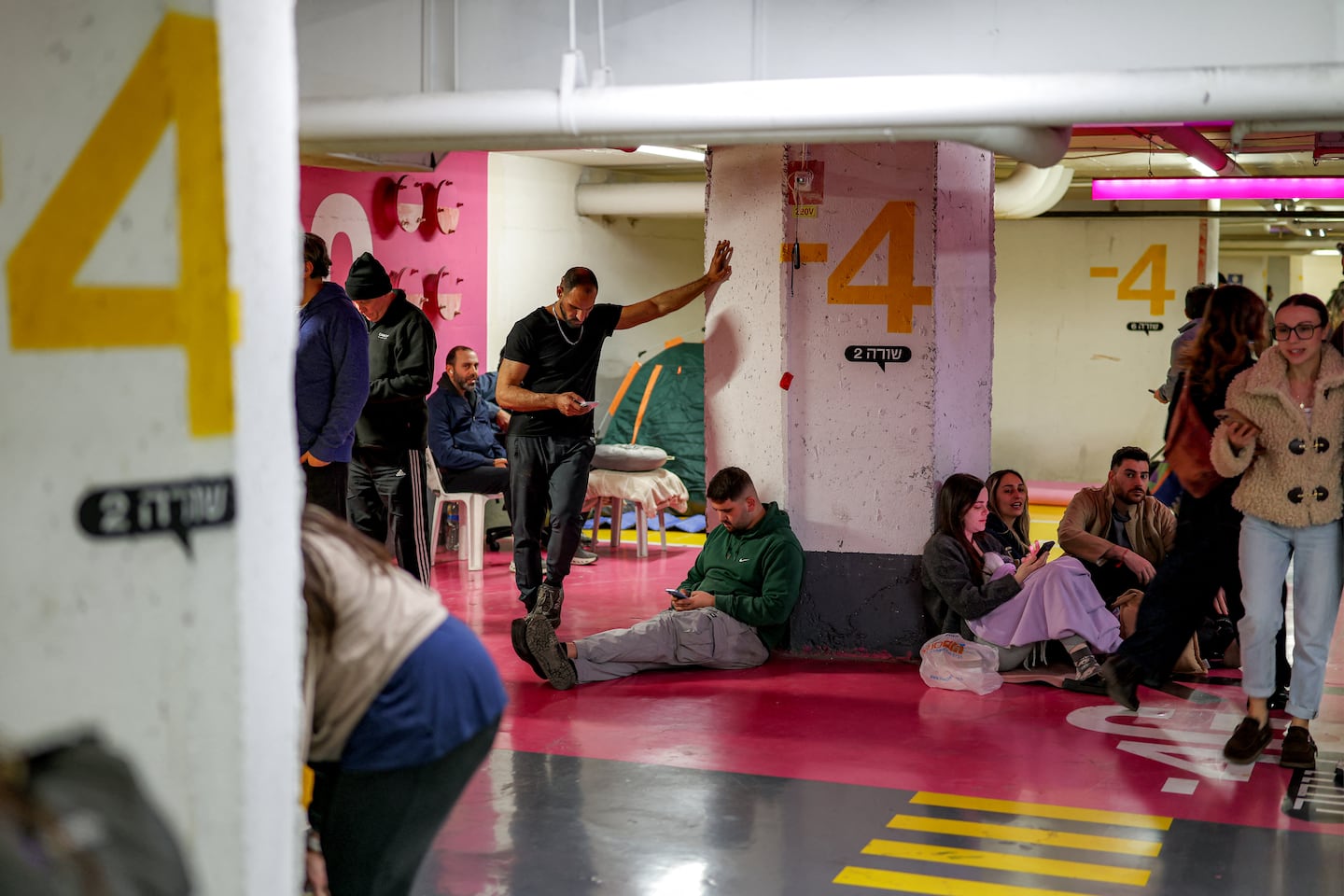 People took shelter in a parking garage after sirens wailed in Tel Aviv in March.ILIA YEFIMOVICH/AFP via Getty Images
After a while, they fall silent. They sense that nobody really wants to hear from them. They are not wrong. For those who stayed behind, these comments from afar can feel like an irritating reminder of the choice the emigres made — and of the shared fate they chose to interrupt. I remember experiencing that resentment myself before I left Israel. Sometimes, people will try to justify their decision: We left because we could not sleep at night. We could not breathe. We have children to think of. We are afraid. This place is lost. We will come back to vote in the general elections, and if HE is not elected again, we will return.
Others who leave the country have entirely apolitical motivations: professional betterment or various personal reasons. For some, living abroad deepens their attachment to Israel or, more precisely, to an idealized version of it. They rediscover the country from a distance and become more devoted to it than ever before. They dismiss every criticism of Israel as antisemitism. Every discussion of the Middle East is presumed to be biased. Some of them seem to volunteer to act as the country’s unofficial public-relations agents.
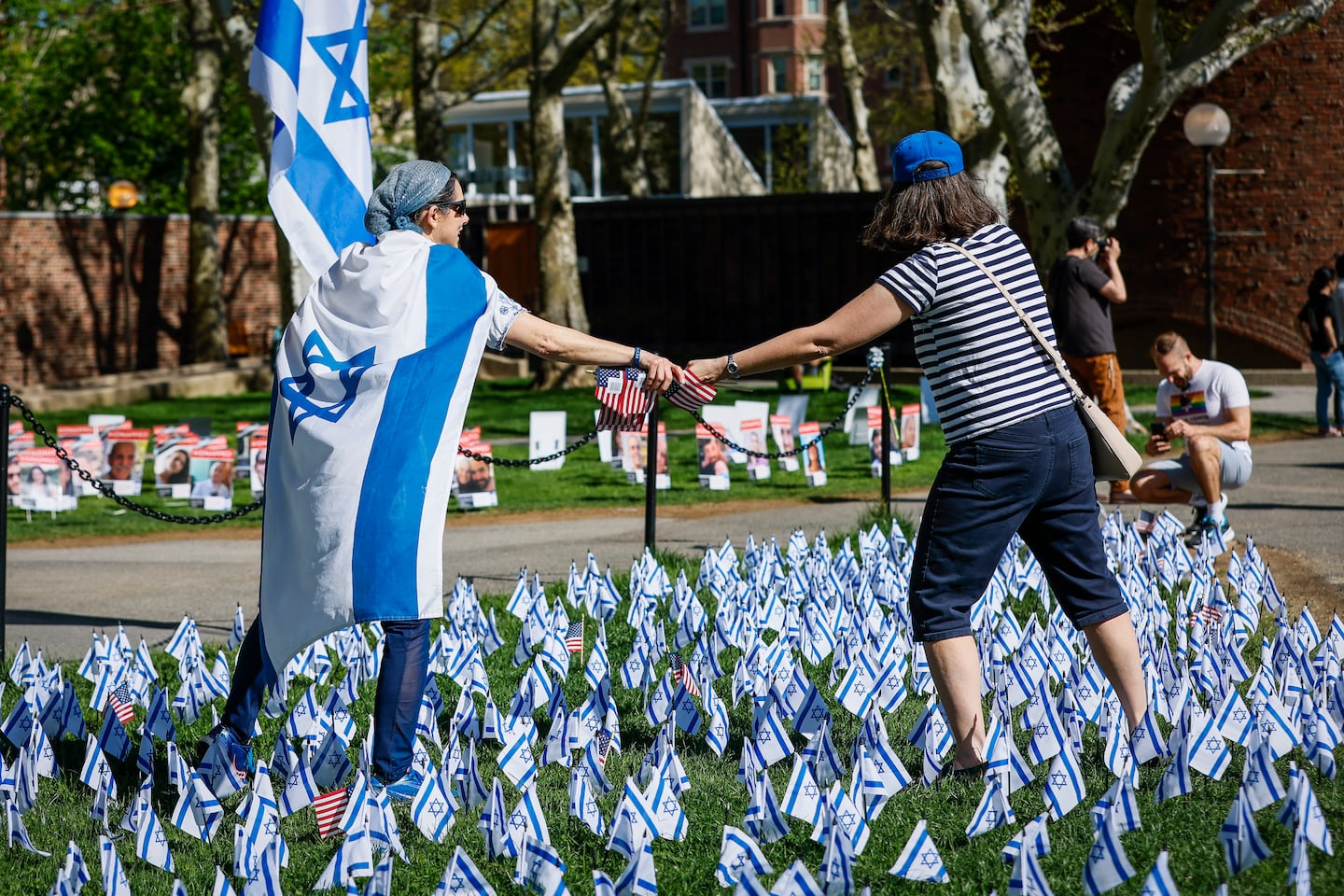 Attendees of the MIT Israel Day celebration placed American flags among Israeli flags nearby a pro-Palestinian encampment on Kresge lawn in May.Erin Clark/Globe Staff
Some of my friends who emigrated years ago now reject everything associated with Israel. They try to embrace a Jewish diasporic identity detached from the Israeli state. Israel was a mistake, they claim. Jewish life should have remained diasporic. The nationalist turn that culminated in the founding of the state was the wrong road taken, they argue. Some even say openly that they hope the state will soon cease to exist.
If I spent years away from Israel, in which camp would I find myself? I wonder. But after only one year away, I see a country that seems to offer its citizens an ever-expanding cycle of violence — toward others and toward itself.
When I hear about the Israeli soldiers in the West Bank who killed two Palestinian parents and their 5-year-old and 7-year-old children in front of the children’s two older brothers, because they seemed “suspicious,” I want nothing to do with Israel ever again. When I hear that the Parliament passed a capital punishment law that effectively applies only to Palestinians, I want nothing to do with Israel ever again.
Above all, I find myself haunted by a question that grows harder to ignore: Is all of this being done in my name? And also: Would it be any less in my name if I moved away from Israel? Does putting physical distance between myself and my country lessen my accountability for its crimes? Does staying increase it?
Cambridge – Beirut – Rehovot
It’s late February in Cambridge and I am carrying my winter coat on my back like a heavy burden. The lawns of Harvard Yard are covered with a thick layer of white snow. The trees are tall, gray, and naked. The world is monochromatic. It is beautiful and quiet. I feel as if I am walking in a Pieter Bruegel painting.
I have just come back from Israel after an unexpected visit to see my mother, who has recently been diagnosed with an advanced-stage cancer.
As I’d walked through Rehovot, where my parents still live, I’d seen it with slightly new eyes, those of an expat or perhaps a longtime traveler, if not yet a full-blown emigrant. Every other person who’d crossed my path had struck me as distressed. The town I’d known so well as a child seemed cluttered and graceless.
My teenage daughters and I had spent the last day of the visit with my mother in the hospital, where she had been admitted for chemotherapy treatment.
There, in the endless stretch of hospital time, with nothing in particular to do, we could simply talk. My mother began telling childhood stories, some of which we had heard before, stories about her own mother. It sounded like the beginning of a farewell.
As I listened to her talking to us in the hospital, I saw no real prospect of leaving Israel. No way of distancing myself from this place.
Two days after we return to Cambridge, the United States and Israel launch an attack on Iran. Iran strikes back, targeting Israel with ballistic missiles and drones, and within days, Israel’s war with Hezbollah is also reignited. On the phone, my parents sound calm — even relieved that their children and grandchildren are not in Israel.
In one of my conversations with my father, we talk about the Israel Defense Forces’ strikes on Lebanon. The familiar names of Lebanese towns are once again flooding the news: Bint Jbeil, Tyre, Nabatieh. I wonder how he feels, having been there 40 years prior. Having returned full of hope that the Israeli military wouldn’t venture into Lebanon again. Back then, he was a young man with a new beard; now he is an older man, stumbling in the dark of night to a shelter, anxious about his ill wife. None of this is spoken. Only this: “If you can, stay there,” he says.
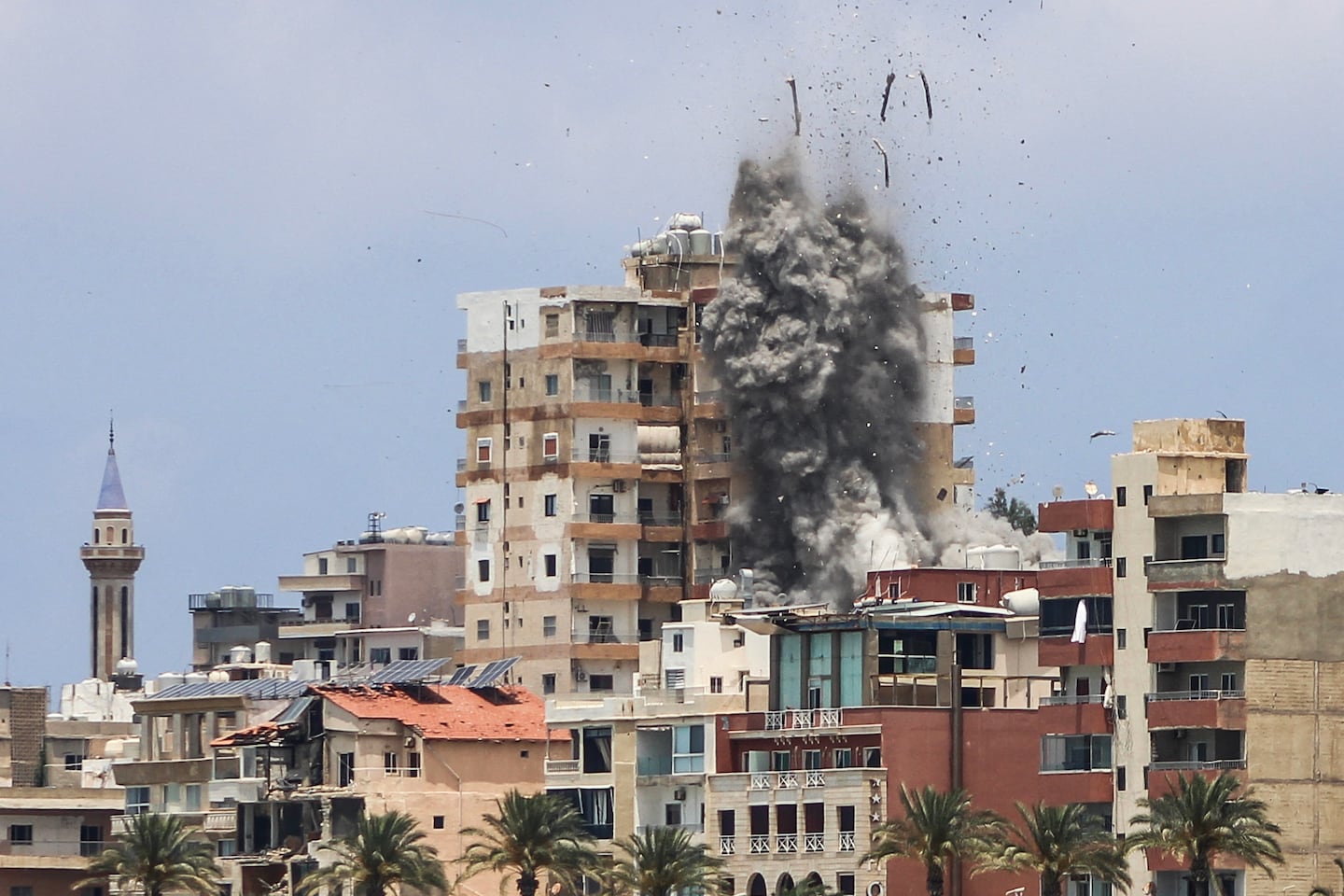 Smoke and debris rose following an Israeli airstrike on Tyre, Lebanon in June.KAWANT HAJU/AFP via Getty Images
It is the middle of June, and I am packing, trying to squeeze clothes, books, memories, and insights into two suitcases. It’s astonishing how much one can accumulate in less than a year.
In a few days, we will be back in Israel, reunited with our friends and family beneath a dark cloud of uncertainty. Is it the right decision? Did we ever really have a choice?
I will not be bringing my parents a letter from a Lebanese girl or a glass giraffe. Nor can I offer my daughters the hope of peace in the Middle East or the possibility of pen pals from countries once considered enemies. They are not that naive. I will try, though, not to forget to buy my parents a box of Swiss chocolate pralines at the airport duty-free shop.