
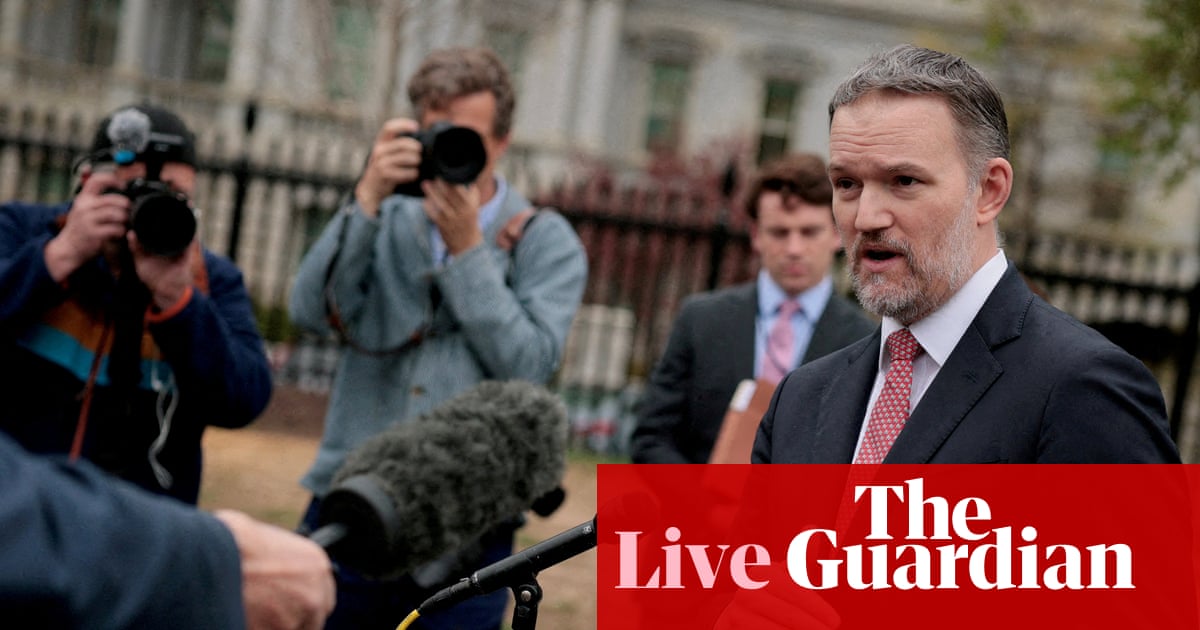
Greer insists that American families have not seen price increases as a result of tariffs
During a heated back and forth with Senator Elizabeth Warren, a Democrat from Massachusetts, Greer insisted that prices for American families have not increased in the wake of Donald Trump’s sweeping tariff policy.
“Core inflation fell to 2.6 % year on year, much better than in January 2025,” the US trade representative said.
While core inflation excludes food and energy, overall inflation is actually around o.5% higher than it was when Trump took office.
Warren pushed back noting that an estimate, produced by Democrats and based on the Congressional Budget Office and the Treasury Department’s own numbers, shows that families are paying an average of $1,700 more in tariff costs since Trump’s return to office.
Updated at 14.29 EDT
Key events
As I noted earlier, the parents of Lt Tyler Feehan accompanied Trump from Dover to Georgia aboard Air Force One, after the president attended a dignified transfer for four service members killed in the Middle East.
Trump addressed Feehan’s family and their loss in his remarks today. “[Feehan] was a person that was going all the way. He was going to be a general. He would have been a general very quickly. He was heading in that path,” Trump said.
Donald Trump has started speaking in Marietta, Georgia. He started his speech joking that he was announces his candidacy for another term in office.
Despite insisting that he was only “kidding”, it is something that the president has routinely floated – even though a third term would be in direct violation of the US constitution.
Updated at 15.55 EDT
US measles cases hit 35-year high according to new data
The number of measles cases in the US has hit a 35-year high according to new data released by Johns Hopkins University.
According to the tracker, there have been 2,295 cases of measles in 2026, as of 21 July.
This number is already higher than the 2,286 reported throughout the whole of 2025, and the highest level since 1991.
The grim milestone is also the most cases reported in a single year since the disease was declared eliminated in the US in 2000.
Unvaccinated individuals or those with unknown vaccination status represent almost all reported measles cases, according to Johns Hopkins.
“High vaccination coverage has protected even the un- and undervaccinated because of herd protection, keeping measles at bay for the past few decades,” said William Moss, an epidemiology professor at Johns Hopkins Bloomberg School of Public Health. “But in communities with pockets of susceptible individuals across a broad age range, measles has been able to take hold, infecting those who are susceptible and spreading rapidly.”
“Measles vaccines are extremely safe and effective,” Moss added. “Getting you or your child vaccinated is the best way to protect against disease.”
José Olivares
The Mexican man who was hit and killed by a semi-truck in Florida when running away from federal immigration officials was vacationing in the US with a tourist visa, according to news reports this week.
The 28-year-old, Juan Jairo Coronilla Durán, was killed on 14 July after an “encounter” with federal officials, including those with Immigration and Customs Enforcement (ICE), a state highway patrol spokesperson said last week.
After federal officials approached him and a group of four men at a gas station that Tuesday morning, they all took off running. The Florida highway patrol spokesperson said Coronilla ran into traffic and was hit by a semi-truck.
Coronilla’s death is one of the four ICE-related deaths that took place in less than one week. Two people, one in Texas and one in Maine, were shot and killed by ICE officers. And a fourth person died in ICE custody, while being transferred to an immigration detention center in Georgia. The four deaths have led to renewed calls by the public and lawmakers to reign in ICE and its parent agency, the Department of Homeland Security (DHS), as they carry out the Trump administration’s aggressive “mass deportation” campaign promise.
ShareHere’s a recap of the day so far
Ahead of Trump’s arrival in Georgia, here’s what’s happened today.
On Capitol Hill, Jamieson Greer, the US trade representative, defended the Trump administration’s unremitting “tariff spree” and insisted that prices for American families have not increased in the wake of the president’s duties on several countries. During a heated back and forth with Senator Elizabeth Warren, a Democrat from Massachusetts, Greer noted that “core inflation fell to 2.6 % year on year – much better than in January 2025.” While this metric excludes food and energy, overall inflation is actually around o.5% higher than it was when Trump took office.
Trump attended the dignified transfer today of four US service members killed in the Middle East. It was the third ceremony that the president has attended since he launched the war in Iran in February. Speaking to reporters on his way to Dover, Trump called it “one of the hardest things to do as a president.” His message to grieving families, he said, will simply be “we love you, we love your child”.
Earlier, the president took to Truth Social and noted that the US will destroy one bridge or power plant, including those near Tehran, “any time” that Iran “shoots a ship” in the strait of Hormuz. This comes after the US conducted its 11th consecutive day of strikes on Iran, with the war showing no sign if easing.
Senate Republicans have also released the text for the Clarity act today – the legislation that would ban public officials from issuing or sponsoring cryptocurrency or digital assets. The bill’s guardrails would apply to the president, vice-president, members of Congress, federal judges and their spouses, and wouldn’t expire until January 2029 – the end of Trump’s term. The bill is one of the first major attempts to shape cryptocurrency use for those in office, and comes after the president’s financial disclosures revealed the president took in more than $1bn from his crypto businesses since returning to the White House.
Meanwhile, in the House, Republican speaker Mike Johnson is desperate to pass the framework for a budget bill that would guarantee funding for the war with Iran. The legislation, which GOP leaders are hoping to pass by reconciliation and avoid the Senate filibuster, faces an array of challenges, including from fiscal hawks who complain that its expected $95bn cost is not offset by any spending cuts, and other Republicans upset that it does not answer the Trump administration’s request for an extra $350bn in defense spending. Johnson can only afford to lose two votes in his quest to pass the package.
Updated at 16.00 EDT
Melody Schreiber
A series of health challenges – hantavirus, screwworm, Ebola, cyclospora, measles, whooping cough, bird flu – are exposing the widening gaps in America’s ability to prevent, identify and halt infectious disease outbreaks.
The rapid dismantling of the US public health system at all levels means the US is in worse shape than it was before the Covid pandemic, former top CDC officials say.
The US Centers for Disease Control and Prevention (CDC) lost much of its funding for battling parasites, which are notable global killers, in the last year. Experts were tasked with monitoring potential outbreaks – such as a previously rare parasite called cyclospora – around the US and the world, lending expertise to help stop crises in their tracks.
But their funding was decimated, and many people at the CDC were laid off or resigned without being replaced.
“Are we ready for the next big pandemic? My answer is no,” said Dan Jernigan, the former director of the CDC’s National Center for Emerging and Zoonotic Infectious Diseases.
Debra Houry, the former chief medical officer of the CDC, told the Guardian: “Unfortunately, we’re really moving in the wrong direction.”
Some 80% of senior leadership positions at the CDC still have no permanent officials appointed, and between 25 and 30% of the CDC’s entire staff are gone.
“Those are boots on the ground,” Houry said. “When you have Ebola, hantavirus, measles, and throw cyclospora in there – staffers were already spread thin, and now they’re spread even more thin.”
Read the full report:
As we noted earlier, Trump is now headed to Marietta, Georgia, where he’ll deliver remarks at a local high school at 3pm ET. We’ll bring you the latest as that gets under way.
In the meantime, a White House official says that the family of 1Lt Tyler James Feehan, one of the US soldiers killed during Iranian strikes in Jordan, will be flying with the president and his team. Feehan’s family are from Georgia, the official notes, and the president “offered to give them a ride home”.
Senate Republicans have also released the text for the Clarity act today – the legislation that would ban public officials from issuing or sponsoring cryptocurrency or digital assets.
The bill’s guardrails would apply to the president, vice-president, members of Congress, federal judges and their spouses, and wouldn’t expire until January 2029 – the end of Donald Trump’s term.
It also requires officials to either sell their crypto holdings and investments in crypto companies or place them in a blind trust they are not able to control.
The bill is one of the first major attempts to shape cryptocurrency use for those in office.
A reminder that Trump took in more than $1bn from his crypto businesses since returning to the White House, according to recent financial disclosures. They showed the president earned more than $500m from his World Liberty Financial business selling new crypto products, while another crypto business, CIC Digital LLC, took in more than $600m from sales of souvenir-type “meme” coins stamped with Trump’s face that launched days before his inauguration.
Updated at 14.30 EDT
Also today, top Democrat Chuck Schumer plans to seek unanimous consent to pass his Presidential Airlift Security Act, which would stop the Pentagon from spending more to modify, restore, or maintain the Boeing 747-8 gifted by the government of Qatar, which Donald Trump has started to use as the new Air Force One.
Republicans previously blocked the legislation, introduced by the Senate minority leader, last year.
On Sunday, Trump admitted that his jet – valued at close to $400m – cannot match the defensive armor of a true presidential aircraft, telling reporters it will soon be grounded and “maxed out” with the protections it was never built with.
This comes after the New York Times reported that the new plane lacks defensive systems fitted to the purpose-built Air Force One fleet, including infrared countermeasures to divert heat-seeking missiles and sensors to detect incoming launches.
The president flew the jet to Ankara, Turkey for the Nato summit earlier this month but switched to an older, more heavily defended aircraft for his return to the US – at the advice of the Secret Service.
Earlier today, ahead of attending a dignified transfer of US service members who died in the Middle East, Trump claimed that a new poll just claimed that while “Americans don’t want high gasoline prices but they’re not against the war”. However, the president didn’t elaborate on who published the new data.
For context, a recent Washington Post-Ipsos poll actually found that only 29% of Americans approve of Trump’s conduct in overseeing the war with Iran.
Donald Trump salutes the coffins of the US service members killed in the Middle East last week.
Donald Trump salutes as a US Army carry team carries the flag-draped transfer case at Dover Air Force Base in Dover, Delaware. Photograph: Saul Loeb/AFP/Getty ImagesShare