

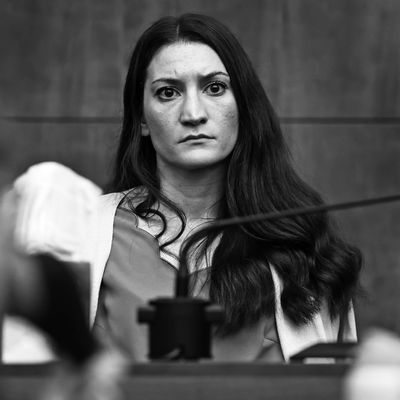
Photo: Greg Derr/Pool The Patriot Ledger via AP, Pool
On the evening of January 24, 2023, Patrick Clancy went to pick up takeout for dinner for his wife and their three young children. When he got back to their house in Duxbury, Massachusetts, less than an hour later, it was unusually quiet, and the bedroom door was locked. Eventually, he found his wife, Lindsay, lying in the backyard, barely conscious. She had slit her wrists and neck and jumped from the second-story window, and she told him she had tried to kill herself. When the paramedics arrived, Patrick found the couple’s three children — Cora, 5, Dawson, 3, and Callan, 8 months — in the basement, where they had been strangled with exercise bands. They were later pronounced dead.
Lindsay Clancy — a former labor and delivery nurse at a Boston hospital — survived, though she was left paralyzed from the waist down. In February 2023, she was charged with three counts of first-degree murder and pleaded not guilty, with her lawyers arguing that she was suffering from severe postpartum mental illness. On Monday, more than three years later, her trial began. Here’s what to know about the case.
Clancy’s lawyer, Kevin Reddington, has said that while Clancy did kill her children, she shouldn’t be held legally responsible for murder, arguing that she suffered from extreme postpartum depression and possible postpartum psychosis — a severe mental illness that affects one or two in a thousand women who give birth.
According to reporting from The New Yorker, Clancy experienced anxiety after the birth of all three of her children, though she was never diagnosed with any postpartum mood disorders. A few months after her son Callan was born in May of 2022, Clancy started seeing a psychiatrist, who diagnosed her with generalized anxiety disorder and prescribed her Zoloft. However, over the next few months, Clancy continued to experience insomnia and told her husband she had thoughts of suicide and harming the children. She was eventually prescribed more than 12 different medications, including Ambien, Klonopin, Valium, Prozac, Ativan, and Seroquel. Clancy’s defense team has blamed her “horrific overmedication” for her deteriorating mental state.
Clancy repeatedly sought treatment for her symptoms, including multiple trips to the emergency room and an inpatient stay at McLean Hospital, but she was never formally diagnosed with postpartum depression or postpartum psychosis. Patrick told The New Yorker that, on the morning before she killed their children, he had thought she seemed like she was getting better.
Clancy and Patrick have since filed separate lawsuits against the doctors who oversaw her mental-health treatment, arguing they failed to properly diagnose, treat, and monitor her “severe postpartum psychiatric condition” despite her efforts to seek help. In her suit, Clancy’s lawyers claim the medications she received precipitated “a state of manic psychosis.” According to the lawsuit, on January 23, Clancy heard a “demanding, powerful male voice” ordering her to kill her children and then herself, and “felt an overwhelming, irresistible compulsion to comply.”
The New York Times reports that state prosecutors plan to argue that Clancy knew what she was doing and that the murders were carefully planned. They claim she was lucid enough to take her daughter to the pediatrician that morning and that she plotted to get her husband out of the house, asking him to pick up the children’s medicine and dinner and looking up the restaurant on Apple Maps, presumably to check how long he would be gone.
In the aftermath of the tragedy, Patrick Clancy has maintained that his wife was a loving and devoted mother in the throes of a mental-health crisis. In a statement a few days after the death of his children, Patrick shared memories of Cora, Dawson, and Callan, writing, “I’m completely lost without them.” He also said that he had forgiven his wife and asked the public to do the same. “The real Lindsay was generously loving and caring towards everyone — me, our kids, family, friends, and her patients,” he wrote.
“I wasn’t married to a monster — I was married to someone who got sick,” he told The New Yorker.
Clancy is currently being held at Tewksbury Hospital in Massachusetts, where she has been receiving court-ordered psychiatric care for the past three years. If convicted, she faces life in prison without parole. According to CNN, if jurors find that Clancy cannot be held criminally responsible for the deaths of her children, the court will likely move to have her committed to a state psychiatric hospital. Juror selection began on Monday, and the trial is expected to last six to eight weeks.
Stay in touch.
The latest in style, self, culture, and power in your inbox.
Vox Media, LLC Terms and Privacy Notice
Related