
A recent newspaper article almost made me spill my morning orange juice.
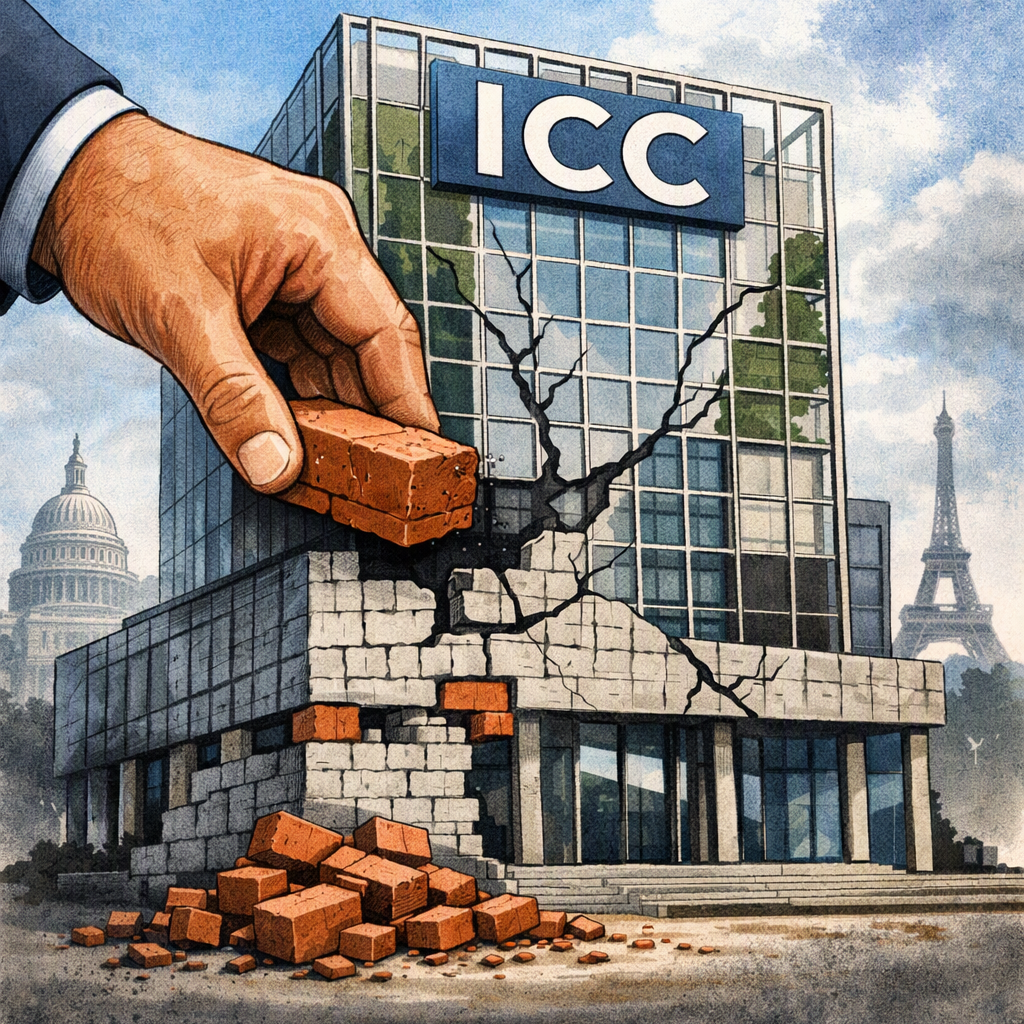
It was a Wall Street Journal column by US Secretary of State Marco Rubio. “This is only the beginning,” he wrote. “Using all the tools at our government’s disposal, working beside every ally with whom we can make common cause, we will dismantle the ICC—brick by brick if necessary.”
Holy moly, I thought, my faith in newspapers is restored!
He was referring, of course, to the International Criminal Court at The Hague, a body that has received much attention over the years for its many bizarre arrest warrants, including the one issued for Bibi Netanyahu. That focus was enhanced recently by New York Mayor Zohran Mamdani’s absurd vow–later retracted in a spurious anti-Zionist and arguably antisemitic speech–to arrest Netanyahu when he comes to New York for the United Nations General Assembly in September.
For me, however, that invigorating spurt of joy came from two other major sources. First, Rubio is my newest hero, who I fervently hope will become the next US president. Especially after Vice President JD Vance—his most likely rival for the Republican nomination—recently succumbed to an avalanche of conspiracy theories involving Israel and Iran.
More importantly, though, I was cheering for the demise of the ICC, an organization I have long considered corrupt, overreaching, and political. I said so, in fact, in a Manila Times column last year. “Don’t get me wrong,” I wrote, “I understand the concept behind the Netherlands-based” court. “Like the United Nations, it is charged with providing its own brand of justice. And, like the UN, it has failed miserably in that endeavor.”
My outburst was prompted by the arrest and deportation of former Philippine President Rodrigo Duterte to face trial by the ICC for alleged “crimes against humanity” during his widely touted war on drugs. I said then—and repeat now—that I have no opinion regarding Duterte’s guilt or innocence. What I felt, and still feel, however, is that the ICC has no jurisdiction in the Philippines or anywhere else, and that giving it such violates the offending country’s sovereignty.
Which is exactly the point Rubio was making. “The ICC and its allies,” he wrote, “seek a standing world tribunal with near-unlimited reach, empowered to override the courts and constitutions of the US and other sovereign states—and to prosecute and arrest our citizens.” For America, he concluded, that would mean “the death of the US as a sovereign and independent nation…To accept the ICC is to surrender control of our national destiny.”
To which I say, “amen!”
Rubio’s declaration got lots of reactions worldwide. “The ICC is an independent body,” The Manila Times proclaimed in an editorial, “and US policy will not legally invalidate its operations.”
Growled another Times’ columnist: “The peace and security of all people depend on the establishment and implementation of a strong rule of law in all nations. Otherwise, chaos and atrocities of all kinds—including war crimes—will prevail.”
The problem, of course, is that the world’s population doesn’t always agree on what constitutes “atrocities” and “war crimes,” differences fueled by local history, culture, and practice amid conflicting political values, outlooks, and interpretations.
While some with specific political agendas, for instance, consider Netanyahu a heinous war criminal, millions of other intelligent and well-meaning people, including me, see him as a necessarily strong defender of a nation under attack. And though many Filipinos view Duterte’s faraway incarceration and trial as morally and legally justified, countless others perceive it as politically motivated corruption.
Which gets to the crux of the matter: given the diversity of the world’s legal and political cultures, it’s hard to recognize the ICC as anything but a dogmatic political entity guilty of, in Rubio’s words, “grave overreach of its purported authority.” And easy to understand why major powers like the US, China, Russia, India, and Israel routinely ignore its pronouncements, while weaker nations including Uganda, Democratic Republic of the Congo, the Central African Republic—and lately the Philippines—honor and bow to its every whim.
The actual crime against humanity, I’m afraid, is the ICC’s.
(An earlier version of this column appeared in The Manila Times).
David Haldane is an award-winning American journalist, author, and radio broadcaster with homes in Joshua Tree, California, and Northern Mindanao, Philippines, where he writes a weekly column for The Manila Times. The son of a Holocaust survivor, he is a former staff writer for the Los Angeles Times, where he contributed to two Pulitzer prize-winning stories. His latest book is Dark Skies: Tales of Turbulence in Paradise.