
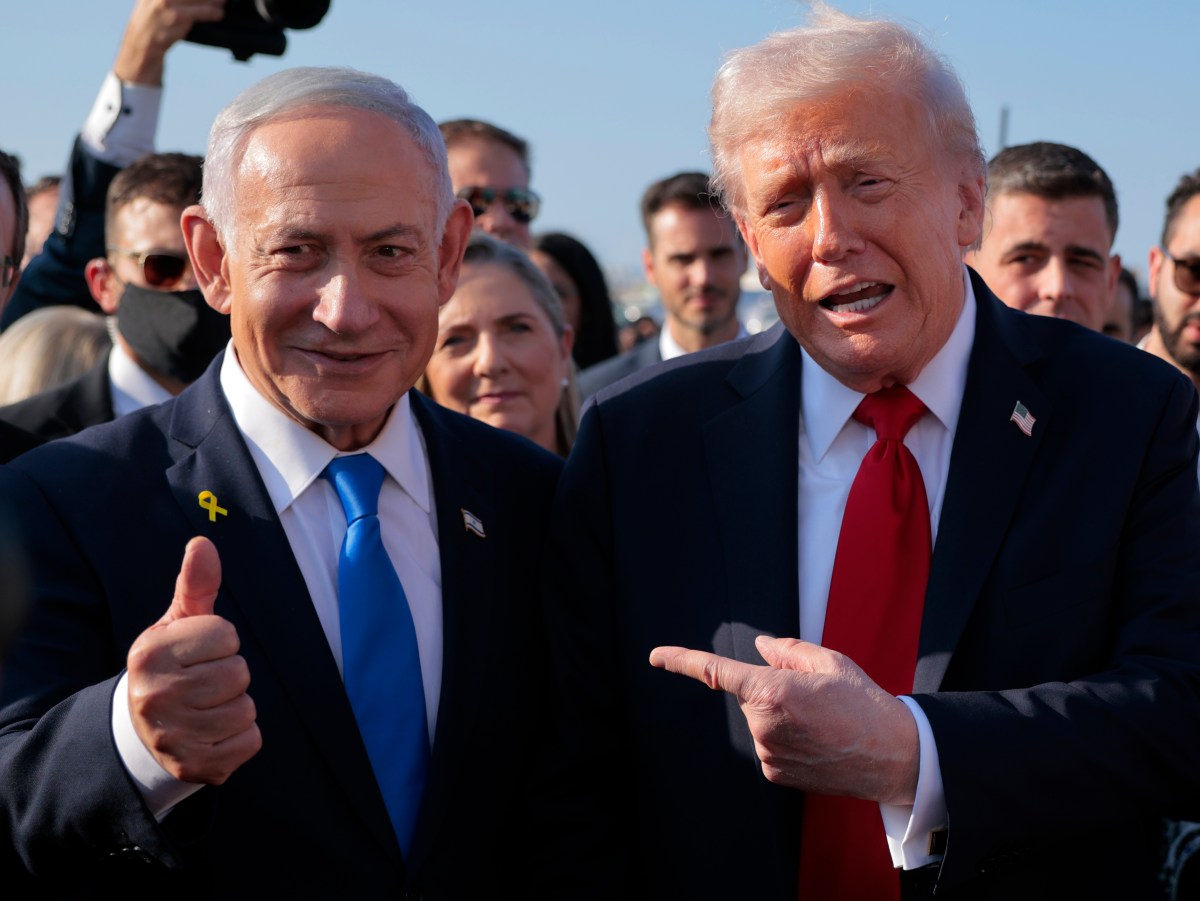
President Donald Trump, who is meeting Benjamin Netanyahu on Tuesday, has made support for Israel part of his political identity. He recognized Jerusalem as Israel’s capital, recognized Israeli sovereignty over the disputed Golan Heights, brokered the Abraham Accords and has always—always—tried to help Netanyahu remain Israel’s prime minister.
Trump plainly believes that helping Netanyahu was synonymous with helping Israel, and has always seemed surprised that most American Jews did not reward him by voting Republican. He should know that his assumption no longer holds.
If Trump again goes out of his way to lend Netanyahu political support during Israel’s coming election campaign, he’ll be unintentionally harming the country and making the destruction of the U.S.-Israel alliance more likely.
Read More on Opinion
The election in Israel on October 27 will be different from every one that preceded it.
If Netanyahu and his nationalist-religious coalition win another mandate, Israelis expect him to finish the constitutional revolution interrupted by the Hamas attacks of October 7, 2023: weakening judicial independence, politicizing oversight institutions, further insulating his government from accountability, and deepening the culture war that is already fracturing Israeli society.
He will also continue coddling the growing ultra-Orthodox minority, enabling their draft evasion and allowing them to continue not educating their youth for modern employment.
US Support for Israel
Most dangerous of all, Israel’s standing in the United States would continue to deteriorate. For decades, Israel enjoyed something extraordinary in American politics: bipartisan support.
Support for Israel was a rare point of consensus among Democrats and Republicans. That consensus is fraying. Among Democrats, the reasons are familiar: the destruction and suffering in Gaza, and alarm over Israel’s democratic trajectory, plus the anti-Israel mania of the progressive movement solidifying around the Democratic Socialists of America movement.
Less noticed—but potentially even more consequential—is the change occurring inside Trump’s own political coalition. A growing number of younger Republicans and populist conservatives question traditional American support for Israel, whether because of foreign aid, Middle Eastern entanglements, or discomfort with Netanyahu’s government.
During the last few years of Netanyahu rule, Israel went from being backed by an overwhelmingly American majority to being viewed negatively by—according to recent polls—60 percent.
A country dependent on the U.S. for everything from munitions to an umbrella at the Security Council blocking economic sanctions cannot afford this. Even if Trump stays loyal, he will not be around forever.
Trump himself is being harmed politically by the sense among many Americans that he is in Netanyahu’s pocket—with, for example, the perception that he was persuaded to launch the unpopular Iran war by the wily Israel leader. Neither one of them can afford that perception to deepen after this latest meeting.
Anyone who cares about this should have been dismayed to see the leaked video this week appearing to show the late Senator Lindsey Graham—whose memorial Netanyahu plans to attend—seeming to receive instructions by phone from Netanyahu on how to present Israel’s security concerns to Trump.
Trump understands branding well—and should recognize that Netanyahu is steadily changing Israel’s brand in America.
The image many Americans increasingly see is not the resilient democracy that inspired bipartisan admiration, but a country associated with conflict, weakening democratic institutions, and extremist ministers who seem to support acts of violence.
Whether every criticism is fair, and whether the reality of the threats facing Israel is understood, is in this context almost beside the point.
Foreign Election Interference
There is also a Russia-Iran angle that Trump should keep in mind.
Israel’s Shin Bet security service has warned that the coming election requires heightened vigilance against foreign interference. Public reporting has not established who may attempt such interference or on whose behalf.
But recent years have shown repeated efforts by Russia and other authoritarian powers to use digital influence operations to polarize democratic societies and strengthen anti-liberal political forces.
It is ironic to think of Iran and its backers trying to boost Netanyahu—but there Israel’s enemies understand that one way to damage Israel would be by helping Netanyahu in the coming election.
A Netanyahu win will produce exactly the outcome Israel’s enemies would welcome most: an Israel increasingly isolated abroad, increasingly associated with occupation and settler extremism, increasingly toxic in American politics, and increasingly incapable of rebuilding the bipartisan support on which its long-term security ultimately depends.
Israel desperately needs a different narrative.
Israel needs a government capable of restoring democratic norms, confronting Jewish extremism with the same seriousness it confronts Palestinian terrorism, rebuilding relations with America’s Democratic Party without sacrificing Republican support, repairing ties with Europe, which is its largest trading partner, and restoring some small measure of hope that the Israeli-Palestinian conflict can move out of its current impasse.
Trump faces a thorny decision on his frustrating war with Iran, and if Netanyahu comes with real intel and assistance Trump should listen.
But beware of Netanyahu’s analyses of events—and by all means stay away from Israel’s election: the most pro-Israel thing Trump could do today is not help Netanyahu win it.
Dan Perry is the former London-based Europe-Africa Editor and Cairo-based Middle East Editor of The Associated Press, chairman of the Foreign Press Association in Jerusalem and the author of two books.
The views expressed in this article are the writer’s own.