
(TNND) — Fighting between the U.S. and Iran has stopped for now, but President Donald Trump faces no easy path forward with an enemy that believes it has the upper hand and an ally, Israel, that might want to take a more heavy-handed approach to shared war goals, according to experts.
“President Trump is frustrated with the fact that the military strikes have not been able to lead to some sort of Iranian capitulation, but this Iranian regime does not have a very deep interest in the welfare of the Iranian people,” veteran diplomat and foreign affairs expert Gordon Gray said Tuesday. “So, their pain threshold is very high, and they, the Iranian regime, are therefore unlikely to capitulate to military strikes alone.”
Gray, a former U.S. ambassador to Tunisia who now teaches at the Elliott School of International Affairs at George Washington University, said the recent bombing campaign has not made Tehran more willing to accept American demands.
Instead, Iran believes it can outlast Trump, citing decades of surviving sanctions, domestic unrest and previous conflicts.
And Rice University political scientist Mark Jones said the Iranian regime thinks that time is on its side, that leaving the Strait of Hormuz snarled simply ratchets up the pressure on Trump to get a deal done and get more oil flowing before Republicans have to defend their congressional seats in the midterms in just over three months.
“And that’s the leverage that the Iranian government knows it has,” Jones said.
Both sides are trying to avoid all-out escalation for now, Jones said.
Iran wants to keep negotiations alive without making major concessions, while not provoking a massive attack on its infrastructure.
Trump said in an interview with “Fox & Friends” on Tuesday morning that he could have the U.S. military destroy Iran’s bridges and power plants in a day if needed.
“And, you know, if I can avoid doing that, I’d like to do that,” Trump said.
Trump told “Fox & Friends” that the U.S. and Iran have “had some very good talks,” despite frustration with how the Iranians are posturing.
“For some reason, we can be in the midst of a beautiful discussion, and they’ll come out and say, ‘We’re not talking,’ or, ‘We didn’t discuss nuclear,’” Trump said. “Well, that’s all we discuss, because they’ll never have a nuclear weapon. They understand that.”
Trump said the U.S. blockade on Iranian maritime shipping is in full force.
U.S. Central Command says it has more than 20 Navy warships operating across the Middle East in support of its missions.
And U.N. ambassador Mike Waltz told CBS News a couple of days ago that the pause in strikes against Iran is “giving diplomacy some space.”
The U.S. conducted nearly two full weeks of nightly strikes on Iran but hasn’t struck since Thursday.
Meanwhile, gas has risen for Americans from about $3.79 to over $4 a gallon on average since the hostilities reignited in the early part of July, according to AAA figures.
Jones said Trump needs a deal that provides both economic relief and some degree of political victory. Any agreement would need to reassure global energy markets while also allowing Trump to claim progress on Iran’s nuclear program, such as enhanced inspections or a pledge to pause nuclear activities.
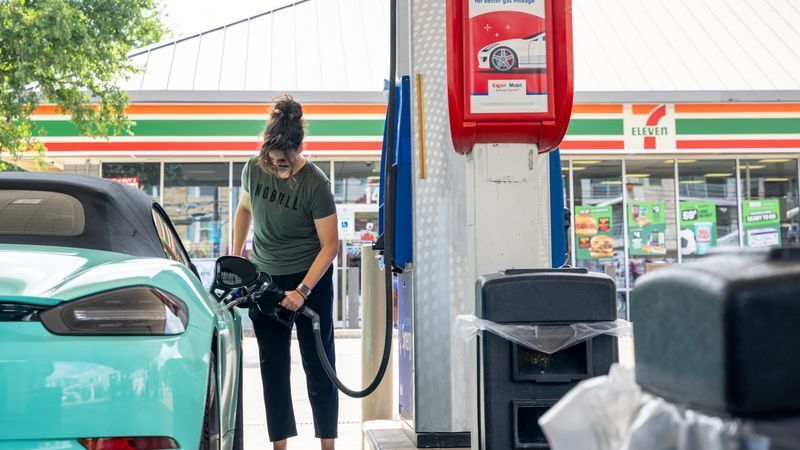
Photo by Brandon Bell/Getty Images, file
Israeli Prime Minister Benjamin Netanyahu met in Washington with Trump on Tuesday and was reportedly set to discuss some new intelligence on Iranian activities at Pickaxe Mountain, a potential nuclear site.
But Trump bristled at the idea that Netanyahu was going to tell him anything about Iran’s nuclear activity that he didn’t already know.
“I don’t need Bibi to tell me that,” Trump said in his Fox News interview, using Netanyahu’s nickname. “Bibi’s telling me that because he wants me to stay involved. I mean, I don’t necessarily – We have the finest, because of the Space Force, we have the greatest cameras in the world focused on (the Iranians). We know exactly what’s going on. But, no, I heard Bibi announce that. I said, ‘Why don’t you just tell it to me? Why do you have to announce it to the world?’ I know exactly what’s going on at Pickaxe. It’s not a big problem. We took out their nuclear sites, and we’ll have to take out Pickaxe if we don’t make a deal.”
Matthew Williams, who served 32 years in the intelligence community and now teaches in the School of Professional Advancement at Tulane University, said Trump and Netanyahu share the same strategic goal but not necessarily the same tactics.
Both leaders want to eliminate Iran’s nuclear threat and limit Tehran’s regional influence, but Israel appears more willing to escalate militarily.
The U.S. has been more cautious, thinking broader attacks, particularly on Iranian energy infrastructure, could trigger an energy crisis and retaliation against Gulf allies such as the United Arab Emirates, Kuwait and Qatar, Williams said.
“I think the Israelis, given the preference, would rather escalate and end things now, where the U.S. realizes that any spike in the conflict carries its own risk to the U.S. and its allies in the region,” he said.
Gray similarly said that he doubts Trump and Netanyahu are fully on the same page.
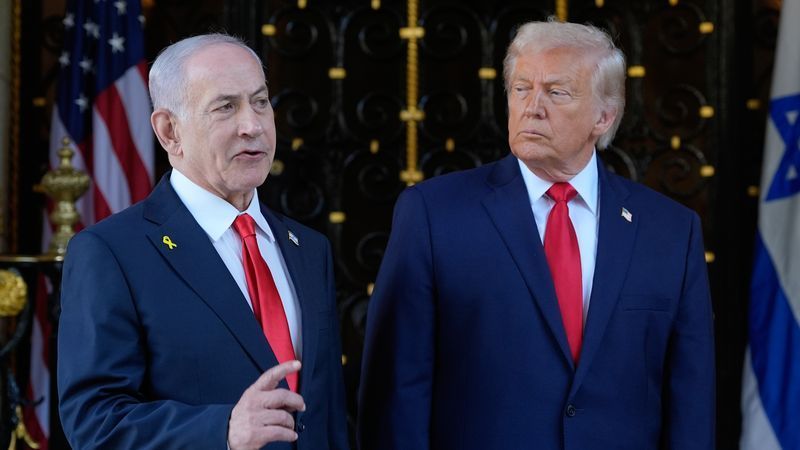
FILE – President Donald Trump listens as Israel’s Prime Minister Benjamin Netanyahu speaks at President Donald Trump’s Mar-a-Lago club, Dec. 29, 2025, in Palm Beach, Fla. (AP Photo/Alex Brandon, File)
Lebanon – where Israel clashes with Iranian-backed Hezbollah – is far more important to Netanyahu, Gray said.
Continuing the war against Iran is also more important to Netanyahu.
Meanwhile, Gray said reopening the Strait of Hormuz is top of the agenda for Trump.
And while Trump might feel political pressure to get the war resolved and gas prices stabilized before the midterms, Israeli elections coming up in late October will decide Netanyahu’s political future.
Gray, Jones and Williams all said the Iranian regime doesn’t care if its people are suffering under the weight of war.
“I think one of the critical errors that the Trump administration made was a belief that if we weaken and wound the Iranian leadership, then the population will effectively push it off the cliff,” Jones said.
And they said Trump misjudged how Iran would respond to the joint attacks by the U.S. and Israel, which began in late February.
“I think he was blinded by the U.S. military’s success in Venezuela,” Gray said. “I think he was taken in by Prime Minister Netanyahu’s telling him in the Oval Office that regime change was going to be easy to accomplish. He disregarded his advisors, and he had also dismissed and/or disregarded the expertise of people in the government.”
Williams said Trump faces the daunting task of dealing with an Iranian regime full of “true believers” – hard-liners who have built their identity on resistance to the U.S. and Israel.
“So, any type of capitulation or agreement to end this conflict on terms acceptable to the U.S. is like a betrayal of their identity,” he said.
And Gray said Trump “only has bad options” left to end the war.
The current pause probably won’t be the end of the fighting, Gray said.
Gray said he expects there eventually to be “some kind of face-saving” deal for Trump to end the war, but he expects to see more of the “oscillations” between air campaigns and negotiations for the immediate future.