
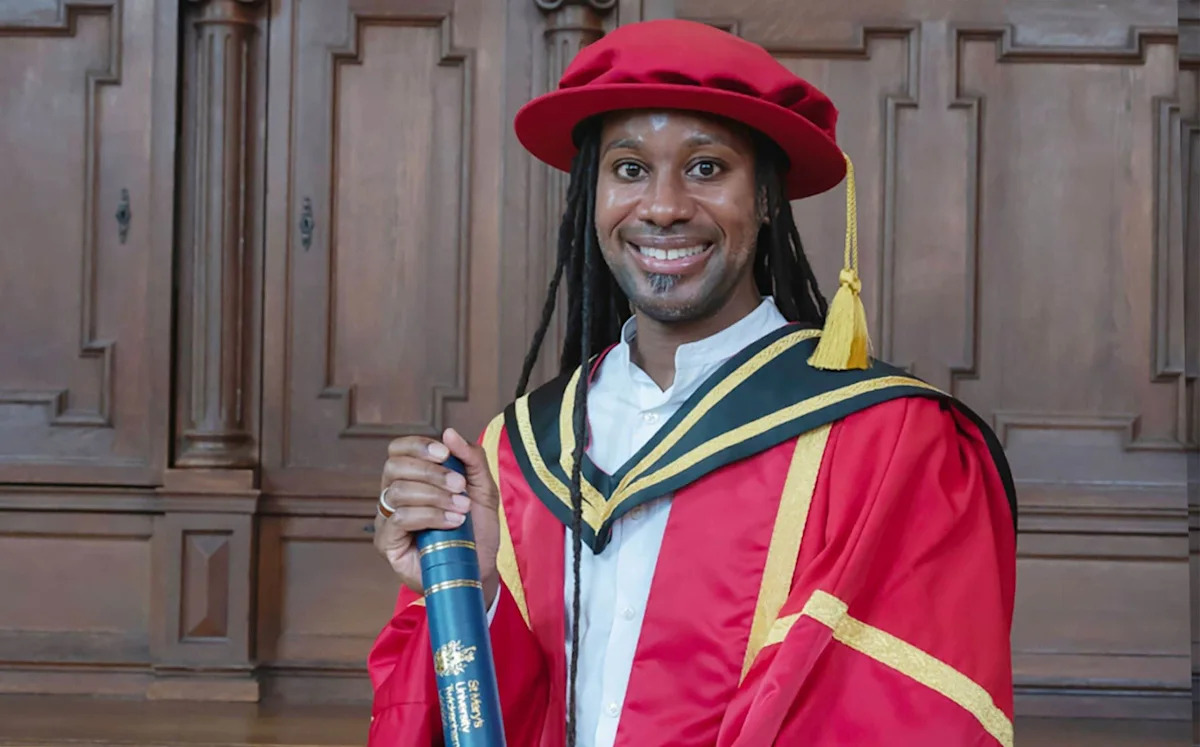
The Cambridge professor at the centre of a plagiarism row is facing questions over claims he has made about his athletic prowess and charity fundraising.
Prof Jason Arday says he once ran 600 miles in six days for charity, 300 miles in three days, and 30 marathons in 35 days, partly with a broken leg.
But experts in ultra-distance running have cast doubt on his claims, expressing surprise that he is not known in the ultra-distance community despite achievements that would put him among the world’s top athletes.
Prof Arday also claims to have been a professional footballer and snooker player, and to have raised £5.5m for more than 70 charities.
Some of the country’s most respected academics have called for an independent investigation into allegations of plagiarism surrounding Prof Arday after The Telegraph reported last week on striking similarities between his PhD thesis and another student’s.
The University of Cambridge insists there is no case to answer, and that he is the victim of a “vile campaign to undermine his credibility”. Liverpool John Moores University, which awarded his doctorate, has also said his work had been checked and cleared.
Running 600 miles in six days
In 2023, Prof Arday became the youngest black professor in Cambridge’s history at the age of 37. His memoir, titled Great and Unfortunate Things, will be published next month, in which he recounts being non-verbal until shortly before his 12th birthday and only learning to read and write at the age of 18.
Questions about Prof Arday’s autobiographical details have been swirling in the academic world for years, and those questions have intensified during the ongoing plagiarism row.
On several occasions, he has described running 600 miles in six days from Edinburgh to London for charity, but on one occasion, he said the distance was 500 miles.
Experts in ultra-distance running cast doubt on whether this was possible for an unknown amateur athlete, given that the world record for a six-day run is 650 miles, which was achieved on a flat circuit with a large support team and medical help on standby, as opposed to an undulating road route with little or no backup.
Prof Arday has also said that he fell and suffered a hairline fracture on the 21st day of his 30-marathon challenge, causing his leg to swell to twice its normal size, but managed to carry on and run another nine marathons.
Damian Hall, who has held several British records for ultra-distance runs and represented Great Britain at the Trail World Championships, said: “I haven’t heard of Jason before. Running 30 marathons in 35 days is perfectly possible and several runners, not necessarily elite, have done similar.
“Running 100 miles in 24 hours is also perfectly possible, but it’s very hard to keep that going for two more days, without good breaks for sleep. Not impossible but pretty unlikely.
“The 600 miles in six days is, again, not impossible, but would be remarkable, akin to the very best record-breaking ultra-runners. It seems odd that there appears to be no evidence of that. Usually runners are very keen to share news of runs like that on places such as Strava. If you’re claiming to have done runs as impressive as those, you should provide evidence, which is very easy via GPS sports-watches.”
Another ultra-distance expert who has helped to stage many 100-mile-plus races said: “The six-day world track men’s record is 650 miles. Given the logistics and terrain, plus the support and sleep required, it would be a miracle.”
In recent months, two universities that gave honorary degrees to Prof Arday have removed or watered down references to the 300-mile and 600-mile runs from their online biographies of him. Prof Arday’s memoir contains no mention of the 300-mile or 600-mile runs.
Anglia Ruskin University recently changed the reference to 600 miles in six days to 600 miles in 12 days.
In 2023, during an interview with the University of Bath to mark the International Day for the Elimination of Racial Discrimination, Prof Arday said: “As a child, I was fortunate to play football well, so I was in the Academy system and then played professionally. I also took up snooker when I was 10 and joined a professional tour.”
Football databases contain no record of Prof Arday being a professional footballer, and his autobiography contains no mention of him being attached to an academy or playing professionally.
The online snooker database CueTracker shows that in 2002, the professor played one match in the English Amateur Championship, losing 4-0, but never turned professional.
The Telegraph asked Prof Arday to provide evidence of his sporting achievements but did not receive a reply.
Prof Arday raised ‘£5.5m and counting’
The professor has also said in the past that he has raised £5.5m for charity.
In a public speaking engagement in 2024, he told the National Funeral Directors Association in the US: “I found myself in a very fortunate position where I did a couple of fundraising activities and they’d raise, you know, a couple of thousand pounds, which was great.
“And then I had an opportunity to do a series of ultramarathons over a five-year period, which earned just over £5m for charity. So my target was to raise £1m for charity before I turned 40, but by the time I’d got to 30 I’d raised over £3m and at the moment it’s £5.5m and counting.”
His memoir contains no mention of the £5.5m figure and says the 30-marathon challenge “far exceeded our original fundraising goal” but does not say what that goal was or by how much it had been exceeded.
Prof Arday’s online biographies say that he has raised money “most notably for Shooting Star Children’s Hospices and Shelter”.
A spokesman for Shooting Star told The Telegraph that Prof Arday had raised a total of £10,800 for the charity. Shelter refused to divulge the total he had raised for them, though a JustGiving page for his 300-mile-in-three-days feat shows a total of £380 raised.
Prof Arday has also said in the past that he donated his share of a £20,000 book advance to charity.
The Telegraph asked Prof Arday to provide a breakdown of his fundraising but received no reply.