
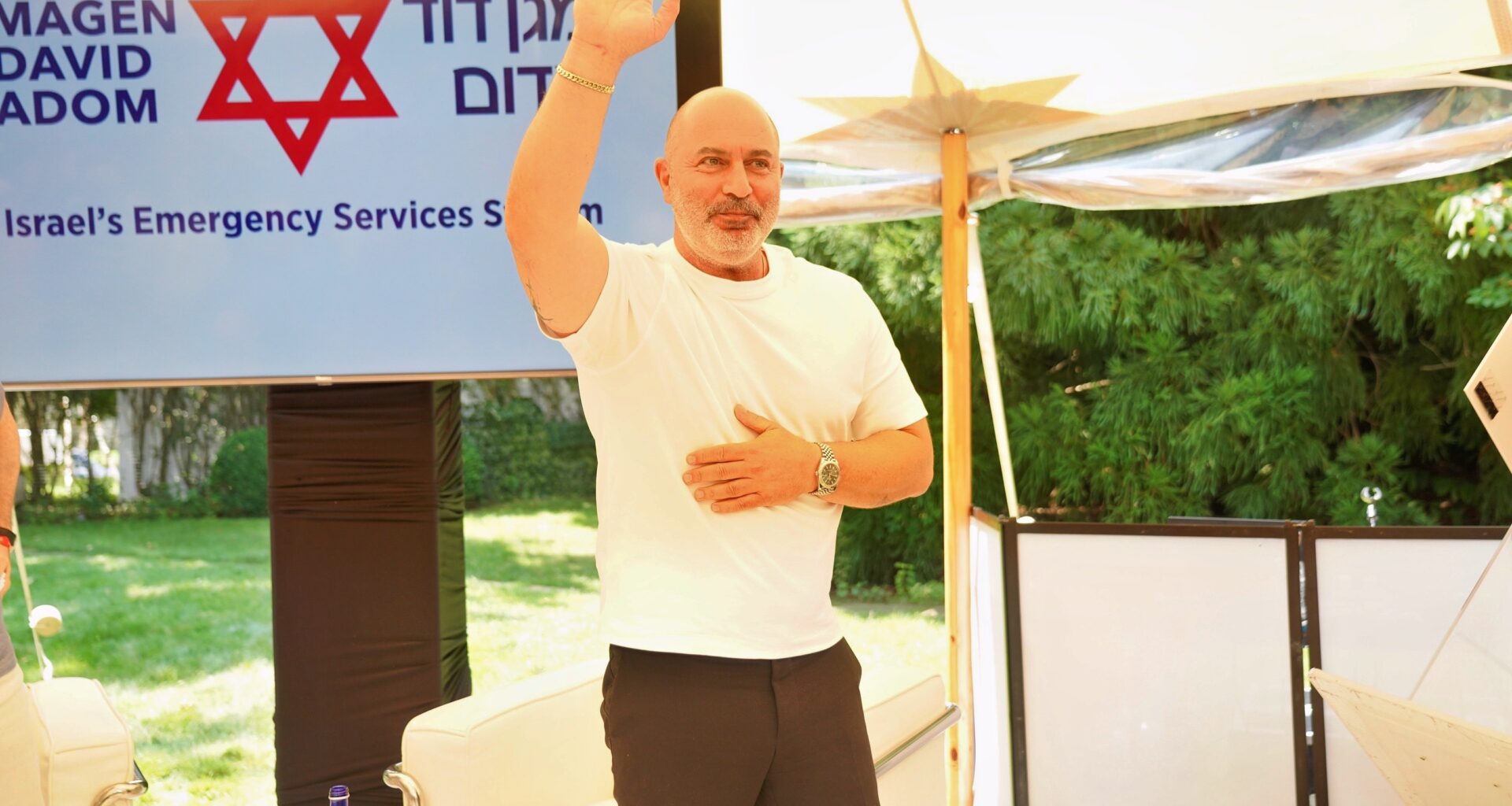
Last weekend, Israeli first responder Erez Geller and Lior Raz, co-creator and star of Netflix’s global hit Fauda, visited the Hampton Synagogue in Westhampton Beach on Saturday and Chabad of East Hampton Sunday morning to share stories about life in Israel. Hosted by American Friends of Magen David Adom (AFMDA), both programs drew capacity crowds who listened to the visitors and their stories, in spite of the torrential rain on Saturday evening.
Rabbi Marc Schneier moderated Saturday’s discussion at The Hampton Synagogue, while Sunday’s event in East Hampton featured a conversation between Raz and Eric Gertler, Chairman and CEO of U.S. News & World Report and Chairman of the American-Israel Friendship League.
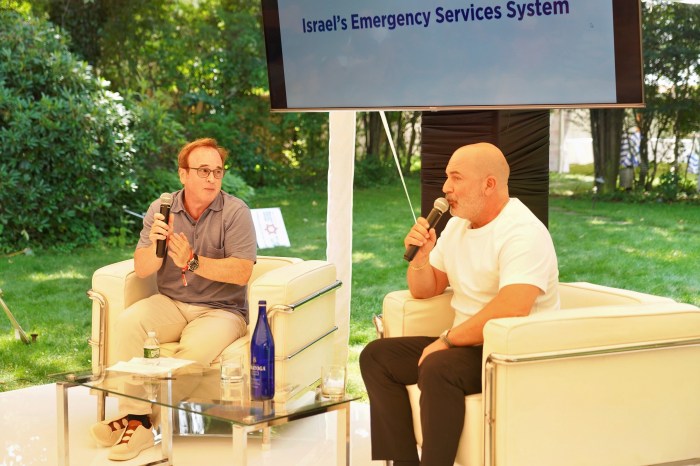 Eric Gertler and Lior Raz in East Hampton
“I was considering canceling the trip until that afternoon,” Geller told the audience on Saturday, noting that renewed escalation of the war with Iran had him questioning whether he should leave his duties in Israel, but he wanted to connect with supporters out east. “It was important for me to come, meet them and simply say thank you. Without their support, these things cannot happen.”
“There is something incredibly powerful about hearing Israel’s story directly from the people living it,” said Alexandra Bernstein, Director of Major Gifts for American Friends of Magen David Adom. “Lior and Erez brought authenticity, courage and hope to these conversations, and you could feel how deeply their stories resonated with everyone in the room. The overwhelming response reminded us that the bond between our community and Israel remains as strong as ever.”
Famous for acting in and co-creating Fauda, among other film and television projects, Raz also spent time as part of a real elite Israeli military unit with members who are fluent in Arabic. During the talk, he reflected on his actual experiences that shaped Fauda, his military service and the events of October 7. He also spoke about Magen David Adom as one of Israel’s greatest examples of coexistence, where Jewish, Muslim, Christian and Druze volunteers work shoulder to shoulder to save lives without regard for religion or background.
While audiences often associate Magen David Adom with war and terrorism, Raz pointed out that the organization’s work goes beyond moments of crisis. Every day, its teams respond to heart attacks, serious car accidents, difficult births and countless other medical emergencies across Israel.
Raz’s fame may have attracted the crowds, but Geller offered something of substance. As director of emergency medical operations across northern Israel, he oversees the response for approximately 1.6 million residents, and he explained what that work now looks like.
“The home front has become the front,” Geller said, noting that emergency response is critical now. “A seriously injured person does not have 10 minutes,” he said. “We do not have the privilege of waiting. When a call comes in, our teams go out knowing they are risking their own lives, because that is what it means to treat people.”
Attendees were surprised to learn that Israel’s national emergency medical service depends heavily on philanthropy. Ambulances, protective equipment, medical supplies and advanced training are all made possible through donor support.