

JTA — Bret Stephens, the Pulitzer Prize-winning New York Times columnist known as one of the paper’s most consistent defenders of Israel, used his Tuesday column to take direct aim at the country’s handling of settler violence in the West Bank — warning that unchecked attacks now pose a threat to Israel’s security and to Zionism itself.
Stephens, who has spent years pushing back on what he sees as double standards applied to Israel, wrote that he decided to speak out against what he called “Jewish terrorists” despite his reluctance to feed the volume of global condemnation facing Israel.
“That’s not only because the terrorism is a menace to Palestinian lives and property, or an affront to Jewish ethics, or a stain on Israel’s reputation — though it’s all those things,” he wrote. “It’s also a direct threat to Israel’s security and statehood, and thus to Zionism itself.”
Stephens’s column drew heavily on a public letter sent Sunday to US President Donald Trump by Matan Vilnai, a retired IDF deputy chief of staff, on behalf of Commanders for Israel’s Security, an organization representing hundreds of retired senior Israeli officers. The letter cautioned that Israeli security services have been effective against Palestinian terror groups but hamstrung when it comes to curbing Jewish extremists. The letter warned about the consequences of Israeli inaction in curbing attacks on Palestinians.
“Unless arrested swiftly and decisively, escalating violence in the West Bank is poised to ignite the region and carries severe ramifications for both Israeli security and US regional interests,” wrote Vilnai.
Get The Times of Israel’s Daily Edition
by email and never miss our top stories
By signing up, you agree to the terms
Stephens pointed to last week’s rampage by extremist settlers through several Palestinian villages — attacks that reportedly included arson at a home and two mosques and an assault on a stonecutting factory — as evidence the problem has become routine rather than exceptional. He cited Israeli military figures showing nationalistic and settler-related crimes climbed to 867 incidents in 2025, up from 682 the year before.
Stephens also cited Eran Shamir-Borer of the Israel Democracy Institute, a former IDF legal official, who told him the government has specifically declined to place suspected Jewish settlers under administrative detention. The practice, imprisoning individuals without formal charges, is regularly deployed against suspected Palestinian terrorists.
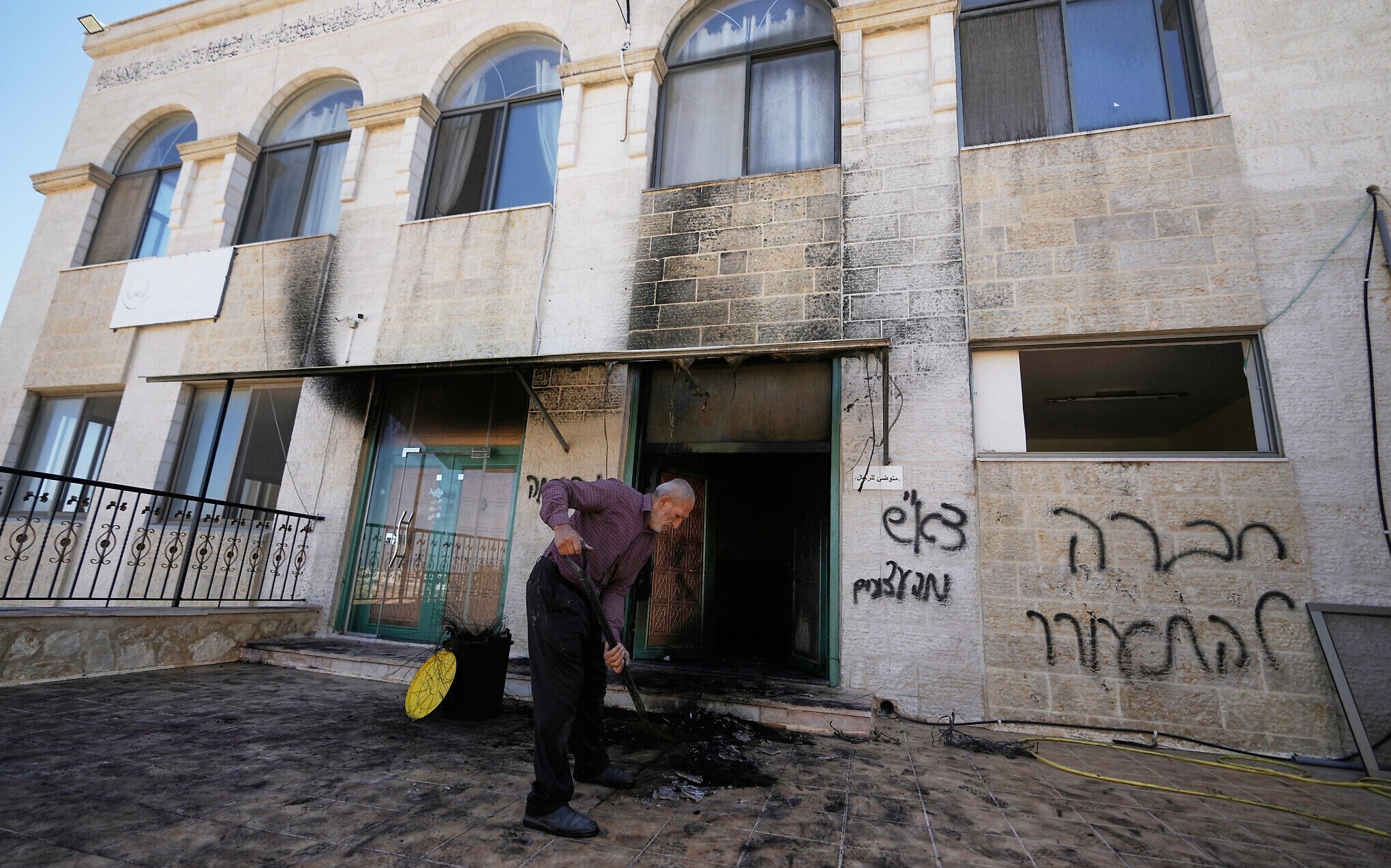
A man clears the rubble as writing in Hebrew on the wall reads ‘revenge, regards to the arrested, people, wake up,’ at one of the West Bank mosques that were vandalized and partly set on fire by Israeli settlers overnight, in the village of Jiljilya, north of Ramallah, June 17, 2026. (AP Photo/Majdi Mohammed)
The columnist dismissed Prime Minister Benjamin Netanyahu’s public framing of the violence as the work of roughly 150 “juvenile delinquents,” as he did in an interview with NBC earlier this month. Stephens argued that a government capable of eliminating a Hamas commander deep inside Iran cannot plausibly claim it’s unable to rein in a few hundred vigilantes.
Stephens is known, and widely admired within the pro-Israel community, for his robust defense of Israel, from refuting the charge of “genocide” directed at Israel to condemning what he has called the “hyperbolic and often conspiratorial hatred of the country.” Editor of the conservative Jewish thought journal Sapir, Stephens was also chosen to give the annual “State of World Jewry” address at the 92nd Street Y earlier this year.
“I think it is really important that people like Bret Stephens are speaking up about settler violence, and I think that it also shows how terrible that it’s become,” said Rabbi Jill Jacobs, CEO of T’ruah: The Rabbinic Call for Human Rights, in an interview with JTA. “Even people who are pretty, let’s say, hesitant or who almost never criticize Israeli policy are speaking up.”
But she also suggested that the issue goes beyond a failure to enforce the law or hold settlers accountable, and instead reflects the priorities of Netanyahu’s right-wing government.
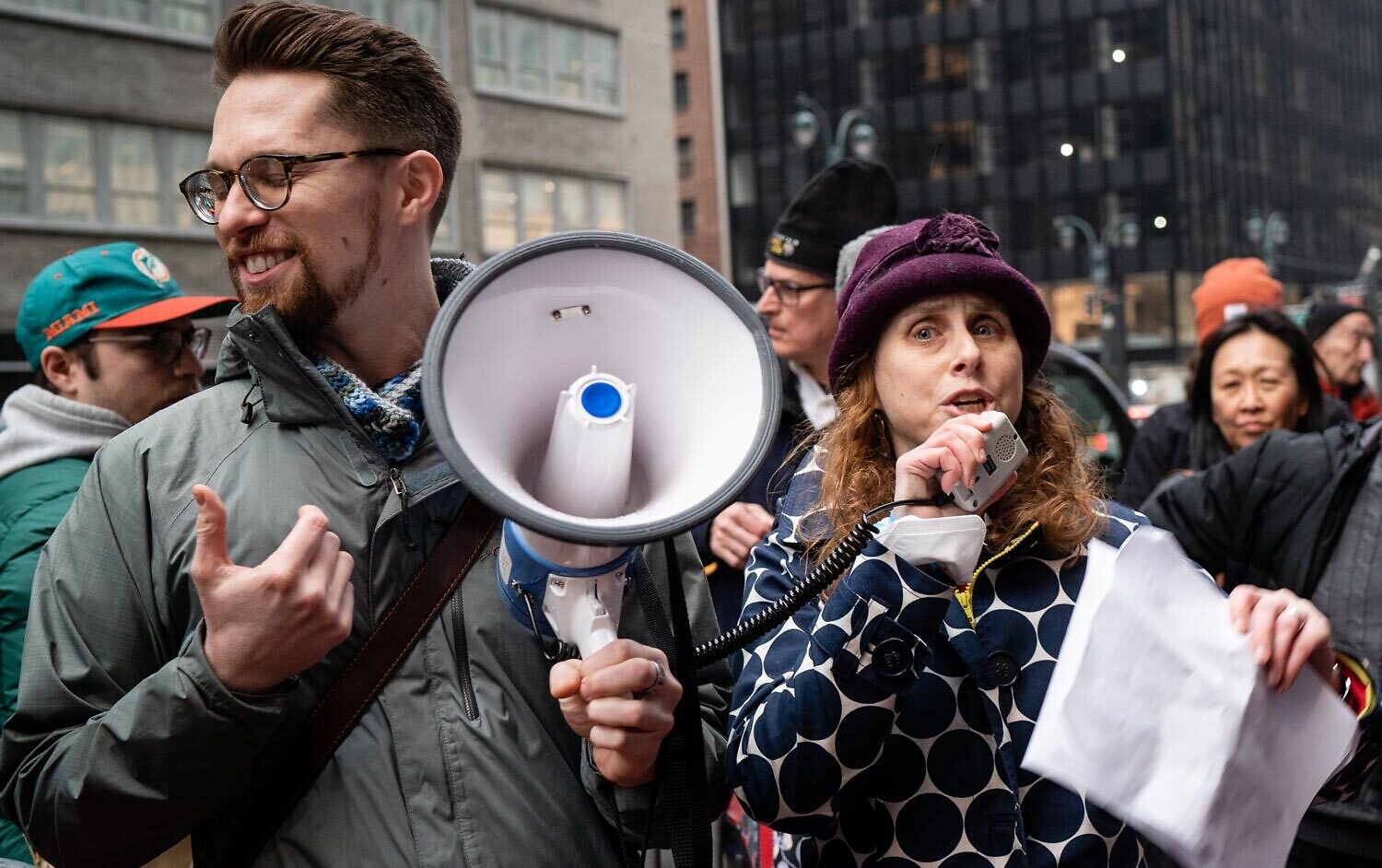
Rabbi Jill Jacobs at a protest against the Israeli government’s proposed judicial reforms in New York City, February 21, 2023. (Luke Tress/Times of Israel)
“This is actually government policy because this is violence that is designed to take more and more of the West Bank,” said Jacobs. “There’s already been not just violence, but expulsions, shoving Palestinians to smaller and smaller areas and, ultimately, annexing the West Bank or at least as much of it as possible.”
Liberal Jewish groups like T’ruah, including Torat Zedek and Bnei Avraham in Israel and the US-based groups Smol Emuni, J Street and New Israel Fund, regularly condemn the settler violence and call on Israeli security forces to hold the perpetrators accountable. They also take part in “protective presence” visits to the West Bank in solidarity with Palestinians threatened by Jewish settlers.
The largest Jewish organizations have been less vocal on the topic, although the American Jewish Committee and the Union for Reform Judaism have issued statements condemning settler violence.
Right-leaning groups have either downplayed the extent of the violence or say Jews living in the West Bank have been provoked by neighboring Palestinians. On the same day that Stephens’s column appeared, the media watchdog group HonestReporting ran an article saying that the major news outlets disproportionately focus on settler violence, and run many fewer articles about Palestinian attacks on Jewish civilians. It also cited official Israeli data suggesting that violence by Jewish civilians in the West Bank had declined significantly since March.
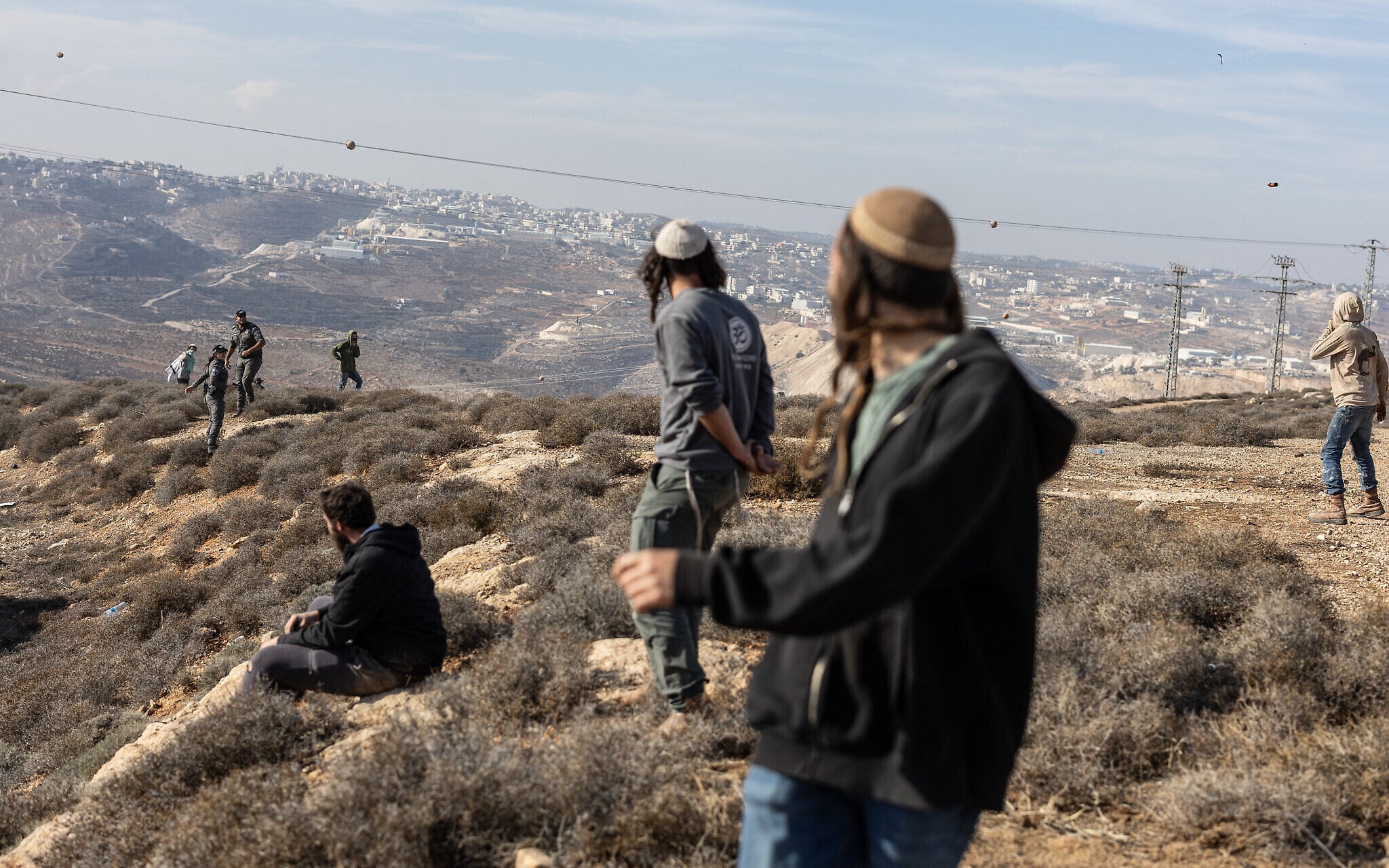
Illustrative: Israeli security forces clash with Hilltop Youth as they evacuate and demolish an illegal outpost built near the Jewish settlement of Metzad, east of the Palestinian city of Sa’ir in the southern West Bank on November 17, 2025. (Menahem Kahana/AFP)
Nevertheless, Stephens appeared to be echoing a growing sentiment even on the right that the settler violence is both wrong and a black eye for Israel at a time when its reputation is suffering around the world.
“I don’t think there are many supporters of Israel in the US who are happy with how Israel has handled, or really mishandled, settler violence,” said David E. Bernstein, a professor at George Mason’s Antonin Scalia Law School and a frequent commentator on Jewish affairs, in an email exchange with JTA. “To me, it’s anti-Zionist to allow settlers to flout the law and public policy, whether by violence or by setting up illegal outposts, because Zionism means accepting the legitimacy of the Israeli state, and radical settlers who don’t are no different than extremist Haredim [Orthodox] in not doing so.”
Last week, Israel’s Channel 13 reported that the government had approved a plan in March to tackle violence by extremist settlers but kept the plan secret due “to political considerations.” The report didn’t say whether the plan has been implemented.
We can’t do this work alone.

The war with Iran has been draining for all of us in Israel. But when I heard about a high casualty incident – ballistic missile impacts in Arad and Dimona that left nearly 200 people wounded – I drank a cup of coffee, packed a bag, and headed south.
There, I spoke with Shilgit, the head of an after-school program for underprivileged youth. Standing outside her destroyed center, Shilgit said it was a miracle that no children were hurt and spoke about the community coming together in the hours since.
As a Times of Israel reporter, I’m committed to telling stories of resilience like Shilgit’s. But my colleagues and I can’t do this alone. If you value work like this, please consider joining our reader support group, The Times of Israel Community. Your financial support is essential to keep real human reporting like this going.
— Stav Levaton, military reporter
Already a member? Sign in to stop seeing this
You’re a dedicated reader

That’s why we started the Times of Israel – to provide discerning readers like you with must-read coverage of Israel and the Jewish world.
So now we have a request. Unlike other news outlets, we haven’t put up a paywall. But as the journalism we do is costly, we invite readers for whom The Times of Israel has become important to help support our work by joining The Times of Israel Community.
For as little as $6 a month you can help support our quality journalism while enjoying The Times of Israel AD-FREE, as well as accessing exclusive content available only to Times of Israel Community members.
Thank you,
David Horovitz, Founding Editor of The Times of Israel