
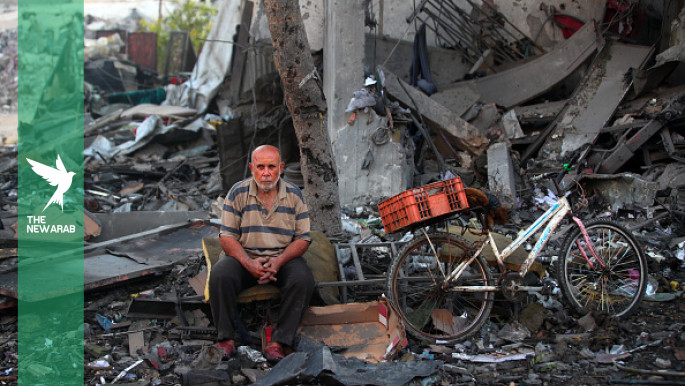
Many Palestinians in Gaza expressed cautious optimism, but they remain sceptical over after watching previous ceasefire agreements collapse due to Israeli attacks. [Getty]
Palestinians in the war-torn coastal enclave, view Hamas’s approval of the final draft of the roadmap for the second phase of the Gaza ceasefire as more than another diplomatic announcement.
Speaking to The New Arab, residents across the Gaza Strip said Hamas’s approval of the roadmap, including disarmament, revived hopes that nearly three years of Israel’s genocidal war could finally be ending.
But many expressed cautious optimism, saying they remained sceptical over Israel’s actions after watching previous ceasefire agreements collapse due to Israeli attacks. Since the latest so-called ‘ceasefire’ brokered by the United States last October, Israel has killed more than 1,200 Palestinians, mainly civilians.
On Friday, Hamas informed mediators that it had accepted the final draft of the roadmap following marathon negotiations in Egypt’s El Alamein involving Egyptian, Qatari and Turkish officials.
The move opens the door to negotiations over some of the most sensitive issues, including governance in Gaza, reconstruction, security arrangements and the future of the factions’ weapons.
Ghazi Hamad, a senior Hamas official and one of the negotiators in Egypt, said in press statements for several Arab and local outlets that the movement accepted the framework proposed by UN Special Coordinator for the US-backed “Board of Peace’s” High Representative for Gaza, Nikolay Mladenov, after amendments were incorporated into the draft.
He rejected claims that the agreement amounted to total disarmament, saying it instead provides for the collection and storage of heavy weapons under the supervision of the National Committee for the Administration of Gaza, without handing them over to Israel or any non-Palestinian entity.
Hamad stressed that any steps concerning weapons remain conditional on a full Israeli withdrawal from the entire Gaza Strip.
According to the proposed roadmap, the inventory of heavy weapons, tunnels and military production sites would begin within two weeks of final approval, alongside the gradual transfer of civilian and security responsibilities to the National Committee, which would oversee Gaza during a transitional period.
Israeli withdrawal would proceed in parallel with the implementation and deployment of an international stabilisation force, and preparations for reconstruction projects.
US President Donald Trump, however, presented a different interpretation of the agreement, announcing that the “Board of Peace” had secured what he described as a “historic agreement” providing for the complete disarmament of Hamas and other armed factions.
He portrayed the deal as a central pillar of his broader Gaza initiative and a step toward establishing a new Palestinian administration before an Israeli withdrawal.
Meanwhile, the National Committee for the Administration of Gaza welcomed progress, saying it was fully prepared to restore public services, oversee recovery efforts and lead reconstruction.
It called for broad Palestinian participation and sustained regional and international support to ensure a successful transition.
Between optimism and reservations
While Hamas has endorsed the roadmap, other Palestinian political groups remain mixed.
Ali Abu Shahin, a member of Islamic Jihad’s political bureau, said in a press statement that the movement supports any agreement capable of easing Gaza’s humanitarian suffering while safeguarding Palestinian national rights and the right to resistance.
At the same time, he added that the Islamic Jihad still have reservations about the current draft because it lacks clear guarantees obliging Israel to implement its commitments and does not sufficiently establish reciprocal obligations between the two sides.
For Gaza-based Palestinian political analyst Mustafa Ibrahim, the latest development represents less a new agreement than an effort to implement understandings that have existed for months.
“The challenge is no longer reaching an agreement but implementing it,” Ibrahim told TNA.
He argued that the current understandings could have been achieved much earlier, potentially sparing Palestinians enormous human losses and widespread destruction.
He believes reconstruction, governance and security arrangements will require years of work, while the central dispute remains unresolved: Israel insists its withdrawal be linked to disarmament, whereas Hamas maintains that any arrangements concerning weapons can only follow a complete Israeli withdrawal.
However, Ramallah-based political analyst Esmat Mansour sees greater reason for optimism.
He believes the current framework differs from previous initiatives because of direct US backing and President Trump‘s endorsement, as well as what he describes as a strategic shift within Hamas under its current leadership following the election of Khalil al-Hayya.
“Hamas now appears more willing to separate governance and political administration from the future of its military capabilities,” he said. “The enormous costs of the war have pushed the movement towards decisions that would have been difficult to contemplate before, creating greater room for compromise.”
Mansour views these changes increase the chances of success, provided Israel actually honours its commitments and does not obstruct implementation during later stages as it usually does.
Success by whether life actually changes
Meanwhile, many Palestinians inside Gaza think political declarations are secondary to the realities of daily survival.
Samir Abdullah, 45, from Gaza City, told TNA that the repeated disappointments have left residents deeply sceptical.
“Every time we think the war is about to end, disagreements begin again,” he said. “If it’s not Hamas, it’s Israel blocking the agreement. People simply want the war to stop so we can live normal lives again.”
Um Raouf Abu Ali, a displaced woman from northern Gaza, told TNA that the value of any agreement would be measured by its ability to quickly improve people’s lives.
“We don’t care what the agreement is called or who governs Gaza,” she said. “What matters is that the war ends, our children return to school, and we have homes instead of tents.”
Ahmed Abu Jarad, another resident from Beit Lahia, echoed those sentiments, saying Palestinians increasingly judge agreements not by political statements but by whether humanitarian aid enters Gaza, electricity is restored and reconstruction finally begins.
Israeli media, citing political sources, reported that Israel continues to insist on the complete removal of all weapons from Gaza, arguing that elements of the proposed roadmap do not fully satisfy its security demands.
Those reports suggest that while negotiations may have reached an important milestone, implementation is likely to prove far more difficult.
Even so, many Palestinian observers regard Hamas’s approval as one of the most significant political developments since the war began, marking a shift from negotiations aimed simply at securing a ceasefire to talks that could reshape Gaza’s political, security and administrative future.
For Palestinians exhausted by years of an ongoing Israeli genocide, however, the agreement’s success will not be judged by diplomatic announcements but by whether the bombs stop falling, displaced families return home, and life can finally start again.