
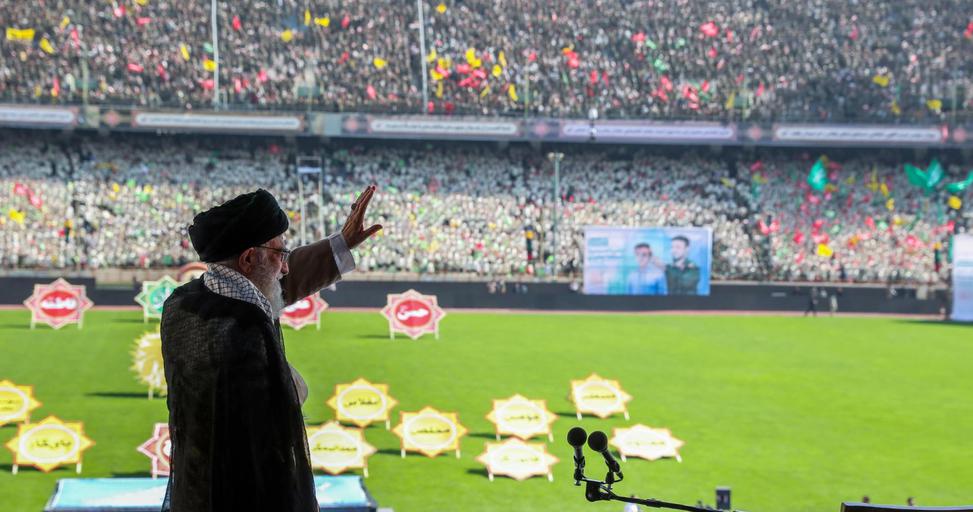
Media outlets in Iran have reported that the historic Azadi Stadium will remain completely unusable for the upcoming football season. Neither Esteghlal nor Persepolis, two of Asia’s most popular clubs, nor the Iranian national team will be permitted to host matches at the venue.
With Takhti Stadium in eastern Tehran and Dastgerdi Stadium in western Tehran also deemed unfit for use, the capital’s flagship clubs will once again be forced to host their opponents outside the city.
This report examines the mechanics of an alleged historic corruption scheme involving the Islamic Revolutionary Guard Corps’ engineering arm, the Khatam al-Anbiya Construction Headquarters.
Built in fewer than 14 months during the Pahlavi era, Azadi Stadium has, over a 12-year cycle of alleged repairs between 2015 and 2026, consumed more public money than the construction costs of several state-of-the-art stadiums built in Qatar, Germany, and the United States for FIFA World Cup tournaments.
The total alleged plunder exceeds $368 million.
A Decade of Renovations: Tracking the Toman Figures
According to a review by the Tabnak news website regarding the repair and restoration costs of Tehran’s ageing stadium: “The first major budget allocation for the renovation and modernisation of Azadi Stadium in recent years occurred in 2015, when a budget of 200 billion tomans was requested.”
While this marked the first massive sum allocated over the past decade, it was far from the last. Iranian media reports indicate that Azadi Stadium has been shut down on seven separate occasions since 2015 under the pretext of repairs and structural overhauls.
A breakdown of the officially announced budgets for Azadi Stadium’s repairs over the years shows:
2015 (1394): 200 billion tomans2017 (1396): 550 billion tomans2018 (1397): 1,100 billion tomans2022 (1401): 160 billion tomans2024 (1403): 1,900 billion tomans2025 (1404): approximately 700 billion tomans2026 (1405): approximately 3,200 billion tomans
Adding these nominal figures produces a cumulative total of 7,810 billion tomans, or approximately 7.8 trillion tomans. However, assessing these funds solely in tomans obscures their true economic value because of Iran’s severe currency depreciation.
Monopolised Contracts and Stadium Construction in Iraq
On December 29, 2024, following one of Azadi Stadium’s brief “reopenings,” the facility was plagued by severe operational failures. These reportedly included sudden floodlight blackouts, unfinished repairs to upper-tier seating, destroyed accessible seating areas, water leaking into media interview zones, flooded players’ locker rooms, and damaged press conference facilities.
Speaking to the ISNA news agency that same day, Hossein Tala, the then-CEO of the Sports Places Development and Maintenance Company, said: “Our contract with Khatam al-Anbiya for the renovation of Azadi Stadium was worth 1,900 billion tomans, alongside approximately 700 billion tomans spent on renovating the stadium’s western wing.”
Tala was dismissed from his post less than 48 hours after making the statement, having publicly revealed the IRGC engineering arm’s direct control over the contracts and funds.
Tala was not the first official to bring the IRGC’s construction monopoly to light. On September 21, 2016, Al Arabiya reported that Khatam al-Anbiya had taken over civil infrastructure projects in Iraq, including a single project valued at more than 1 trillion tomans.
In December 2017, the Young Journalists Club quoted Iran’s deputy sports minister as confirming these operations: “The cities of Karbala and Najaf belong to the Islamic world, and all Muslims consider themselves stakeholders in these cities. For this reason, Khatam Construction Headquarters is building stadiums for the Muslim people of Iraq alongside its construction projects in Iran.”
While the IRGC reportedly constructed more than 12 modern sports stadiums across Iraq, it built no comparable infrastructure in Iran. Instead, Iran’s historic national stadium has been driven into physical collapse under the guise of continuous repairs.
Calculating the True Cost: The $368 Million Conversion
Evaluating the historical costs solely in Iranian tomans fails to reflect the real purchasing power of the funds at the time they were allocated.
By converting each annual allocation using the lowest prevailing US dollar exchange rate for that particular year, the true scale of the expenditure becomes clearer:
2015 – $1 = approximately 3,490 tomans:200 billion tomans = $57.3 million
2017 – $1 = approximately 3,830 tomans:550 billion tomans = $143.5 million
2018 – $1 = approximately 10,540 tomans:1,100 billion tomans = $104.4 million
2022 – $1 = approximately 29,330 tomans:160 billion tomans = $5.5 million
2024 – $1 = approximately 58,560 tomans:1,900 billion tomans = $32.4 million
2025 – $1 = approximately 93,580 tomans:700 billion tomans = $7.5 million
2026 – $1 = approximately 179,080 tomans:3,200 billion tomans = $17.9 million
In total, the minimum inflation-unadjusted conversion amounts to more than $368 million.
At Iran’s current exchange rate, this would be equivalent to more than 72 trillion tomans in public funds spent on a stadium that remains unusable.
What $368 Million Builds Globally vs. What the IRGC Delivered
Iranian media sources have confirmed that Azadi Stadium remains unfit for use.
In December 2025, the state-aligned outlet Varzesh 3 quoted Sports Minister Ahmad Donyamali as saying that the stadium would become operational before the conclusion of the 2026 FIFA World Cup.
However, the ministry has now reportedly admitted that no team will be permitted to play or train at the venue until at least the end of the first half of the domestic season.
To put the $368 million figure into perspective, international stadium construction costs illustrate what could have been built in Iran with an equivalent amount:
Allianz Arena, Munich, Germany: Built in 2005 for approximately €340 million as a venue for the 2006 FIFA World Cup.
State Farm Stadium, Arizona, United States: Built in 2006 for approximately $455 million and selected as a venue for the 2026 FIFA World Cup.
Ahmad bin Ali Stadium, Al Rayyan, Qatar: Built in 2020 for approximately $360 million – $8 million less than the amount spent on Azadi Stadium’s repairs – for the 2022 FIFA World Cup.
Khalifa International Stadium, Doha, Qatar: Completely renovated in 2017 for approximately $374 million ahead of the 2022 FIFA World Cup.
Al Thumama Stadium, Doha, Qatar: Built in 2021 for approximately $342 million – $26 million less than the amount spent on Azadi Stadium’s repairs – for the 2022 FIFA World Cup.
Azadi Stadium, Tehran, Iran: Consumed more than $368 million in renovation funds between 2015 and 2026, yet remains unusable.
While world-class facilities meeting international standards were constructed or fully renovated across Germany, Qatar, and the United States for comparable budgets, the IRGC’s engineering apparatus allegedly directed Iranian public resources towards regional infrastructure projects in Iraq while leaving the country’s premier sporting venue non-functional.