
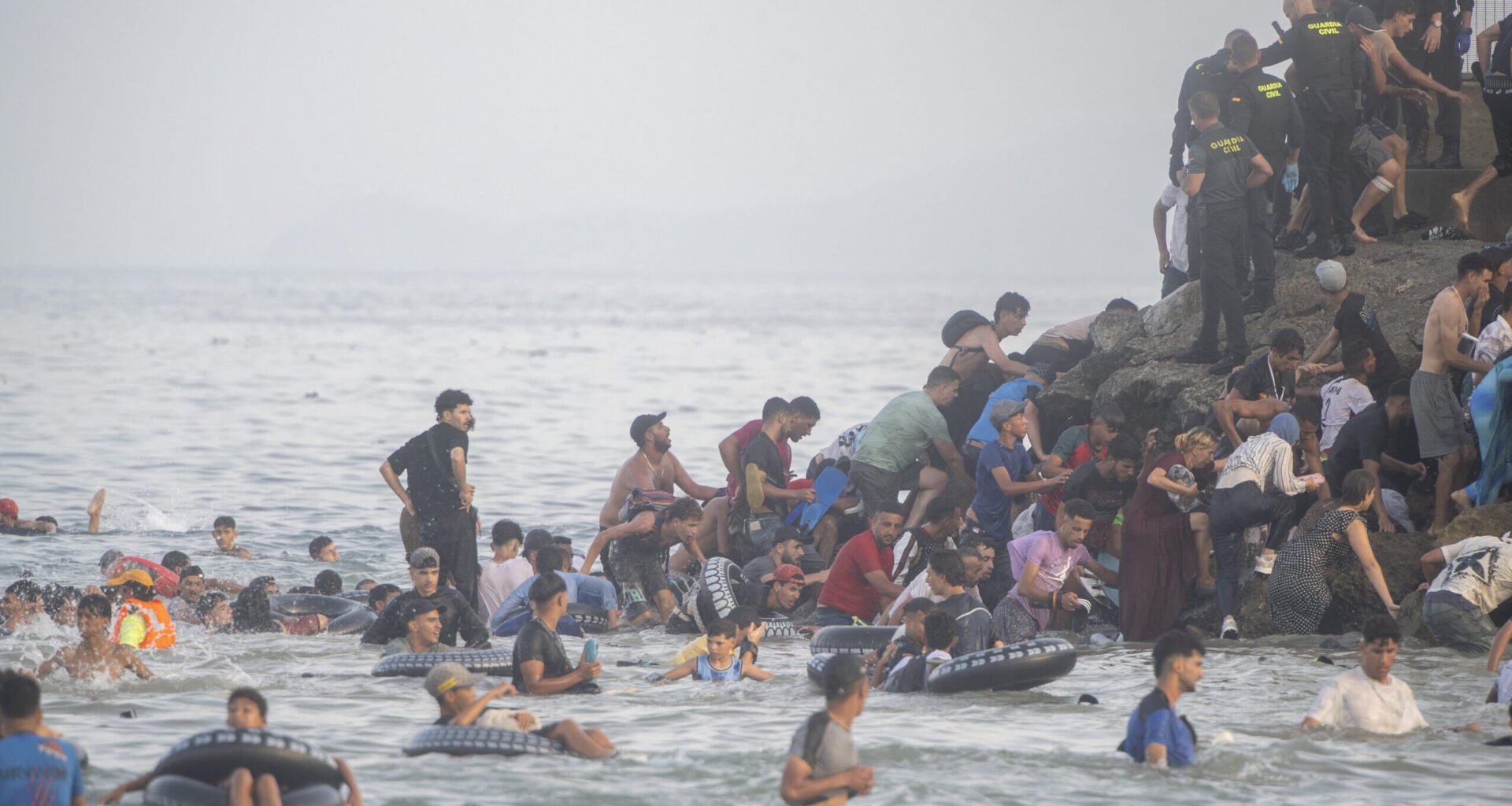
An estimated 60,000 illegal migrants invaded Spain’s North African enclave of Ceuta from Morocco within 24 hours; at least 19 of them were confirmed dead. Spanish troops and police were deployed as the mass of illegal migrants clashed with locals and broke into houses; the invasion spread to Melilla overnight.
Spain and Morocco moved on Friday to stop further entries and accelerate returns. Prime Minister Pedro Sánchez travelled to Ceuta and denounced what he described as a ‘violation of sovereignty’. Madrid blamed trafficking networks for falsely presenting a recent Supreme Court ruling as protection against removal.
The verdict prohibited pushbacks for intercepted sea arrivals, requiring them to go through the usual asylum procedure; coupled with the Sánchez government’s unprecedented regularization policy, launched in April and setting the number of legalized illegal migrants at 500,000—already exceeded by 100 per cent by June—it worked as a massive pull factor for the invasion.
However, more advanced explanations behind the civil war-like scenes on the coast of Ceuta immediately emerged as the news broke. Rabat was accused of conducting a deliberate hybrid coercion operation, loosening border control to put pressure on Spain and Europe, similarly to the methods used in an almost identical, yet much smaller-scale, incident in 2021. At the time, around 8,000 people entered the city amid Morocco’s diplomatic dispute with Spain; the motive and the conduct were obvious.
The European Parliament later accused Rabat of using migration as political pressure against an EU member state. These allegations were already present from the start of the current crisis, with European People’s Party (EPP) President Manfred Weber being the strongest critic of both the instrumentalization of migration by Morocco and Spain’s permissive migration policy.
From a Rebellious Ally to a Reliable Partner
Some recent signs, however, point to an even deeper geopolitical game—5D chess, as they say—at least according to some analysts and social media reports. One of the theories circulating on social media increasingly over the past two days claims possible American and Israeli involvement in the operation that resulted in tens of thousands of young Muslim men invading a city of 80,000 within hours.
The premise of the theory is that the Trump administration, coupled with Israel, wants to ‘punish’ Sánchez for the country’s refusal to grant the US permission to use the Rota and Morón bases and Spanish airspace for operations against Iran, while strongly condemning the war. The Socialist prime minister also has taken one of the most pro-Palestine positions in the EU, constantly condemning Tel Aviv’s Gaza war as ‘genocide’, and is among the staunchest backers of sanctioning the Jewish state in connection with the conflict. Madrid recognized Palestine, restricted weapons traffic to Israel, criticized the Gaza campaign and opposed the US–Israeli strikes on Iran. Spain permanently withdrew its ambassador in March.
Foreign Minister Gideon Sa’ar accused Sánchez’s government of ‘standing with tyrants’ and ‘standing with Iran’. Trump called Spain a ‘terrible partner’ and ordered a halt to trade with Madrid.
The military bases in question are equally important. Rota hosts five forward-deployed Arleigh Burke-class destroyers and supports US and NATO operations across the Atlantic, Mediterranean, Africa and the Middle East. Together with Morón, its position near the Strait of Gibraltar provides American aircraft with a direct staging and refuelling route towards the Middle East, reducing flight times and the tanker support required for operations against Iran.
‘Rabat also claims Ceuta and Melilla’
Unlike Spain, Morocco is a more cooperative partner for both governments. Washington designated it a Major Non-NATO Ally in 2004, signed a defence-cooperation roadmap through 2030 and continues to conduct the African Lion exercises with the Moroccan armed forces. Morocco normalized relations with Israel under the Abraham Accords after Trump recognized Rabat’s sovereignty over Western Sahara in 2020.
Rabat also claims Ceuta and Melilla, regarding the enclaves as remnants of Spanish colonial rule and geographically integral to Morocco. Madrid, however, maintains that both cities have formed an integral part of Spain for centuries and that their sovereignty is non-negotiable.
A House Appropriations Committee report in April placed that claim in an official American document. It described Ceuta and Melilla as Spanish-administered cities ‘located in Moroccan territory’, supported negotiations over their ‘future status’, and directed at least $20 million in National Security Investment funding and another $20 million in Foreign Military Financing to Morocco. The same report condemned Spain for closing its airspace and alliance bases to American operations against Iran.
The current mass invasion is the peak of a slower-building process increasingly accelerated since January, with an increase of 164 per cent in illegal land-border crossings compared to 2025 by July. Support for such dynamics has been equally articulated by many Israeli and American political commentators and analysts in the same period. Former Pentagon official Michael Rubin called in March for a new Moroccan ‘Green March’ involving unarmed civilians entering the enclaves. An April analysis in Israeli outlet Ynet argued that the US–Spain rupture had created an opportunity for Morocco to advance its claims with Israeli support.
A 2019 post by Israeli Prime Minister Benjamin Netanyahu’s son has been recirculated in recent days, in which he urged Arabs and Muslims seeking to ‘free occupied’ territory to begin with Ceuta and Melilla. He also claimed that Israel would refrain from funding Spanish NGOs campaigning for the cities’ transfer if Spain stopped supporting groups advocating an Israeli withdrawal from the West Bank.
Control over the Strait of Gibraltar
Four days before the beginning of the invasion, on 30 July, Trump announced that Morocco’s 1,055-kilometre Tiznit–Dakhla expressway through Moroccan-controlled Western Sahara would bear his name, news that was also heavily promoted by the US embassy in Rabat. Rubio and Sa’ar both congratulated Mohammed VI on Throne Day, which coincided with the crisis. Reacting to the news, Israeli UN Ambassador Danny Danon accused Spain of hypocrisy and asked why it maintained ‘colonial enclaves in Africa’.
The strategic significance of Ceuta is, nevertheless, more than punishing Spain for not liking Trump. The enclave occupies the African side of the eastern approaches to the Strait of Gibraltar, one of the major chokepoints of global commercial trade and a precious military and logistical asset. Morocco already controls the coastline around Tangier and Tanger Med. Acquiring Ceuta would remove a Spanish military and intelligence position, consolidate Moroccan surveillance and logistics, and provide Washington with an additional partner opposite Gibraltar after Madrid demonstrated that access to Rota and Morón was not guaranteed.
The invasion is also dividing the EU. Italy called for Spain’s temporary suspension from Schengen, Finland backed the proposal, France strengthened checks on its Spanish border and Sweden urged Madrid to regain control. All of the countries partly blamed Sánchez’s regularization policy for what was happening, connecting it to the EU’s own security. The footage circulating arguably strengthens the already tense anti-immigration atmosphere across the continent, including in mainstream politics.
Trump’s 2025 National Security Strategy precisely warned that mass migration and demographic decline threatened Europe with ‘civilizational erasure’, while his administration constantly clashed with EU members on migration policy. While Trump has never shied away from dividing the EU, the operation indirectly pushes Europe towards the tougher stance on immigration promoted by Washington.
No evidence has emerged so far that the United States or Israel directed the mass invasion to destabilize Spain. Morocco had independent reasons to pressure Madrid, including Sánchez’s rapprochement with Algeria, its regional foe, and its territorial claims. Spain’s mass regularization definitely encouraged more migration into the country and looks set to hurt Sánchez more than it benefited him.
Related articles:
At a time when public debate is increasingly polarized and superficial, Hungarian Conservative remains committed to depth, intellectual honesty, and independent conservative thought.
Producing high-quality journalism requires resources. Your contribution helps us expand our coverage, reach new audiences, and keep our content accessible.

Please consider supporting our mission.