
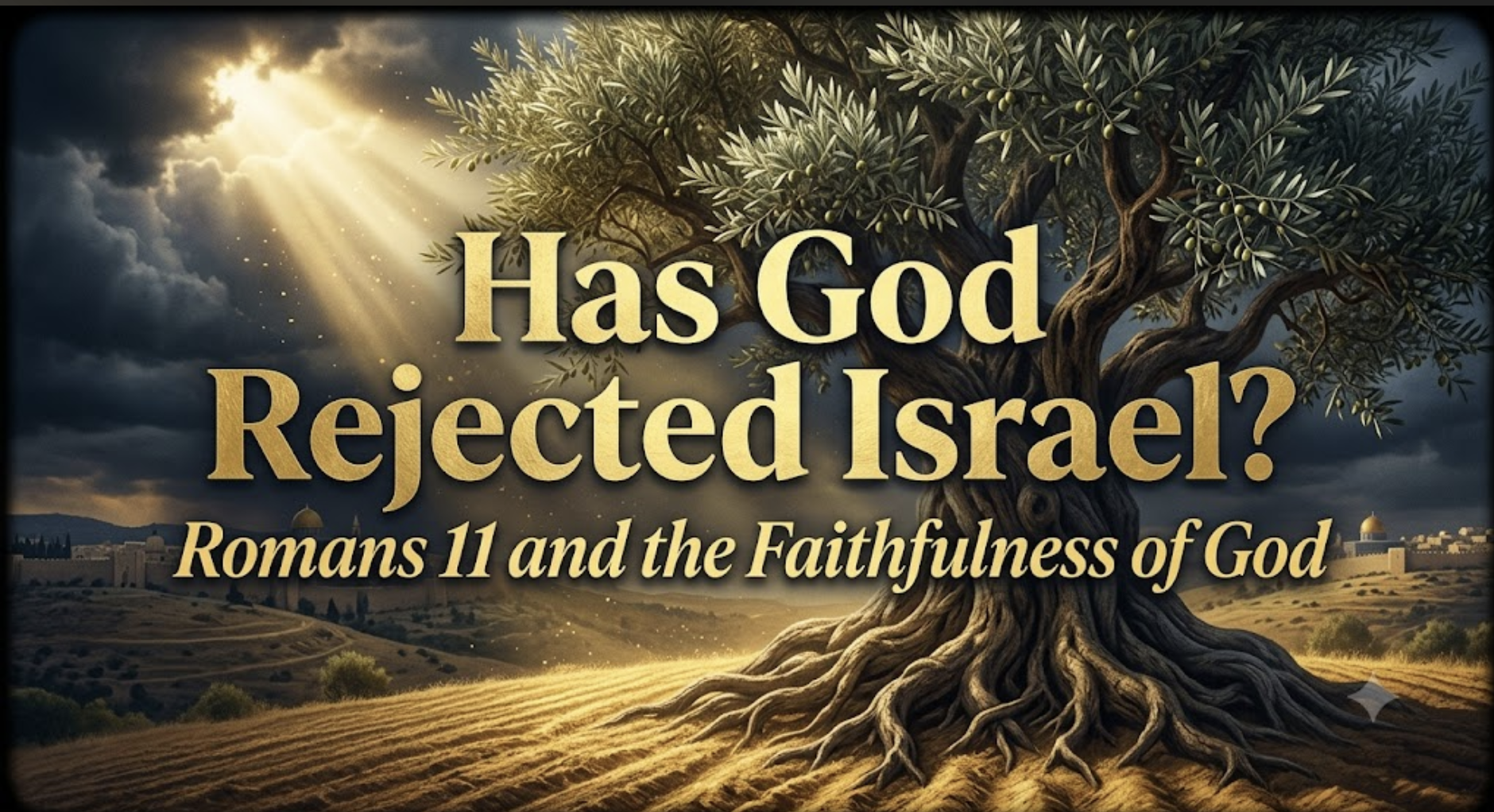
The problem here is not merely historical, but it is also biblical. Romans 11 stands in the middle of the New Testament as perhaps the clearest rejection of the idea that God has finished with Israel. I’m not sure exactly why, but it remains one of the least preached and least understood chapters in Scripture. If Paul were writing today, I suspect he would be astonished that Christians are still debating a question he addressed so directly nearly two thousand years ago: Has God rejected His people?
Paul’s answer could not be stronger: Has God rejected Israel? “By no means!” (Rom. 11:1).
But Paul’s concern extends beyond the Jewish people because what is at stake is the character of God Himself. If God can abandon Israel, what confidence can Christians have that He will remain faithful to His promises to us? Romans 11 is therefore not only about Israel. It is also about whether God can be trusted.
Romans 9–11 is Paul’s extended defense of God’s covenant faithfulness. Israel’s widespread unbelief within Israel created a serious theological question for the early Church. If Israel was truly God’s chosen people, what were Christians supposed to make of the fact that so many Jewish people had not embraced Jesus as the Messiah? Did that mean God’s word had failed? Had He somehow gone back on His promises? Could God really cast aside the very people He had once called His own?
Paul refuses even to entertain that possibility. “I ask, then, has God rejected his people?” Once again, his answer is this: “By no means!” Notice that Paul does not start by laying out a complicated prophetic timeline as American Christians are used to seeing. He starts with the character and faithfulness of God. After all, every promise of the gospel rests on the faithfulness of God.
Paul points to himself as living proof that God had not rejected Israel by reminding them that he himself is an Israelite, a descendant of Abraham, and a member of the tribe of Benjamin. Paul’s story showed that God was still keeping His promises to Israel. His own conversion was proof that God was still at work among the Jewish people.
Paul then turns to the story of Elijah in 1 Kings 19. Elijah had become convinced that all of Israel had turned away from God and that he was the only faithful person left. God corrected him by saying, “I have kept for myself seven thousand men who have not bowed the knee to Baal.” That detail matters because the seven thousand had not kept themselves faithful. God preserved them.
Paul draws the same lesson for his own generation. From the outside, it may have looked as though all of Israel had turned away, but that was not the whole story as God had preserved a remnant who was “chosen by grace.” Israel’s widespread unbelief did not mean that God had turned His back on His people. It simply meant that God was still working, even when His purposes were not easy to see. At the present time there is a remnant, chosen by grace.
This pattern runs throughout Scripture as human beings tend to look at what is happening in front of them and conclude that God’s work has failed. Elijah had made that mistake, and Paul did not want the Gentile believers in Rome to repeat it. God has always kept a faithful remnant, not because they were strong enough to preserve themselves, but because He is gracious and faithful.
Paul then raises another question: Had Israel failed beyond recovery? This is an important question. But Paul’s simple answer is clear: “By no means!” Israel had stumbled, but that did not mean its fall was final. Israel’s rejection opened the way for the gospel to reach the Gentiles, but even that was part of God’s larger plan. An important fact that Christians need to be cognizant of is that the inclusion of the Gentiles was never meant to prove that God had cast Israel aside.
This brings us to Paul’s image of the olive tree in Romans 11:16–24. Before I address this I need to state that the olive tree is Israel, which means it remains a Jewish tree. Few images in Paul’s writings have been misunderstood more than this one. Many Christians read Paul as though he were describing two separate trees—Israel, which is fading away, and then the Church, which takes Israel’s place. Paul never says this because there is only one tree. The New Testament never resolves the relationship between Israel and the Church by simply renaming the Gentile Church “Israel.” Gentiles are brought into Israel’s blessings, but Jewish Israel does not disappear.
Where exactly are the roots of that tree found? The answer to that question is simple, namely in the patriarchs and in the covenant promises God made to Abraham, Isaac, and Jacob. Gentile believers are not placed into a separate tree with no connection to Israel. Instead, they are graciously grafted into a tree that was already there. God’s covenant story did not begin with the Church. It began with Israel, the prophets, the covenants, and the promises that eventually brought the Messiah into the world.
This means that Gentile Christians are living from roots they did not plant themselves. We do not support the root because the root supports us, which is why Paul warns Gentile believers not to become arrogant toward the natural branches. This makes our proper posture to be gratitude, and not superiority.
Paul is clear that some of the natural branches were broken off because of unbelief. He is also clear that being Jewish by birth does not automatically guarantee salvation.
This means that both Jews and Gentiles stand before God by grace through faith. Yet Paul makes it clear that God can graft those natural branches back into the tree. In fact, Paul says it would be far more natural for them to be grafted back in than it was for wild Gentile branches to be added in the first place.
The whole image is meant to humble Gentile Christians. We were once outsiders, but God brought us near by His grace. We did not begin the covenant story, earn the promises for ourselves, or replace the people through whom those promises were given. We were grafted in.
Unfortunately, Church history often moved in a very different direction. Within a few centuries, influential Christian leaders began speaking as though God had finished with Israel for good. Justin Martyr helped move the Church toward this view by increasingly speaking of the Church as the true Israel. John Chrysostom’s infamous sermons against the Jews showed how theological disagreement could quickly turn into open contempt.
Augustine opposed violence against the Jews and believed they should be allowed to survive rather than be killed. Yet he often viewed their continued existence mainly as evidence of God’s judgment and as a witness to Christian truth, rather than as proof that God still had a future for them within His covenant purposes. His view may have prevented some violence, but it also helped create a theology in which Jewish suffering was seen as proof that Christianity had triumphed.
Replacement theology was not the only cause of Christian antisemitism as history is often more complicated than that. Yet it helped create a theological climate in which anti-Jewish attitudes could easily take root. Once Christians believed that God had rejected the Jewish people, it became much easier for them to justify treating Jews with contempt.
Paul leaves no room for this kind of arrogance. He warns Gentile believers not to become proud, but to fear. We stand only by faith, so Christians should never speak about Jewish unbelief as though we are somehow wiser, better, or more deserving. We are here only because God has shown us mercy.
Paul brings his argument to its high point in Romans 11:25–29. He says that Israel’s hardening is only partial and then speaks of a future when “all Israel will be saved.” Christians may disagree about exactly what that phrase means, but Paul’s larger point is clear: Israel’s present condition is not the end of the story.
Paul then says that, although many within Israel are presently enemies regarding the gospel, they remain “beloved for the sake of their forefathers.” Why? “For the gifts and the calling of God are irrevocable.” God does not take back His promises when people fail. He remains faithful because faithfulness is part of who He is.
Israel’s calling was not exhausted when the Messiah came. Paul says that Israel remains beloved and that its calling remains irrevocable. This means that the Jewish people continue to have a place within God’s purposes for the world.
That is why Romans 11 matters so much. It is not only about prophecy, ethnicity, or the modern State of Israel. At its heart, it is about whether God keeps His promises. The God who remains faithful to Israel is the same God who remains faithful to the Church.
The Church needs to hear Paul’s warning again. We must reject Gentile pride and any theology that treats the Jewish people as leftovers from a covenant God has abandoned. We do not support the root. The root supports us.
Romans 11 leaves no room for contempt toward the Jewish people because it leaves no room for Christian triumphalism. It also leaves no room for the claim that God’s covenant faithfulness has expired.
Our proper posture is humility, gratitude, and hope. We stand by grace, live from promises we did not create, and worship the God whose gifts and calling are irrevocable.
McDermott, Gerald R. Israel Matters: Why Christians Must Think Differently about the People and the Land. Grand Rapids: Brazos Press, 2017.
McDermott, Gerald R., ed. The New Christian Zionism: Fresh Perspectives on Israel and the Land. Downers Grove, IL: IVP Academic, 2016.
McDermott, Gerald R., ed. Understanding the Jewish Roots of Christianity: Biblical, Theological, and Historical Essays on the Relationship between Christianity and Judaism. Bellingham, WA: Lexham Press, 2021.