
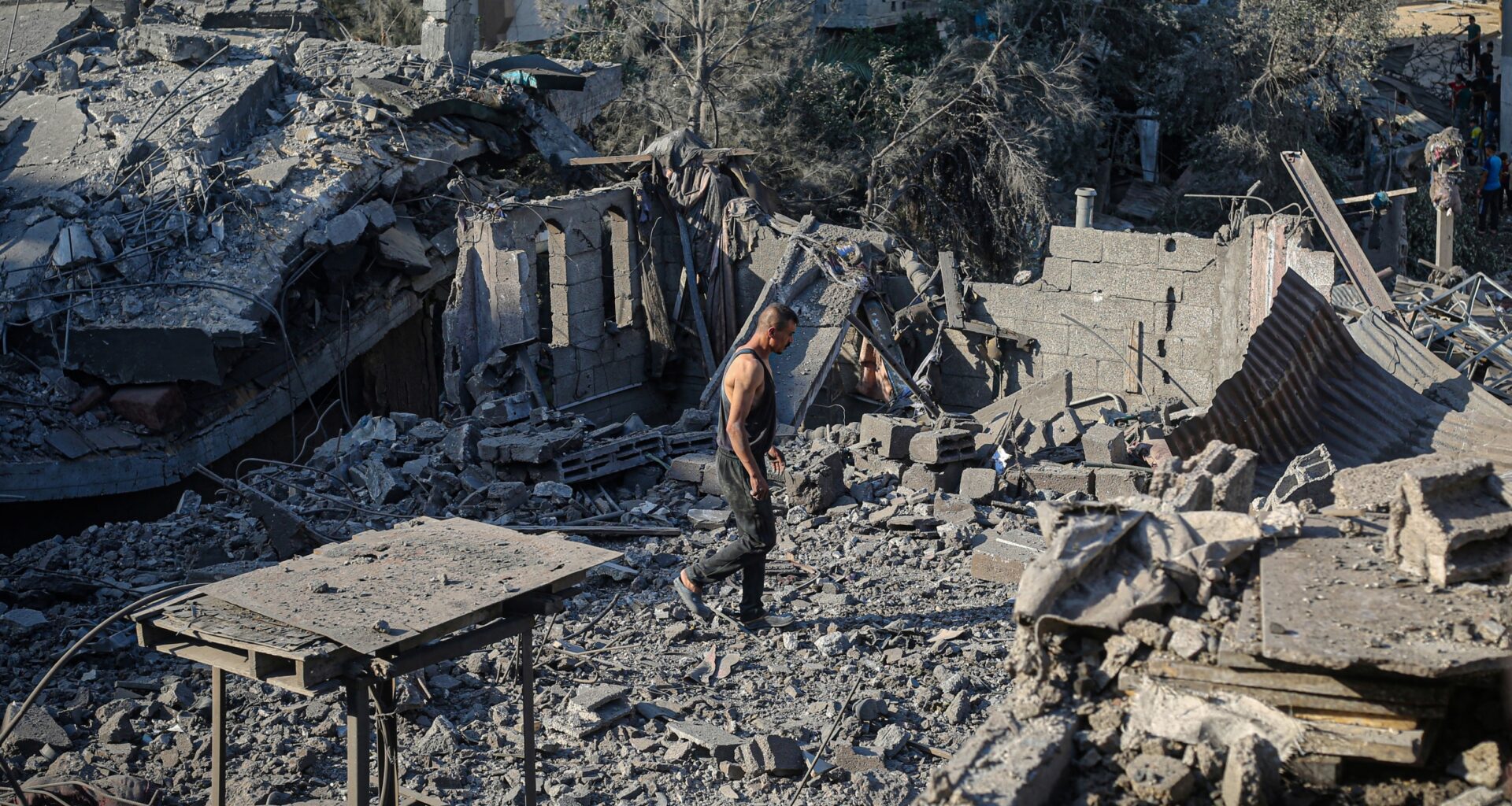
Israeli strikes killed at least 17 Palestinians across the Gaza Strip overnight into Sunday evening, including children, according to local hospitals and Gaza’s civil defense, as Israel offered its first substantive on-record response to Hamas’s disarmament roadmap more than three days after the agreement was announced, directly contradicting an earlier claim by a former Fatah official that a senior Trump adviser had secured an Israeli agreement to halt attacks beginning Sunday morning.
Among those killed were a man and woman struck in an Israeli helicopter strike on an apartment south of Deir al-Balah, according to the Palestinian Civil Defense. Separate strikes killed three people in Khan Younis and one person in Gaza City’s Old City, with the toll rising through the day as additional casualties were reported elsewhere in the territory. The continued and escalating strikes stand in direct tension with an account from Mohammed Dahlan, a former Fatah security official living in exile in the United Arab Emirates, who said Saturday that Jared Kushner, a senior adviser to President Trump, had told him Israel agreed to stop attacks in Gaza beginning Sunday morning as part of the disarmament process moving forward. Israeli officials never independently confirmed his account, and Sunday’s rising casualty figures indicate no such halt has taken effect on the ground.
Israel offered its first substantive on-record response to the roadmap Sunday, more than three days after Thursday’s announcement. Doron Spielman, a spokesperson for Prime Minister Benjamin Netanyahu’s office, told The Associated Press that Israel had shared “serious security concerns” with the White House regarding the proposed deal. Spielman said Israel’s intelligence assessment is that Hamas remains committed to rebuilding its military rather than genuinely demilitarizing, and said the Israeli military would not withdraw from Gaza, where it currently controls more than 60% of the territory, before Hamas “truly” disarms. “Our assessment is that if we redeploy before Hamas is truly disarmed, it will quickly expand its presence throughout Gaza, rebuild its terrorist infrastructure, once again threaten Israeli communities,” Spielman said. Anonymous Israeli officials briefed on the matter said one of Israel’s specific demands is retaining freedom to conduct military operations inside Gaza even after any disarmament process begins.
Far-right National Security Minister Itamar Ben-Gvir has been separately vocal in his opposition, calling the plan “unacceptable” and saying it was “tantamount to agreeing to Hamas organizing for the next massacre”; he has said Israel should continue targeting Hamas leaders regardless of the roadmap’s progress. Netanyahu himself faces a difficult reelection battle ahead of October elections, with far-right coalition partners including Ben-Gvir urging him to maintain pressure on Hamas and keep Israeli forces in Gaza, even as opponents continue to accuse him of failing to prevent Hamas’s October 7, 2023, attack that killed around 1,200 people and saw 251 others taken hostage. Analysts have said Israel appears unlikely to pull back significant forces or make other major concessions ahead of the election.
President Trump has offered a considerably more optimistic account of Israel’s position than the statements now coming from Netanyahu’s own office. Asked during a Cabinet meeting at Camp David whether the United States had received assurances that Israel would abide by the deal, Trump said, “We do have an understanding with Israel. Israel’s very happy about it. Israel helped us with it,” while acknowledging the situation remained “complex” and could go through “ups and downs.” Spielman’s on-record comments Sunday have not echoed that characterization, widening rather than narrowing the gap between Trump’s framing and Israel’s own public position since Thursday’s announcement.
Hamas, for its part, has continued to insist that any disarmament remains contingent on Israel first halting operations and withdrawing in line with last year’s ceasefire agreement. Ghazi Hamad, a member of Hamas’s negotiating team, has said the movement is awaiting an Israeli response to amendments it submitted on the roadmap’s weapons article. Under the terms reported by mediators, Hamas would decommission its weapons over six to eight months and provide maps of its tunnel networks and arms depots, with weapons placed into storage under the Gaza National Administration Committee’s control rather than surrendered directly to Israel.
Violence beyond Sunday’s strikes has continued to underscore the gap between the ceasefire’s nominal status and events on the ground. An Israeli strike Saturday destroyed a medical supply warehouse operated by Al-Aqsa Martyrs Hospital in Deir al-Balah, leaving a crater roughly 20 meters wide and 10 meters deep and destroying a nearby cluster of displacement tents, according to witnesses at the scene. That strike came a day after separate attacks in the same city killed at least two Palestinians Friday, and a Friday strike east of the Nuseirat refugee camp injured at least 10 people, according to hospital officials.
That Sunday’s toll climbed from an initial eight deaths to at least 17 over the course of the day, even as Israel’s government issued its most authoritative statement yet on the roadmap, suggests the pace of Israeli military operations has not meaningfully slowed despite more than three days of diplomatic statements surrounding the disarmament process. Spielman’s explicit warning that Hamas would “quickly expand its presence throughout Gaza” if Israel withdraws prematurely reframes the dispute as a security assessment rather than a purely political sticking point, and his identification of continued freedom to operate militarily inside Gaza as an active Israeli demand suggests the gap between the two sides’ positions may be wider than the “genuine disarmament” language alone had indicated. Netanyahu’s approaching reelection contest, and the pressure from coalition partners like Ben-Gvir to maintain rather than reduce Israel’s footprint in Gaza, gives him a clear domestic political incentive to hold a hard line regardless of how the diplomatic roadmap develops. That Dahlan’s specific, dated prediction of a Sunday halt proved incorrect, arriving just before Israel’s own office issued its most skeptical public statement yet, leaves Trump’s optimistic framing further removed from the pattern of continued and escalating Israeli military activity than it was even before the claim first circulated.
Attention in the coming days is likely to center on whether Israel’s government issues any further, more detailed public statement building on Spielman’s comments, and on whether the strikes that continued and escalated through Sunday persist as the follow-up talks among U.S., Qatar and Turkish mediators in Egypt proceed. Continued monitoring of Netanyahu’s political calculus ahead of October elections, any further comment from Ben-Gvir or other Israeli officials opposed to the plan, and the daily casualty toll in Gaza are expected to remain central to assessing whether the roadmap is translating into changed conditions on the ground.
Originally published on HNGN