
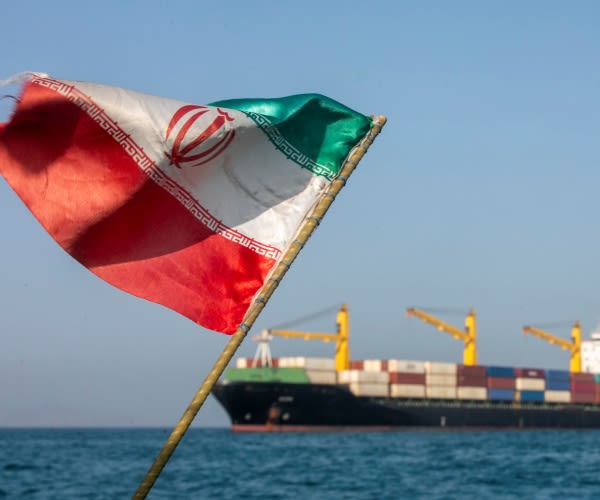

An Iranian flag flutters in the wind as ships remain anchored on May 16, 2026 in the Strait of Hormuz near Larak Island, Iran. (Photo by Majid Saeedi/Getty Images)
Iran’s top national security official said Saturday the Strait of Hormuz will not fully reopen unless the United States meets a sweeping list of demands, including lifting sanctions and its naval blockade, withdrawing U.S. military forces from around Iran, and paying compensation for damage caused by the war.
Mohammad Bagher Zolghadr, secretary of Iran’s Supreme National Security Council, also demanded the release of frozen Iranian assets, an end to attacks on Tehran’s regional allies, and an end to threats against Iran.
The conditions cast new uncertainty over efforts to restore commercial traffic through the critical waterway just as Iran and neighboring Oman appeared close to reaching an agreement on how ships could transit the strait.
Iranian Foreign Minister Abbas Araqchi said Saturday the two countries were “very close” to an agreement on a temporary shipping route while technical and legal issues surrounding a permanent arrangement are resolved.
But Araqchi said an agreement with Oman would not by itself reopen the strait, saying that would depend on other conditions, including compensation from the United States for what Tehran considers violations of a June cease-fire agreement.
Iranian military officials also hardened their rhetoric Saturday, with army spokesman Brig. Gen. Amir Akraminia declaring Tehran’s control of the strait “irreversible” and warning Washington to accept the new status quo or face greater costs.
The latest demands came the same day the United Arab Emirates accused Iran of firing a missile at a vessel affiliated with the state-owned Abu Dhabi National Oil Company as it transited the Strait of Hormuz. No injuries were reported, and Iran did not immediately comment on the accusation.
Oman condemned repeated attacks on ships in the strait while saying negotiations with Iran were proceeding in a “positive and constructive atmosphere.”
Vice President JD Vance told Fox News on Saturday that negotiations over Hormuz remained in “the middle of the game” and said Washington was working on a system that would allow commercial vessels to pass safely.
“What we’re really working through now is how you can actually set up a traffic scheme so that the ships that pass can pass through safely,” Vance said. “That includes of course demining, but it also includes a commitment from the Iranians that they’re not going to fire at commercial vessels.”
Before the war, roughly one-fifth of global oil and gas shipments passed through the Strait of Hormuz. The conflict began with U.S. and Israeli attacks on Iran on Feb. 28.
© 2026 Newsmax. All rights reserved.